
Wheelchair Resort Review Before You Book
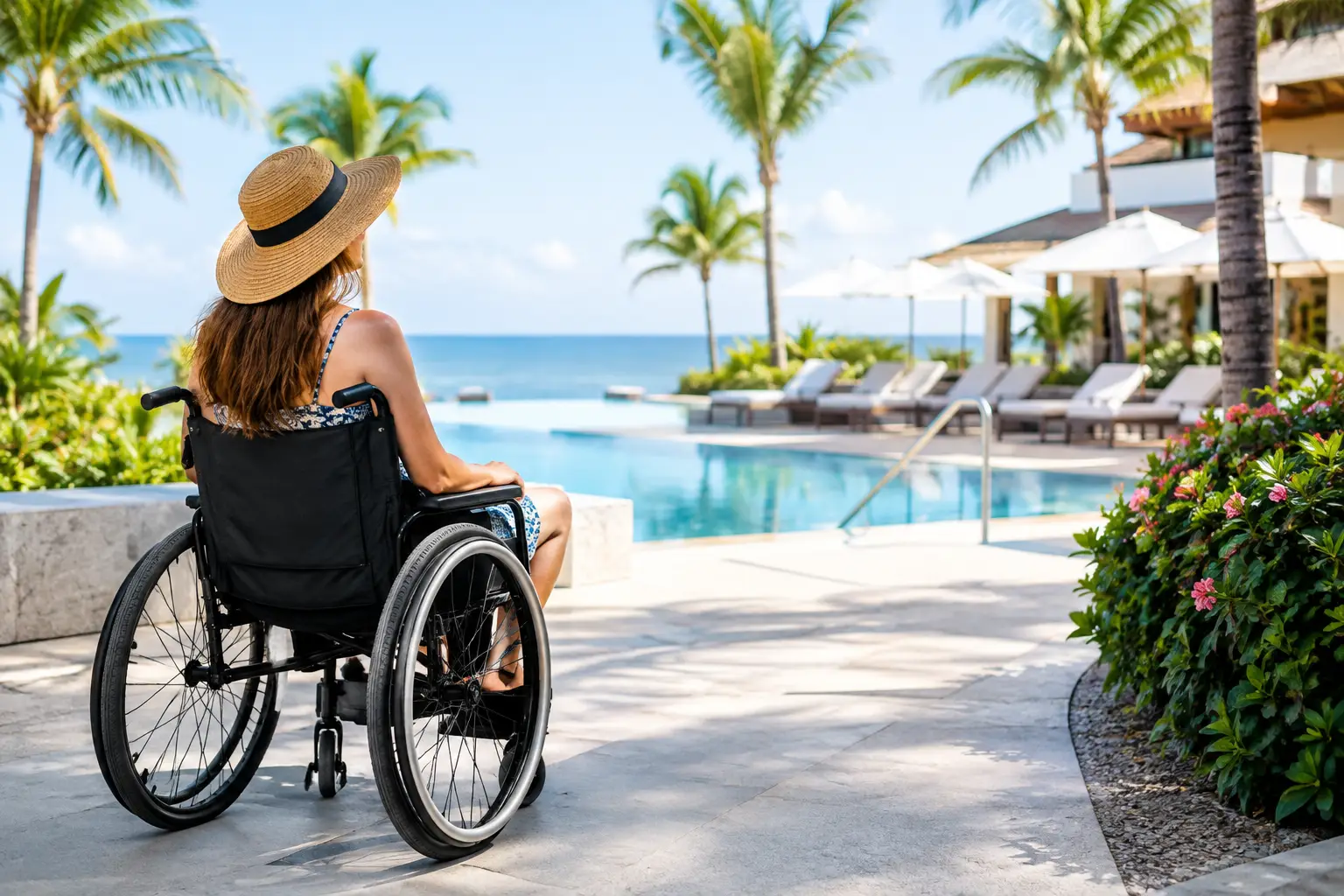
A glossy photo of a ramp tells you very little. It does not tell you whether your mobility scooter fits through the bedroom door, whether the pool hoist is actually working, or whether the ‘accessible beach’ involves battling through soft sand for 100 metres. A useful wheelchair resort review needs to deal with the bits that decide whether you have a proper holiday or spend the week adapting to avoidable barriers.
Resorts often describe themselves as accessible because they have a lift and one adapted room. That may be enough for some guests, but accessibility is never one-size-fits-all. A manual wheelchair user, a powered chair user, a mobility scooter user and someone who can walk short distances all need different things. The only sensible approach is to look past the label and check how the resort works in real life.
What a wheelchair resort review should actually cover
Start with the route, not the room. You may have an excellent accessible bedroom, but it is of limited use if it is at the top of a steep hill, reached by uneven paving, or a long way from the restaurant and pool. Large all-inclusive resorts can be particularly difficult because they are built across sprawling grounds. Golf buggies may help, but only if they can safely carry you and your wheelchair or scooter, run often enough, and are available after dark.
A decent review should explain the layout plainly. Is the reception level with the drop-off point? Are paths smooth, wide and well lit? Are there gradients that become awkward in rain? Is the main building connected to the accommodation, or will you need to go outside for every meal? These details are far more useful than a vague claim that the property is ‘wheelchair friendly’.
It should also say what type of equipment was used during the stay. A route that is manageable in a lightweight manual chair may be tiring or impossible in a heavy powered wheelchair. Likewise, a cobbled promenade may be unpleasant on a scooter even if there are technically no steps.
The room is more than a widened doorway
Accessible rooms vary wildly, even within the same hotel. Ask for current photographs and measurements before booking, rather than relying on a standard room description. The key question is whether you can use the room independently.
Look at the clear width of the bedroom and bathroom doors, the space around both sides of the bed, and whether there is enough turning room for your chair or scooter. Check the bed height as well. A bed that is too high or low can turn transfers into hard work, and some hotel beds have solid bases that prevent a hoist from getting underneath.
The bathroom deserves proper scrutiny. A roll-in shower is not automatically a good shower. Is it level entry, or does it have a lip? Is the shower chair stable and suitable for your needs? Are the grab rails positioned where they are useful? Does the toilet have room alongside it for a transfer, or has the accessible label been earned simply by adding a rail to a cramped bathroom?
If you travel with a mobility scooter, ask where it can be stored and charged. Do not assume it can go into the room. Some resorts insist scooters stay outside, which raises obvious concerns about rain, security and access overnight. You also need to know whether the charging point is close enough and whether it is safe to leave equipment there.
Pools, beaches and the parts of a resort you came to enjoy
Many people choose a resort for the pool, the beach, the restaurants and the evening entertainment. These areas must be reviewed with the same care as the bedroom.
For pools, check whether there is a fixed hoist, a portable hoist, steps with handrails, or no accessible entry at all. A hoist is only useful if staff know how to operate it and it is available when you want to swim. Find out whether you need to ask in advance, whether a sling is supplied, and whether you are expected to bring your own. The surrounding surface matters too. Slippery tiles, tight gaps between sunbeds and deep drainage grates can make poolside access stressful.
Beach access needs an honest description. A wooden boardwalk may end well before the water. Beach wheelchairs may be available, but there could be only one, it may need booking, or staff may not be around to help transfer. If getting into the sea is a priority, ask exactly how it works. A resort should not get credit for beach access if the accessible route only reaches the beach bar.
Restaurants and bars are another common weak point. Check for step-free entrances, accessible tables that are not tucked away in a corner, and whether buffet counters can be reached from a seated position. It is also worth asking about table service. Independence matters, but so does not having to stretch unsafely for a hot plate because every counter is set at standing height.
Questions to ask before trusting a wheelchair resort review
First-hand reviews are valuable, but they have a shelf life. A change of management, a refurbishment or a broken lift can alter the experience quickly. Use a review as a starting point, then contact the resort directly with questions that match your own needs.
Avoid broad questions such as, ‘Is your resort wheelchair accessible?’ They usually produce a reassuring but unhelpful yes. Be specific. Ask whether the accessible room has a level-entry shower; whether the route from that room to breakfast has steps or steep slopes; whether the pool hoist is in service; and whether an adapted transfer vehicle is available from the airport.
For a larger trip, these are the areas worth confirming:
- The exact room number or building, along with door widths, bed height and bathroom layout.
- The step-free route from your room to reception, dining, pools, bars and entertainment.
- Pool entry equipment, beach access arrangements and any requirement to pre-book assistance.
- Transfer vehicle type, including whether it has a ramp or lift and space for your chair or scooter.
- Scooter charging, secure storage and the resort’s policy on bringing your own equipment.
Get the reply in writing and keep it with your booking paperwork. This is not about being difficult. It gives the reservations team a clear record of what they have agreed to provide, and it is invaluable if there is a problem on arrival.
Transport can make or break an accessible resort holiday
A resort can be excellent once you are inside it, yet still be a poor choice if the transfer is unsuitable. Standard shuttle buses often have steps, limited luggage space and no room for a powered chair. Even when an adapted vehicle is promised, ask whether it is exclusive or shared, how long the journey takes, and what happens if your flight is delayed.
If you use a mobility scooter, provide its dimensions, weight and battery type. Resorts and transfer companies need the real figures, not an estimate. A scooter that fits into an accessible taxi may not fit into every minibus with a ramp. If your chair cannot be secured properly, do not accept a driver’s hopeful suggestion that it will be ‘fine’.
Think about leaving the resort too. Can you reach the local promenade, shops or attractions without using a taxi? Is there accessible public transport nearby? Some travellers want a quiet, contained break, while others want the freedom to head out each day. Neither is wrong, but a resort should suit the holiday you want rather than trapping you in one place.
How to read reviews without being misled
A five-star rating is not proof of accessibility. Look for detailed accounts from people who describe the same practical needs as yours. The best reviews mention doorways, slopes, toilet layouts, transfer vehicles and staff response when something went wrong. They do not just say, ‘They were very accommodating.’
Pay attention to negative comments, especially repeated ones. One guest may have had a one-off bad experience. Ten people mentioning a broken lift, poor housekeeping in adapted rooms or steep paths is a pattern. Also check when the review was written. A report from several years ago may still be useful for understanding the layout, but it cannot confirm that equipment remains in place.
At Andy Wright Travel, the aim is always to replace wishful thinking with information you can use. A good accessible holiday is not one where you are grateful for the bare minimum. It is one where the practical arrangements are sorted, so you can put your energy into the views, the food, the people you are with and the places you came to see.
Book the resort that answers your questions clearly, shows you the reality rather than stock photos, and understands that independent access is not a luxury. It is the starting point for a holiday worth having.
0 Comments
Leave a Comment