
Wheelchair Accessible Bangkok Itinerary Example
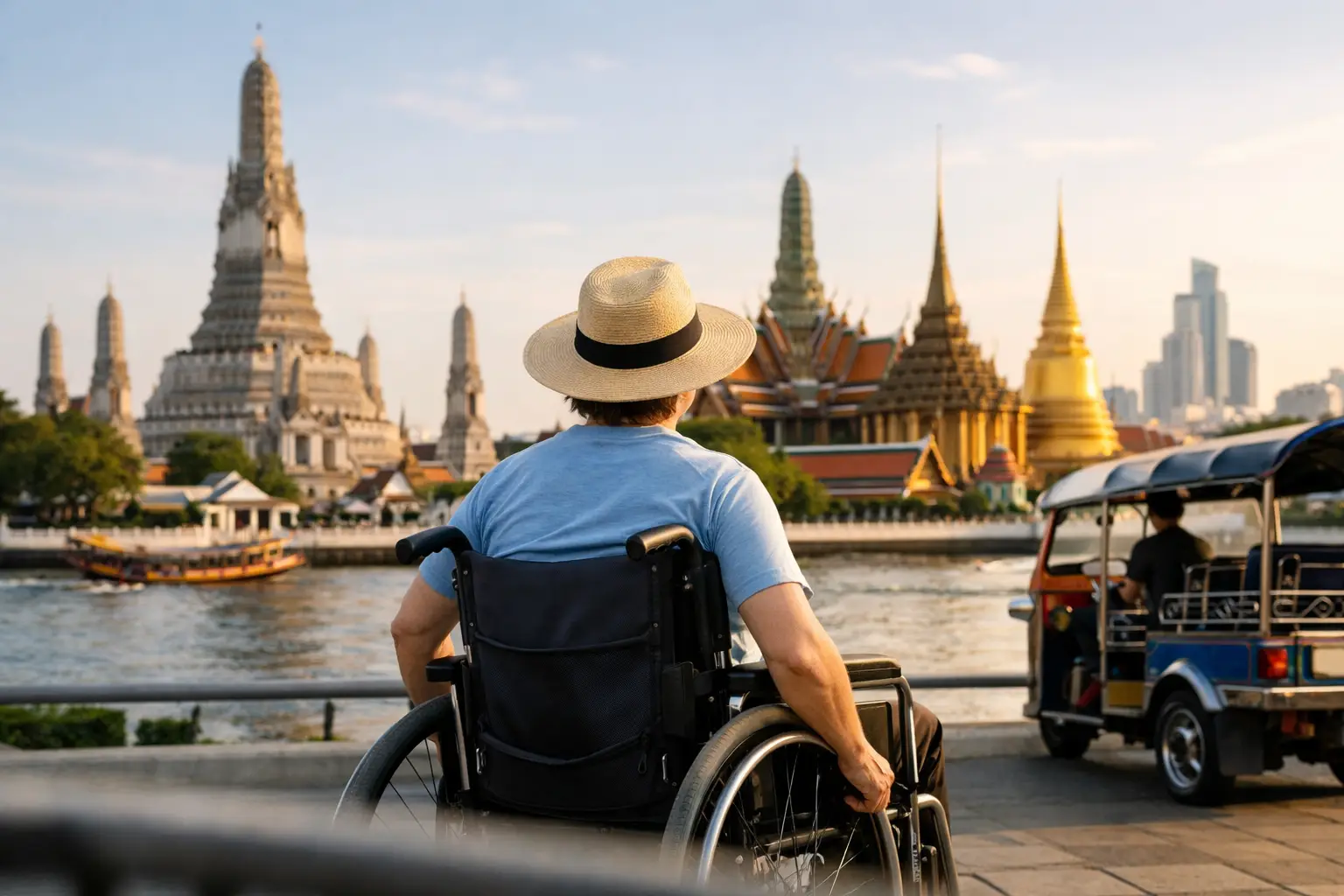
Bangkok can be brilliant, frustrating and completely unforgettable in the space of one street. A shopping centre may have excellent lifts and accessible toilets, then the pavement outside disappears behind a row of food stalls, uneven paving or a kerb with no dropped section. That is why this wheelchair accessible Bangkok itinerary example is built around realistic journeys, not a wish list of sights scattered across the city.
The key is to keep each day in one area, use air-conditioned indoor attractions when the heat is at its strongest, and treat taxis as a useful part of the plan rather than a failure to use public transport. Bangkok is possible with a wheelchair or mobility scooter, but it rewards preparation and a willingness to change course when the pavement says no.
Before you set off: make Bangkok work for you
For most visitors, staying near Sukhumvit, Siam or the riverside makes the most sense. Sukhumvit has a huge choice of hotels, restaurants and shopping centres, while Siam puts you close to several modern malls and the Bangkok Art and Culture Centre. The riverside is more relaxed and works well if you want ICONSIAM, hotel downtime and a view rather than constant traffic.
Do not book a hotel purely because it says it has an accessible room. Ask for photographs of the bathroom, including the shower entrance, toilet space, grab rails and the route from reception to the room. Check whether the bed can be approached from both sides and whether the door is wide enough for your chair or scooter. A roll-in shower is only useful if there is enough turning room once you are inside.
Bangkok's BTS Skytrain has lifts at many stations, but lift availability, opening arrangements and the exact exit you need can affect a journey. Stations can also be busy, with platforms and ticket gates that feel tight at peak times. The MRT is often a more comfortable option where it serves your route. In practice, use rail when you have checked the stations at both ends, and use a taxi or pre-booked accessible vehicle when it saves a difficult pavement journey.
If you use a mobility scooter, confirm its size and weight before arranging transport. Ordinary saloon taxis are unlikely to take it unless it folds or can be lifted safely. A larger vehicle arranged through your hotel or a specialist provider is usually the sensible option. Build extra time into every journey. Bangkok traffic is not something you can rush.
A three-day wheelchair accessible Bangkok itinerary example
Day one: Sukhumvit, shopping centres and an easy start
Start gently around your hotel. Bangkok heat and humidity can be draining, particularly after a long flight, so make your first day useful without turning it into an endurance test. If you are based on Sukhumvit, aim for the connected shopping areas around Phrom Phong or Asok, depending on your hotel location and station access.
The EmQuartier and Emporium area is a strong choice for wheelchair users because modern malls generally provide lifts, accessible toilets, smooth floors and plenty of places to stop for a drink. It is also a practical place to get your bearings, pick up supplies and test how you cope with the temperature. Shopping centres in Bangkok are not just for shopping. They are often the most reliable accessible refuge in the city.
For lunch, choose somewhere inside the mall rather than crossing several roads in search of a particular restaurant. Food courts are normally straightforward, although tables can get busy. Staff are often helpful when you need space moved or a clearer route found, but it is still worth travelling with a companion at the busiest times if you can.
In the evening, use a taxi to reach a restaurant that has been checked in advance, or stay close to the hotel. Sukhumvit can be lively and enjoyable, but the pavement quality varies massively from one block to the next. Do not assume a short distance on a map will be a quick roll in real life.
Day two: riverside Bangkok without fighting the pavements
The riverside gives you a different side of Bangkok, but it is best approached with a clear transport plan. Arrange a taxi or accessible vehicle directly to ICONSIAM, rather than relying on a long walk from a station. ICONSIAM is large, modern and generally much easier to manage than the streets around it. It has wide internal routes, lifts, accessible toilets, restaurants and excellent views over the Chao Phraya River.
Spend the late morning exploring at your own pace. The indoor floating market-style area is visually impressive, though it can become congested. If crowds are difficult for you, go early and keep to the wider outer routes rather than trying to push through the centre at lunchtime.
A river cruise can be tempting, but do not book on the assumption that a pier or boat is step-free. Access changes with water levels, vessel design and the particular boarding point. Some ramps are steep, narrow or unsuitable for a heavier powered chair. If a cruise matters to you, ask direct questions about the ramp gradient, doorway width, accessible toilet provision and whether staff can safely assist without lifting you.
Instead, consider a riverside hotel restaurant or return to ICONSIAM for dinner as the light fades. You still get the river atmosphere without gambling the whole day on a boat transfer. This is one of those occasions where choosing the simpler option can give you a better holiday.
Day three: Siam and culture with reliable indoor access
For the final day, base yourself around Siam. Take a taxi to the Bangkok Art and Culture Centre, often called BACC, and begin there. It is a useful cultural stop because it has lifts, accessible facilities and changing exhibitions, although it is wise to confirm any temporary access restrictions before travelling. The building is close to major malls, so it is easy to adjust the day if the weather turns or you are running low on energy.
From BACC, Siam Centre, Siam Discovery and nearby malls offer a practical run of indoor, air-conditioned spaces. The raised walkways around Siam are not automatically wheelchair-friendly simply because they look connected. Lift locations can be inconvenient and not every route works in both directions. It may be quicker and far less stressful to take a short taxi ride between places than to hunt for a working lift in the midday heat.
If you want Thai food without a difficult street route, use a mall restaurant or food hall. This is not a watered-down experience. Bangkok's shopping centres are part of everyday city life, and they allow you to enjoy good food while keeping toilets, shade and level access close by.
What about the Grand Palace and temples?
The Grand Palace, Wat Pho and Wat Arun are the sights many people want to see, and they can be included if they are a priority. They should not, however, be treated as an easy add-on to an already full day. Historic sites have uneven surfaces, kerbs, crowds, steps and changing access arrangements. Some areas may be manageable with assistance; others may be effectively out of reach in a wheelchair or larger mobility scooter.
The most practical approach is to book a private vehicle for a half-day, travel early, and accept that you may see selected areas rather than every corner. Dress requirements still apply, so bring clothing that covers shoulders and knees. Avoid relying on public boats to link the temples unless you have confirmed the boarding arrangements for your exact chair and travel date.
There is no shame in deciding that the heat, surface conditions and crowds are not worth it. Bangkok has plenty to offer without proving yourself on difficult ground.
Small details that make a big difference
Carry water, a rain cover for your chair or scooter controls, and a portable battery pack for your mobile phone. Heavy rain can arrive quickly, and a dry, air-conditioned shopping centre is often the best place to wait it out. Keep your hotel address written in Thai as well as English, especially if you are using taxis.
Most importantly, leave space in the itinerary. A blocked pavement, a station lift out of service or an accessible toilet being used for storage can change the plan. That is not you getting it wrong. It is simply the reality of travelling independently in a city that is improving, but remains uneven.
Bangkok is at its best when you give yourself permission to choose the accessible route, take the taxi, stop for an iced drink and enjoy what is genuinely within reach. Independence does not mean forcing every barrier. It means having enough information to make the call yourself.
0 Comments
Leave a Comment