
What Makes a Good Accessible Travel Vlogger?
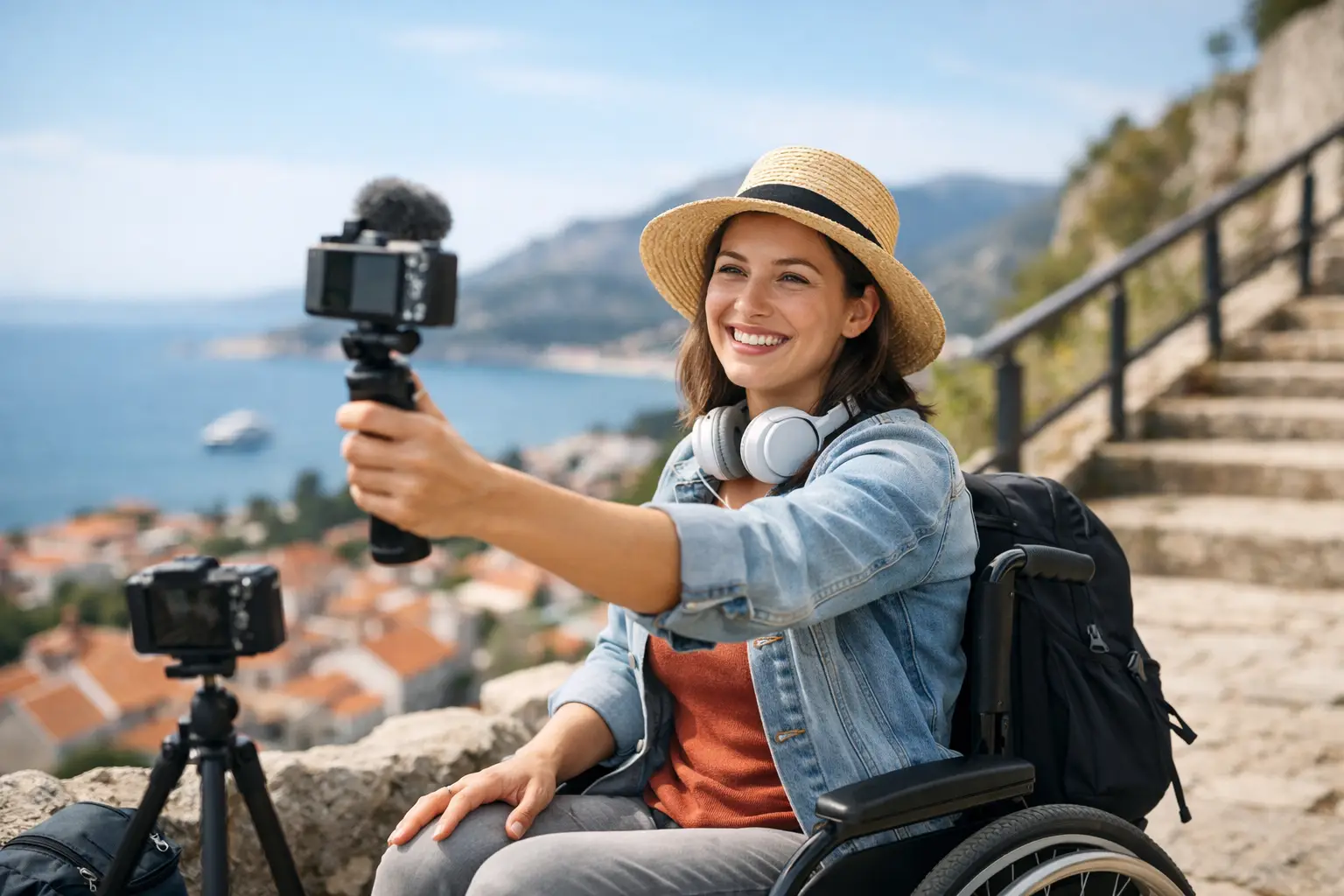
You can spot the difference within two minutes. One accessible travel vlogger shows a lovely hotel lobby, a smiling check-in and a wide shot of the pool. Another shows the dropped kerb outside, the width of the lift, the bathroom threshold, how steep the ramp really is and whether a mobility scooter fits beside the bed. For disabled travellers, that second video is the one that saves time, money and stress.
That is really the point. Accessibility content is only useful when it answers the questions disabled people actually need answered. Nice scenery matters, of course. So does inspiration. But if a video skips over the transfer from airport to hotel, the pavement quality outside the entrance or whether the so-called accessible room has a shower seat that is actually usable, it leaves too much guesswork.
Why an accessible travel vlogger matters
For wheelchair users, mobility scooter users and anyone travelling with limited mobility, poor information is often the biggest barrier before the journey even starts. You can cope with plenty if you know what is coming. What makes trips harder is vague wording, staged promotional content and accessibility claims that fall apart on arrival.
A good accessible travel vlogger fills that gap by turning lived experience into practical intelligence. Video is especially useful because it shows scale, slope, surfaces and space in a way written descriptions often cannot. A hotel can say it is accessible. A video can show whether the bed height works, whether the corridor turns are tight and whether the accessible loo in reception is tucked behind a heavy manual door.
That is why the best creators in this space are not simply making travel videos. They are doing on-the-ground checks that help other people plan with more confidence.
What separates a useful accessible travel vlogger from a generic one
The biggest difference is attention to operational detail. Generic travel vloggers usually focus on atmosphere, food, scenery and broad impressions. That is fine for many viewers, but it does not help much if your first question is whether the train platform has step-free access or whether the beach has a boardwalk suitable for a scooter.
A useful accessible travel vlogger notices the things that affect independence. They show kerb cuts, gradients, paving quality, accessible transport boarding, entrance routes and whether there is enough turning space in key areas. They do not assume viewers only care about official accessible facilities either. Street layout, traffic-free routes, distance between stops and the reliability of lifts often matter just as much.
They are also honest about trade-offs. A place might have an excellent accessible room but be surrounded by steep streets. A beach resort may offer good promenades but poor accessible taxis. A city break could be manageable with planning yet exhausting if you rely on older public transport infrastructure. That sort of honesty is far more valuable than blanket praise.
Real measurements beat vague reassurance
There is a big difference between saying a room is spacious and showing whether a wheelchair can pass both sides of the bed. The same goes for ramps described as gentle when they are clearly not, or bathrooms labelled adapted when they still require awkward transfers.
The best vloggers show what matters rather than dressing it up. They pan slowly through the room. They film the route from street to reception. They show how long it takes to get from one point to another. If there is a problem, they say so plainly.
Lived experience changes the quality of advice
Disabled travellers tend to trust creators who understand the consequences of bad access information. That does not mean every disabled person travels the same way, because they do not. A manual wheelchair user, powerchair user, scooter user and ambulant disabled traveller may all have different priorities. Still, lived experience usually produces sharper questions and better judgement.
It also changes what gets noticed. Someone used to navigating barriers will instinctively clock lip heights, heavy doors, awkward layouts and whether a so-called accessible route is realistic without assistance. That practical eye is what gives the content real value.
What to look for before you trust an accessible travel vlogger
Not every creator offering accessibility advice gives the same depth. Some are strong on storytelling but light on detail. Others are excellent on transport but less thorough on accommodation. It depends what sort of trip you are planning.
Start by asking whether the vlogger shows enough evidence for you to make your own call. Good content does not just tell you a place is accessible. It gives you enough visual and practical information to decide whether it is accessible for you.
Consistency matters too. If every destination is described as amazing, barrier-free and perfect, be cautious. Disabled travel is rarely that tidy. A trustworthy accessible travel vlogger will usually mention the awkward bits as well as the wins.
Look closely at how they cover these areas:
- arrival and transfer logistics
- step-free routes and surface quality
- hotel room layout and bathroom access
- transport boarding and station access
- attraction access in practice, not just on paper
- whether assistance was required and when
If those details are missing, the content may still be enjoyable, but it is less useful for planning.
Why video works so well for accessible travel planning
Written guides are still important, especially when you need specific facts in one place. But video gives context that is difficult to capture in text alone. You can see whether a so-called smooth path is actually uneven. You can judge noise, crowding and the pace of movement. You can watch someone approach a ramp or board transport and get a far clearer sense of what to expect.
That visual evidence also helps with the grey areas. Plenty of accessibility decisions are not simple yes-or-no questions. A route may technically be possible but tiring. A museum might be mostly accessible, with one awkward section that some people can manage and others cannot. Video handles those shades better than glossy marketing copy.
For carers and family members, it is useful too. It helps everyone picture the day more realistically, which makes planning easier and avoids nasty surprises.
The limits of any accessible travel vlogger
Even the most detailed creator cannot guarantee your exact experience. Conditions change. Lifts break. Staff vary. Hotel rooms differ, even within the same category. Transport systems that worked one week can fail the next.
That is why good accessibility content should reduce uncertainty, not pretend to remove it completely. The best creators make that clear. They show what they encountered, explain how they managed it and leave room for the fact that another traveller may have different needs.
There is also the question of travel style. Some vloggers are comfortable with a fair amount of problem-solving and last-minute adjustments. Others focus on lower-risk, tightly planned trips. Neither approach is wrong, but viewers need to know which one they are watching. If your priority is certainty, you may need a creator who goes heavy on practical checks rather than spontaneous adventure.
Why honesty matters more than production quality
A polished video is nice. Clear sound and steady filming help. But for this audience, honesty matters far more than fancy editing. A straightforward room tour filmed properly can be more valuable than a cinematic montage with no useful detail at all.
The strongest accessible travel content tends to feel grounded. It is less about selling a dream and more about proving what is possible. That does not make it negative. Quite the opposite. Realistic information gives people confidence because it replaces fear with facts.
That is also why first-hand disabled travel brands such as Andy Wright Travel matter. They do not treat accessibility as a side note. They build the whole review around the real decisions disabled travellers need to make.
A good accessible travel vlogger helps you travel on your terms
The best creators in this space do more than recommend destinations. They give viewers the tools to judge whether a trip will work for their own mobility needs, energy levels and travel style. That is a much more useful service than generic positivity.
If you use a wheelchair or mobility scooter, you already know that access can be excellent in one part of a journey and poor in the next. Good content respects that reality. It shows the smooth bits, the awkward bits and the workarounds where they exist.
That sort of information does not just make travel easier. It protects independence. It helps people book with their eyes open, ask better questions and avoid being fobbed off by vague promises. And sometimes that is the difference between staying home and getting out there.
When you find an accessible travel vlogger who consistently shows the details that matter, hang on to them. Good accessibility information is not about hype. It is about giving people the confidence to go further than they thought they could.
0 Comments
Leave a Comment