
UK Hotels for Wheelchair Users: What Matters
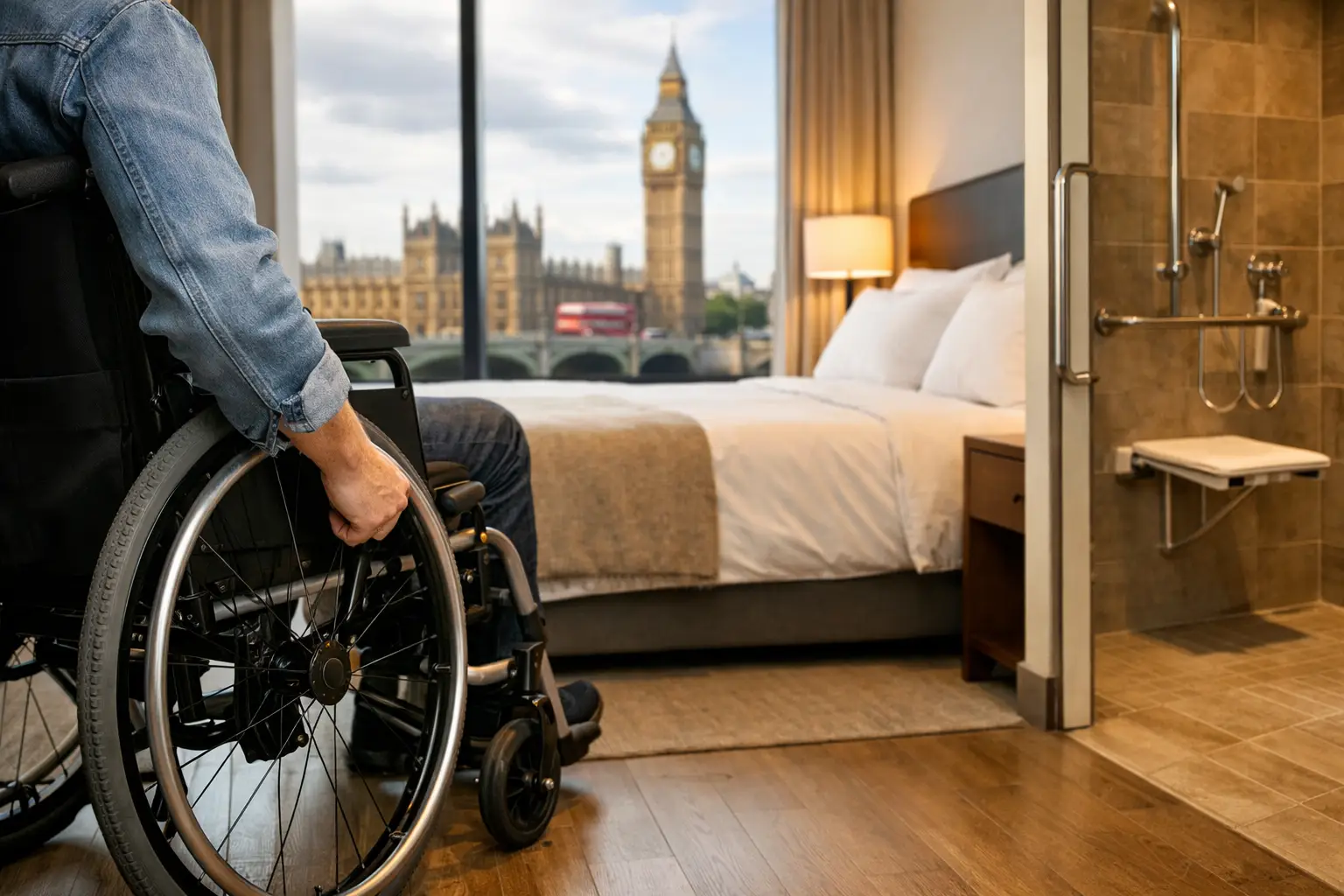
Book an "accessible room" in enough UK hotels, and you quickly learn the problem is not the label. It is what sits behind it. For wheelchair users, and especially for anyone using a larger powerchair or mobility scooter, the gap between "accessible" on a booking page and accessible in real life can be the difference between a relaxed break and a stressful one.
That is why choosing UK hotels for wheelchair users needs more than a quick skim of the room description. You need practical detail. Can you actually get from the car park to reception without a steep ramp? Is the lift big enough for your chair or scooter? Is the wet room genuinely usable, or just a standard bathroom with one grab rail added as an afterthought? Those are the questions that matter.
Watch my YouTube playlist, Hotel Motel Holiday Inn series for video reviews of hotels in the UK and abroad.
What makes UK hotels for wheelchair users genuinely usable
A decent, accessible hotel is not just about getting through the front door. It is about the full journey through the property. Parking, entrance, check-in, lift access, bedroom layout, bathroom design and restaurant access all need to work together.
This is where many hotels fall short. A property may have one adapted bedroom, but place it at the far end of a corridor with heavy fire doors. Another may offer level access into reception, but then have a breakfast room reached only by a short set of steps. None of this is always obvious when you book.
The most useful way to think about a hotel is as a chain of access points. If one link breaks, the stay becomes harder than it needs to be. That is why broad claims like "wheelchair friendly" are never enough on their own.
Start with your own access needs, not the hotel's wording
Not every wheelchair user needs the same setup. A manual chair user travelling with someone who can assist may manage with features that would not work at all for a solo traveller in a powerchair. A mobility scooter user may need excellent step-free access but not necessarily a roll-in shower. Someone else may need a profiling bed, hoist space or enough turning room beside the toilet.
Before you compare hotels, be clear on your non-negotiables. That usually includes door widths, step-free access throughout, bathroom type, bed height and space around the bed. If you use a mobility scooter, charging arrangements matter too. Some hotels are perfectly happy to charge for the room. Others worry about batteries and will suggest a storage area, which may or may not be practical. Watch the new video Britannia Hotel because that is exactly what happened. Luckily, they let it go.
There is no point booking a stylish city-centre hotel because the photos look good if you then cannot transfer safely in the bathroom or manoeuvre around the bed. Independence comes from matching the room to the way you actually travel.
The questions worth asking before you book
You do not need to interrogate every hotel, but you do need to ask better questions than "Do you have an accessible room?" That question often gets a cheerful yes, followed by very little detail.
Ask whether the route from arrival to the room is completely step-free. Ask if there are any slopes, heavy doors or tight corners. Ask for the bathroom layout, not just whether it is a wet room. A proper accessible bathroom should have enough floor space to turn, a roll-in shower or level-access shower, correctly positioned grab rails and a toilet that can be approached from a usable side.
Bed clearance matters more than many hotels realise. If the bed is fixed against a wall on one side, some wheelchair users will struggle with transfers. If the mattress is unusually high or low, it can make an otherwise good room unusable. It is worth checking whether furniture can be moved if needed.
If you use a mobility scooter, ask for exact lift dimensions and room door widths. "It fits most wheelchairs" is not useful if your scooter is wider or longer than average. Reception staff often mean well, but they may not know the measurements unless they go and check.
Why photos and floor plans matter more than glossy descriptions
A written accessibility statement can help, but photos are often more revealing. A bathroom picture can show whether the shower seat folds down properly, whether the sink blocks transfer space and whether the toilet is actually positioned sensibly. A bedroom photo can tell you if there is enough room to circle the bed or if the layout is far tighter than the description suggests.
If a hotel cannot provide photos of the accessible room, that is not always a reason to rule it out, but it should make you more cautious. The same goes for vague wording. "Suitable for less mobile guests" is not the same as wheelchair accessible. In practice, it often means there is a lift and little else.
This is one reason specialist accessible travel coverage matters. Brands such as Andy Wright Travel are useful because they focus on the details mainstream travel content usually skips - the turning space, the bathroom setup, the route to breakfast, the practical reality once you arrive.
Chain hotels versus independent hotels
There is no single winner here. Chain hotels can be easier because they often follow a more consistent accessible room format. You may find familiar layouts, standard wet room designs and clearer policy information. That predictability can take some of the stress out of booking, especially if you have used the chain before.
Independent hotels, though, can sometimes offer better flexibility. A smaller property may be willing to reserve a nearby parking space, move furniture, provide a shower chair or answer detailed questions with more care. The downside is inconsistency. One independent hotel may be excellent; another may have "accessible" rooms created in a listed building with obvious compromises.
It depends on what matters most to you. If predictability is your priority, a chain may be safer if personal service and flexibility matter more, an independent hotel could be the better fit - but only if you can get clear answers before booking.
Location is part of accessibility
A good room in the wrong location can still ruin a trip. Hotels near steep hills, rough paving, limited Blue Badge parking or inaccessible public transport may technically be accessible inside, while being awkward everywhere else.
This matters especially in older UK towns and seaside destinations. You can find a well-adapted hotel room, but still struggle with dropped kerbs, cobbles, narrow pavements or long distances between parking and attractions. City-centre hotels may offer convenience, but they can also come with expensive parking or awkward drop-off points.
When you assess UK hotels for wheelchair users, look beyond the building. Think about where you will eat, how you will reach attractions, whether there is level access nearby and how exposed you will be to bad weather if the route is long. Practical accessibility starts before you enter reception and continues after you leave.
Restaurants, lounges and public areas are often overlooked
Many travellers focus on the bedroom and bathroom, which makes sense. But if the restaurant has tightly packed tables, the bar area is raised, or the accessible toilet is hidden behind a heavy corridor door, the stay becomes less comfortable very quickly.
Breakfast access is a common issue. Buffet layouts can be difficult from a seated position, and some dining rooms are simply too cramped at busy times. If you rely on room service as a fallback, check whether it is available at the times you need it and whether there is an extra charge.
The same goes for leisure facilities. If a hotel advertises a pool, spa or gym, do not assume any of it is accessible. Pool hoists, changing places and step-free access are still far from standard.
Reviews can help, but you need to read them carefully
General review scores do not tell you much about accessibility. A hotel can be rated highly overall and still be a poor choice for wheelchair users. What helps more is finding comments that mention wet rooms, lifts, step-free routes, scooter storage or staff handling of access requests.
Even then, treat reviews as clues rather than proof. One guest may describe a bathroom as spacious because they travelled with a walking frame. Another may find the same bathroom unusable in a powerchair. Accessibility is specific.
That is why direct confirmation from the hotel still matters. Reviews can point you in the right direction, but they should not be the only thing you rely on.
A realistic booking approach that saves stress
The best approach is simple. Shortlist a few hotels, compare their room details, then contact them with precise questions. Ask for measurements where needed. Request photos. Confirm parking, entrance access and bathroom layout. If anything sounds vague, ask again.
It takes a bit longer, but it is far easier than arriving and finding out the "accessible" room has a shower lip, no transfer space and a lift too small for your chair. Good planning is not being fussy. It is protecting your independence.
You should be able to travel without having to gamble on whether a hotel understands wheelchair access. The more clearly you ask, the more clearly weak options reveal themselves. And when a hotel gives detailed, confident answers, that is usually a good sign that they take accessibility seriously.
A hotel stay should make travel easier, not turn it into an obstacle course. If a property cannot explain how access works in practice, keep looking. The right one is the one that lets you get on with enjoying the trip.
0 Comments
Leave a Comment