
UK Accessible Travel Resources That Actually Help
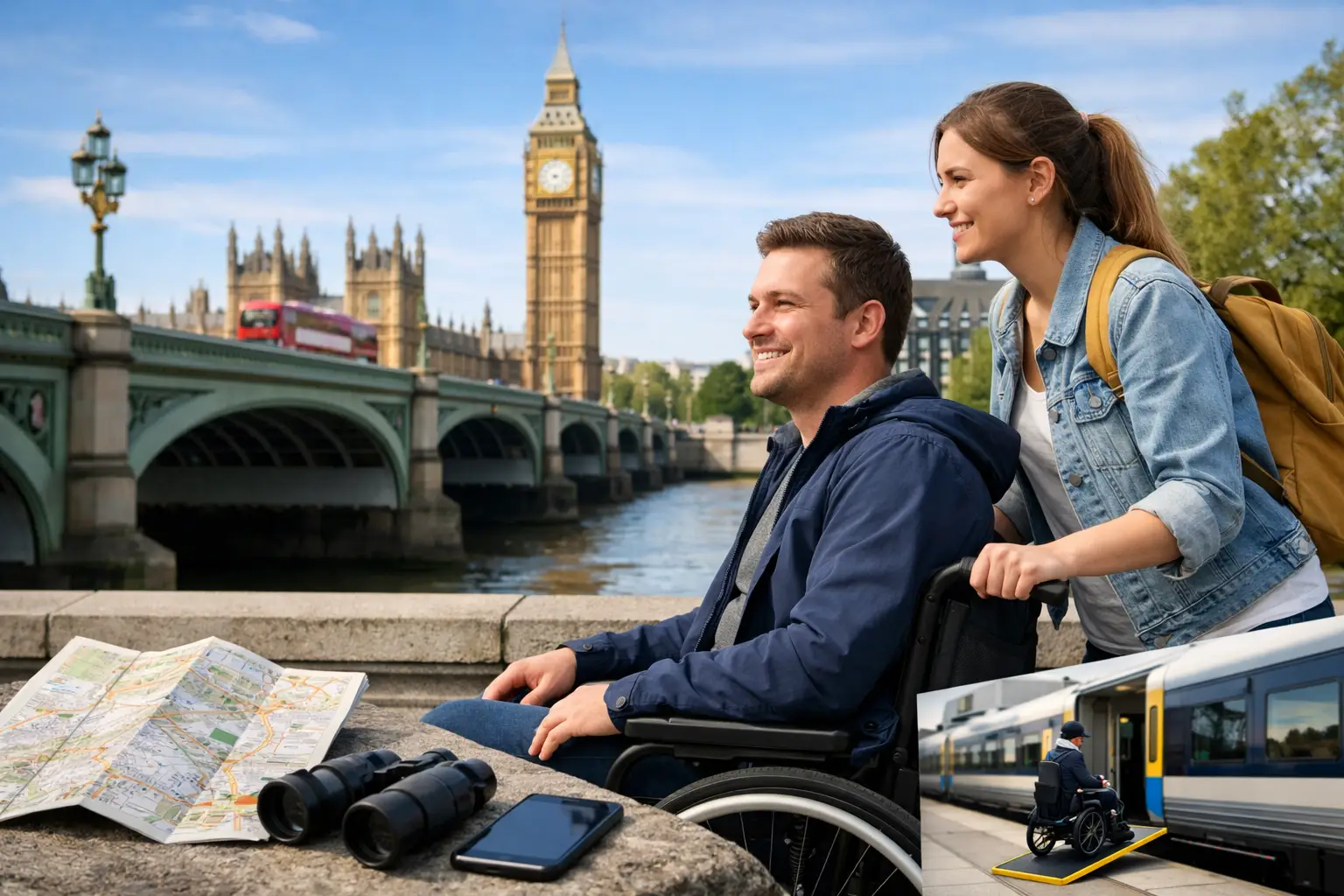
A hotel can call itself accessible because it has a ramp at the front door, yet still put the accessible room behind heavy fire doors, provide a bathroom you cannot turn around in, or offer a lift too small for a mobility scooter. That is why UK accessible travel resources need to do more than repeat an accessibility symbol. They need to help you work out whether you can actually get there, get in, get about and enjoy the trip independently.
For wheelchair users, mobility scooter users and anyone travelling with reduced mobility, the best resource is usually the one that answers the awkward practical questions before you have paid a deposit. It should deal with gradients, dropped kerbs, accessible toilets, charging, room layouts and transport boarding - not simply say that a destination welcomes everyone.
Start with the journey, not the destination
A brilliant attraction is not much use if the route from the station is impossible. Before looking at hotels and things to do, map out how you will travel door to door. This is where many holidays either become manageable or turn into hard work.
National Rail station information can be useful for checking step-free routes, lift availability, accessible toilets and whether staff assistance is available. But do not stop at the station listing. Look at the route beyond the platform. A station may be step-free while the pavement outside has steep slopes, narrow sections or a long stretch without a safe crossing.
If you are travelling by train, book Passenger Assist where it is available and give accurate details about your chair or scooter. Weight, width and whether it folds can matter. Some older trains have limited wheelchair spaces, and not every mobility scooter is accepted for carriage. A compact pavement scooter may be fine where a larger road scooter is not.
For coaches, check the specific operator and service rather than assuming an accessible vehicle will be provided. For taxis, ask whether the vehicle can take your chair or scooter in the form you use it. A driver saying they have a wheelchair-accessible vehicle does not automatically mean it will fit a large powered chair or scooter.
Driving can offer more control, but parking deserves the same level of checking. Find out whether there are Blue Badge bays close to the entrance, whether the surface is level, and what happens if those bays are full. Gravel, grass and uneven cobbles can make a short distance feel very long.
UK accessible travel resources worth checking
No single website, app or brochure can tell you everything. The strongest planning comes from combining official details with recent, experience-led information.
Start with the organisation running the service or venue. Their access statement, accessibility page and customer service team may confirm the basics: step-free entrances, adapted toilets, hearing loops, lifts and parking. Treat this as the starting point, not the final answer. Access statements can be detailed and honest, but they can also be old, vague or written by somebody who has never tried to move through the building in a wheelchair.
Then look for reviews from disabled visitors. First-hand reports are particularly useful when they explain what type of mobility aid was used, when the visit happened and where the problem occurred. “Wheelchair friendly” is less useful than “I used a mid-size mobility scooter, the entrance was level, but the lift was too narrow for my turning circle.”
Video walk-throughs can be even better for judging a place for yourself. You can see the slope to the entrance, the width of a corridor, the condition of paths and whether a supposed accessible viewing area has a clear view. Written information often misses those details because they are difficult to describe properly.
Local disability groups and tourist information teams can also help, especially for smaller towns and rural areas. Ask specific questions. Instead of asking whether the town centre is accessible, ask whether there is level access between the car park, main shopping street, accessible toilet and the attraction you plan to visit.
At Andy Wright Travel, the focus is always on that real-world detail: what works for a scooter or wheelchair user once you are actually there. It is the difference between travel inspiration and usable travel intelligence.
How to check a hotel before booking
Accessible hotel rooms vary wildly, even within the same chain. The words “accessible room” or “disabled access” tell you almost nothing about the layout, equipment or route through the building.
Call the hotel and ask to speak to somebody who can check the actual room, not just read the booking notes. Ask whether the room has a level or ramped route from parking and reception, whether there are steps anywhere on that route, and whether lifts are needed. If a lift is involved, ask for its internal dimensions and door width if your scooter or powerchair is substantial.
The bathroom is often where problems appear. Find out whether it is a wet room or has a roll-in shower, where the grab rails are positioned and whether there is enough space beside the toilet for your transfer. A shower seat may be fixed, fold-down or movable. Those differences matter depending on how you transfer.
It is also sensible to ask for photographs or a room plan. Check the bed height, clearance underneath it if you use a hoist, space beside both sides of the bed and whether furniture can be moved. If you travel with a mobility scooter, ask where it can be stored and charged safely. Never assume charging in a corridor will be allowed or practical.
There is a trade-off here. A central hotel may put restaurants and attractions close by but have restricted parking, cramped bedrooms and older lifts. A modern hotel on the edge of town may offer a better room and easier parking but require accessible taxis every time you go out. Neither option is automatically better. Choose the one that suits the way you want to travel.
Questions that prevent expensive surprises
When a hotel is vague, these are the questions worth pressing for:
- Is the route from the accessible parking space to the room step-free from start to finish?
- What are the bathroom and lift door widths?
- Is the shower genuinely level access, with suitable seating and grab rails?
- Can my mobility scooter or powered wheelchair be stored and charged securely?
- Are the restaurant, bar, breakfast room and accessible toilet reachable without steps?
A good hotel will answer clearly or check for you. If the response is hesitant, keep looking. You should not have to arrive and hope for the best.
Attractions, beaches and outdoor days out
Attractions are often better at describing entrance access than the experience once inside. Museums may have lifts but limited access to galleries. Heritage sites may have accessible parking and toilets but rough ground, steep gradients or alternative routes that miss the main features.
Read the venue’s access information, then check recent visitor feedback and photographs. Pay attention to the terrain, not just the building. Grass can be manageable in dry weather and impossible after rain. Loose gravel can stop scooter wheels. Cobblestones can be painful, tiring and capable of shaking loose equipment if the route is long enough.
For beaches, look for more than a disabled parking symbol. Check the distance from parking to the promenade, whether there are accessible toilets nearby, the surface of the approach and whether beach wheelchairs are available. If a beach wheelchair is offered, ask whether it must be booked, what support is provided and whether you need someone with you to push it.
Nature reserves and gardens can be excellent accessible days out, but route grades are vital. A trail described as “easy” may still be steep for a manual wheelchair or too muddy for a scooter after poor weather. Look for path material, slope information, resting points and the location of accessible toilets. If you rely on a battery-powered scooter, consider the total distance rather than only the main route.
Build in a backup plan
Even careful planning cannot prevent a broken lift, a cancelled train or a car park closure. The aim is not to worry about every possibility. It is to know what you will do if one part of the day changes.
Keep key telephone numbers saved, carry confirmation of booked assistance, and arrive with enough time that a delay does not ruin the whole day. If you are taking a mobility scooter, take your charger where practical and know its realistic range, not the best-case figure from the brochure. Cold weather, hills, rough paths and a full day out can reduce battery life.
It also helps to choose one flexible option each day. If the planned attraction proves inaccessible or the weather turns a path into mud, you can switch to a nearby café, museum, accessible shopping area or scenic drive rather than feeling that the day has been lost.
The most useful accessible travel resource is not a glossy promise. It is honest information that lets you make your own decision. Ask the detailed questions, trust recent lived experience, and plan for the bits that brochures leave out. That preparation is not giving up spontaneity - it is what gives you the freedom to go further.
0 Comments
Leave a Comment