
Train or taxi for disabled travellers?
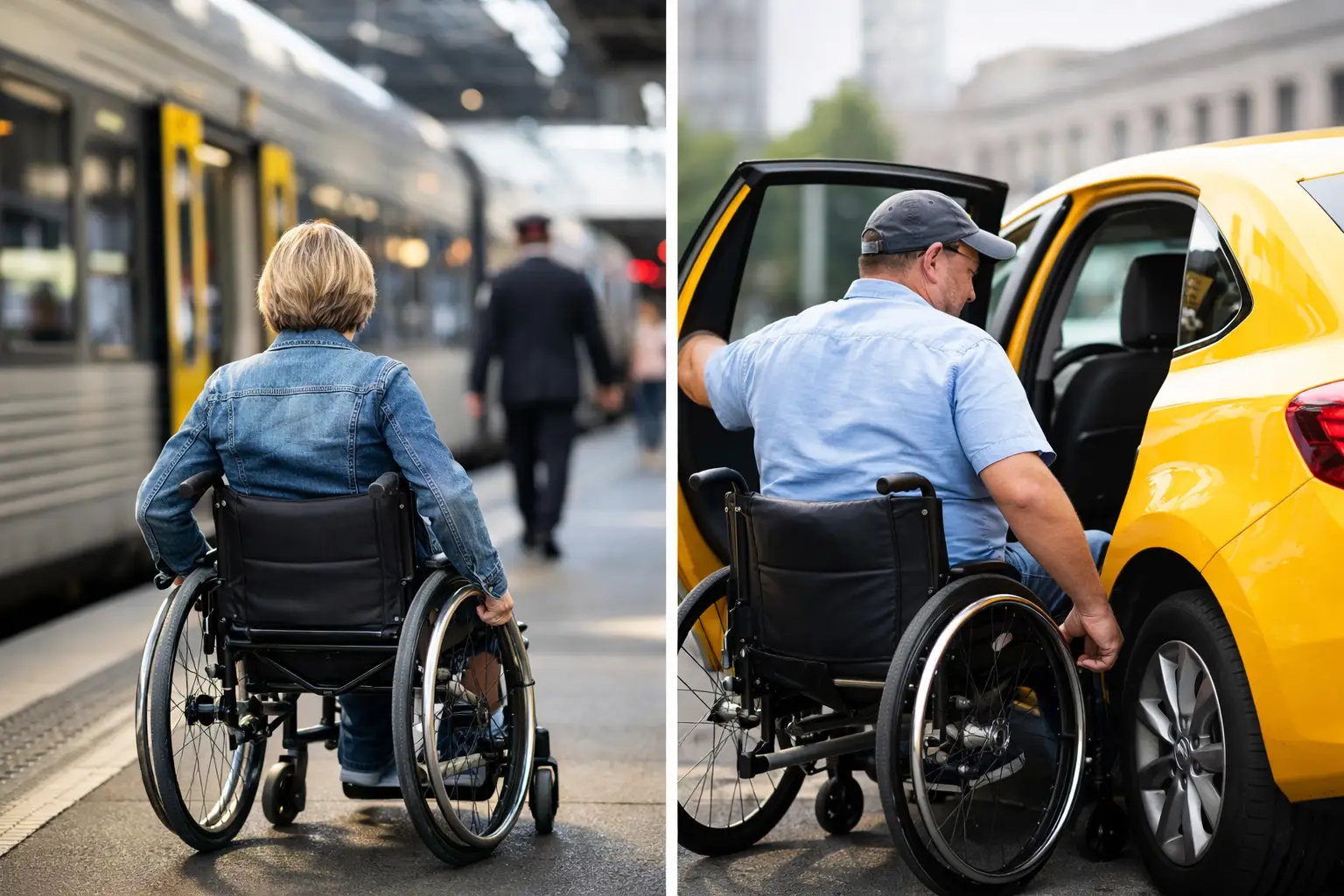
You can feel the difference before you even leave home. One journey looks simple on paper but involves ramps, station staff, lifts that may or may not be working and a tight connection. The other is door to door, but the driver may not understand how to secure a wheelchair or where a scooter can fit. When it comes to train or taxi for disabled travellers, the right answer is rarely about speed alone. It is about what gives you the best chance of arriving safely, comfortably and with your dignity intact.
For many disabled people, especially wheelchair users and mobility scooter users, transport decisions are not a minor detail. They shape the whole day. A journey that works well can make a trip feel freeing. A journey with poor access, bad communication or unrealistic transfer times can wipe out the confidence to travel at all. That is why this choice deserves a proper look, not the usual generic advice.
Train or taxi for disabled travellers: what actually matters
Most mainstream travel advice treats transport as a basic comparison of price and journey time. That is not how disabled travel works. The real questions are whether you can board without hassle, whether there is a working accessible toilet if you need one, whether your wheelchair or scooter will fit, whether staff are expecting you and what happens if something goes wrong.
A train can be excellent when the route is straightforward, the departure and arrival stations are properly accessible and assistance is booked and delivered as promised. You may get more space, a smoother ride and, on longer routes, better value than a private hire taxi.
A taxi can be the better option when station access is poor, there are multiple changes, weather is bad or fatigue is a factor. It also removes one of the biggest accessibility problems in the UK - the gap between what is advertised and what actually happens on the ground.
So the real comparison is not public transport versus private transport. It is controlled complexity versus controlled convenience.
When the train is the better choice
Rail travel can work brilliantly for disabled travellers when a few conditions line up. If you are travelling between major stations with step-free routes, reliable lifts and booked assistance, the experience can be far easier than many people expect. On a direct route, a train often gives you more freedom than a car journey. You are not stuck in traffic, you can move a little if needed, and longer distances can feel less tiring.
If you use a wheelchair, a train may also give you designated space and an accessible toilet, though that depends heavily on the operator and rolling stock. If you use a folding mobility scooter, some train journeys are manageable, but this is where you need to check the operator's policy very carefully. Not every scooter is accepted, and staff may apply the rules inconsistently.
Cost is another factor. If you are travelling a fair distance, especially with a companion, train fares booked at the right time can be cheaper than a long taxi journey. Railcards and local concessions can make a difference too.
But none of this means rail is automatically the best option. Train travel is strongest when the route is simple. The moment you add a change at a station with unreliable lifts or a short platform transfer, the balance shifts.
The weak points of rail travel
The biggest issue is not usually the train itself. It is the chain around it. Getting to the station, finding the right entrance, locating staff, waiting for the ramp, dealing with platform changes and hoping booked assistance appears on time can all add pressure.
Even where assistance services are decent, they are not perfect. Staff can be stretched. Communication between stations can break down. A missed handover can leave you waiting on the platform or worrying whether anybody will meet you at the other end.
Then there is equipment failure. One broken lift can turn a planned journey into a serious problem. If your route depends on full step-free access, a station issue is not a small inconvenience. It can end the trip.
When a taxi is the better choice
A taxi comes into its own when certainty matters more than anything else. Door-to-door travel removes several points of failure in one go. You are not dealing with station entrances, crowded platforms, ramps, changing trains or trying to cover extra distance inside a large terminus.
For shorter local journeys, or when you are heading to a hotel, airport, hospital, theatre or attraction with awkward access, a taxi can be the practical choice. It is often better if you are travelling early in the morning, late at night or in poor weather, when even a small access issue can become exhausting.
For some wheelchair users, an accessible taxi is not a luxury. It is the only realistic way to travel independently on certain routes. The same applies if pain, fatigue or balance problems mean that a station-based journey would take too much out of you before the day has even begun.
If you are travelling with luggage, medical equipment or a carer, a taxi can also simplify everything. You start in one place, you finish in one place, and there is far less room for confusion.
The weak points of taxis
The problem with taxis is that accessibility standards can be patchy. Not every driver understands wheelchair tie-downs, safe boarding, scooter storage or the difference between a lightweight folding chair and a larger powered device. Booking an accessible vehicle does not always mean you will get one that suits your exact needs.
Cost can also rise quickly. A short trip may be reasonable, but longer intercity journeys can become expensive. If traffic is heavy, the journey may take far longer than expected. And if you rely on a local operator you have never used before, quality can vary wildly.
There is also the issue of confidence. Some disabled travellers have had excellent experiences with taxi firms that know their needs. Others have dealt with last-minute cancellations, unsuitable vehicles or drivers who were plainly not prepared. That uncertainty is why I always say a taxi is only as good as the booking process behind it.
How to decide between train or taxi for disabled travellers
The best way to choose is to stop thinking in terms of a single headline factor and look at the whole chain of the journey.
Start with the route. If the train is direct, both stations are genuinely step-free and you can book assistance with confidence, rail is often worth considering. If there are changes, long station walks or any doubt about lift access, a taxi may quickly become the stronger option.
Then look at your energy, not just your mobility. A journey can be technically accessible and still be too draining. That matters. A disabled traveller should not have to spend all their energy budget just getting somewhere.
You also need to think about your equipment. A manual wheelchair, powerchair and mobility scooter each create different practical questions. Size, weight, turning space and battery type can all affect what is possible. Never assume a train or taxi will work just because someone says it is accessible.
Timing matters too. A midday rail journey on a direct route is very different from trying to manage a station during commuter rush hour. In the same way, an accessible taxi may be easy to book for the afternoon and much harder to secure on a bank holiday evening.
Practical checks before you book
Before booking a train, confirm step-free access at every station involved, not just the final destination. Check whether assistance must be booked in advance and ask what happens if your train is delayed. If you use a scooter, verify the exact acceptance policy rather than relying on general wording.
Before booking a taxi, ask direct questions. Will the vehicle take your wheelchair or scooter as it is, without dismantling it? Is it a rear-entry or side-entry vehicle? Will there be tie-downs if needed? Has the driver handled similar journeys before? If the answers are vague, keep looking.
This is one area where experience-led travel advice matters. At Andy Wright Travel, that sort of detail is exactly what helps disabled travellers avoid nasty surprises.
Sometimes the best answer is both
There are journeys where the smartest option is not train or taxi, but train and taxi. A taxi to the station can save energy and remove the stress of parking or negotiating pavements. A direct train can then cover the long section more comfortably and cheaply than a full road journey. At the other end, another taxi can take you straight to the hotel or venue.
This hybrid approach often works well for city breaks and longer UK trips. It cuts out the hardest parts of station access while still making use of rail where rail is strongest.
That is really the point. Good disabled travel planning is not about proving you can do things the hard way. It is about choosing the option that gives you the best day, not just the cheapest ticket or the fastest route on an app. If a train gives you freedom, take the train. If a taxi gives you certainty, book the taxi. The right choice is the one that lets you travel with less stress and more confidence.
0 Comments
Leave a Comment