
Thailand Wheelchair Travel Experience in Practice
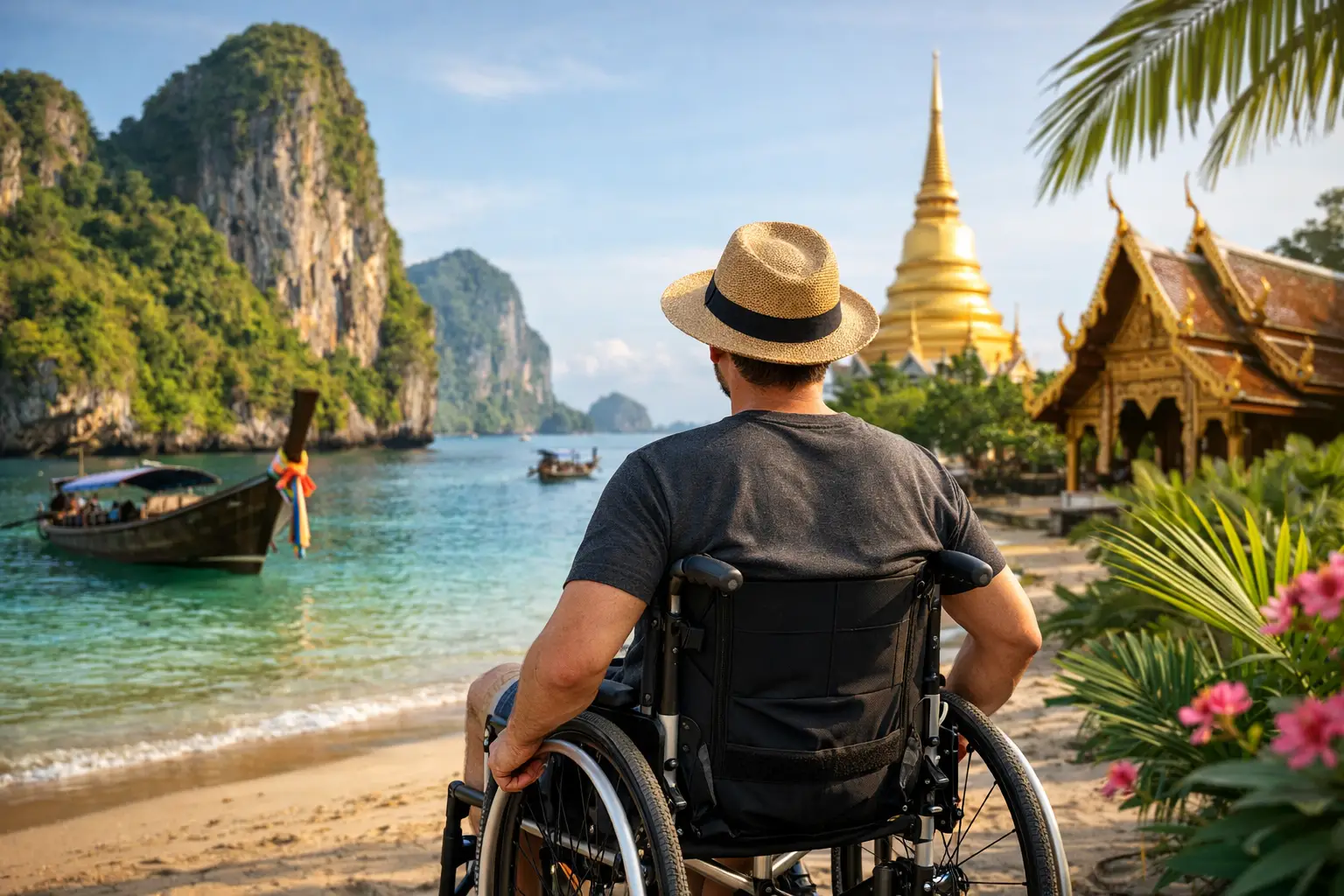
Thailand is not a destination where you can assume that a step-free hotel entrance means the whole holiday will be easy. A good Thailand wheelchair travel experience is absolutely possible, but it depends on choosing the right base, asking far more than one accessibility question before booking, and having a realistic plan for getting around once you are there.
The reward is worth the effort. Thailand offers warm weather, outstanding food, welcoming people and hotels that can deliver genuine comfort. But the street-level reality can be uneven: broken pavements, high kerbs, steep ramps and busy traffic are common. Treat accessibility as something to verify, not a label to trust, and you can protect your independence rather than spending the holiday firefighting avoidable problems.
What Thailand wheelchair travel is really like
The biggest difference between Thailand and much of the UK is that accessible routes are rarely continuous. You may find a perfectly usable dropped kerb, then a drain cover, a parked motorbike or a missing section of pavement a few metres later. In central Bangkok, heat, crowds and traffic add another layer of difficulty. A manual wheelchair user may need regular assistance outdoors; a powered wheelchair or mobility scooter gives more independence, but needs careful route choices and reliable charging.
This does not mean you should stay inside the hotel. It means that Thailand works best when you plan journeys from door to door. Think about the hotel entrance, pavement outside, vehicle transfer, arrival point and final distance to the restaurant, market or attraction. The last 50 metres are often where glossy accessibility claims fall apart.
A companion is helpful, especially on first visits, but independent travellers can do well too if they build in extra time and avoid trying to cover too much in a day. In the hottest months, a short journey can become exhausting quickly. Plan indoor stops, carry water and keep a poncho or rain cover handy during the wet season.
Choose your base carefully
Bangkok is exciting, busy and often challenging on wheels. It is a brilliant place for food, temples, river trips and large shopping centres, but it is not the easiest place to simply roll around without a plan. The malls can be a genuine refuge: air-conditioned, generally level, with accessible toilets and plenty of places to eat. They are also useful landmarks when arranging transport.
For a first Thailand trip, it can make sense to combine a few nights in Bangkok with a resort stay. Major beach destinations such as Phuket, Pattaya and Hua Hin can be easier to manage if you select an accessible resort and are happy to use pre-booked transport rather than relying on pavements. Each has trade-offs. Phuket is hilly in many areas, Pattaya can be busy and uneven outside the main developments, and Hua Hin is calmer but has fewer big-city transport options.
Do not book solely because a property calls itself wheelchair-friendly. Ask for current photographs or video of the exact room and route from reception. A room may have a wide door but a bathroom with a lip at the shower, a toilet positioned too close to a wall, or a balcony threshold that stops a wheelchair. Ask whether there is a roll-in shower, fixed or portable shower seat, grab rails, turning room beside the bed and a level route to breakfast, the pool and the road.
Also ask about the lift. In smaller hotels, a lift may be narrow, stop between floors, or be unavailable during maintenance. If you use a larger powerchair or scooter, give the hotel its full width, length, height and weight. “Wheelchair accessible” often means a standard manual chair in the mind of the person answering.
Pools and beaches need separate checks
An accessible bedroom does not guarantee access to the pool or beach. Pool hoists are uncommon outside larger international hotels, and steps into a pool are still the norm. Beachfront properties can have sand right after the terrace, with no matting or firm path to the water.
If swimming matters to your holiday, ask the hotel exactly how a wheelchair user gets into the pool and whether staff are trained and available to assist. If the beach itself is the priority, ask for recent photos of the route from the room to the shoreline. Seasonal tides, weather and temporary beach works can change conditions quickly.
Getting around: book certainty where it matters
Flying with a wheelchair or mobility scooter is manageable, but it starts before you leave home. Tell the airline exactly what equipment you are taking, including the make, model, dimensions, weight and battery type. Lithium batteries have specific rules, and some airlines require removable batteries to travel in the cabin. Keep a copy of the chair or scooter’s battery information and instructions with you.
Request airport assistance, but remember that assistance means getting through the airport safely. It does not automatically mean your own wheelchair will be waiting at the aircraft door. If you need your own chair right up to boarding, make that clear. Remove loose cushions, joystick controls and anything that could be damaged or lost. Photograph the equipment before handing it over and make sure staff know where it can safely be lifted.
At Bangkok’s main airports, distances can be long, so allow plenty of time. On arrival, do not let pressure from queues rush you into leaving without checking your chair. Test the controls, tyres, footplates and battery connection before departing the airport area. Sorting damage out later is much harder.
In Bangkok, rail systems can help, but they should not be treated as a guaranteed step-free network. Some stations have lifts, while others may have awkward access routes, temporary closures or staff procedures that slow the journey down. The MRT is often the more straightforward option for wheelchair users, but confirm your exact stations and operating arrangements close to travel.
For many travellers, a taxi or private accessible vehicle is the practical answer. Standard taxis may not take a large wheelchair, and an accessible van cannot be assumed to be available on demand. Pre-book a suitable vehicle for airport transfers, day trips and any journey where arriving independently matters. If your chair folds, be clear about whether you can transfer into a car and whether the driver can safely handle the equipment. Never agree to have a heavy powerchair lifted into a vehicle not designed for it.
Ride-hailing apps can be useful for ordinary car journeys, but availability, vehicle size and driver willingness vary. Keep the name and address of your hotel written in Thai as well as English. It saves confusion, particularly when you are tired or dealing with rain and traffic.
Temples, markets and everyday access
Thailand’s most memorable places are not always its most accessible. Many temples have steps, raised thresholds and cobbled or uneven surfaces. Some offer side entrances or staff help, while others simply cannot be reached safely in a wheelchair. Check expectations before travelling across the city for a particular sight. A temple visit can still be worthwhile if you can enjoy the grounds and atmosphere, but do not let anybody pressure you into an unsafe manual lift up steps.
Night markets and street-food areas are similarly variable. Go early if possible, before the busiest period, and choose wider streets or modern market spaces over tightly packed lanes. It is often easier to enjoy a few excellent stalls than attempt a full evening pushing through crowds. Good food is everywhere, so there is no prize for making one inaccessible venue work.
Accessible public toilets are improving in malls, airports and major attractions, but they are less reliable in older buildings and smaller local venues. Use an accessible toilet when you find a decent one rather than assuming the next stop will have one. Carry hand sanitiser, tissues and any essential continence supplies in a day bag.
Small preparations that make a big difference
A few practical choices can make the difference between a holiday that feels restricted and one that feels free. Take a universal travel adaptor, a compact extension lead if your charging set-up needs one, a waterproof cover for controls and a basic puncture or repair kit suited to your chair. Humidity and heavy rain are hard on electrical equipment, so avoid leaving a scooter outdoors overnight even under a cover.
Travel insurance needs close attention. It should cover your health needs, equipment and the cost of hiring or replacing mobility equipment if it is damaged in transit. Read the equipment limits rather than relying on a general statement that wheelchairs are covered. If you use a specialist cushion, hoist sling or detachable control, include it in your declared equipment list.
Finally, leave space in the itinerary. Thailand rewards flexibility. A sudden downpour, a blocked pavement or a hotel ramp that is steeper than expected should not ruin the day. Have a comfortable indoor alternative nearby, whether that is a shopping centre, hotel café, massage venue with level access or a restaurant you can reach by vehicle.
Thailand does not hand wheelchair users effortless access at every turn, but it can offer a rich, memorable and independent holiday when the planning is honest. Book the details that matter, keep your daily routes simple, and give yourself permission to choose the practical option over the supposedly must-see one. That is not settling for less - it is travelling on your own terms.
0 Comments
Leave a Comment