
Thailand Street Accessibility for Wheelchair Users
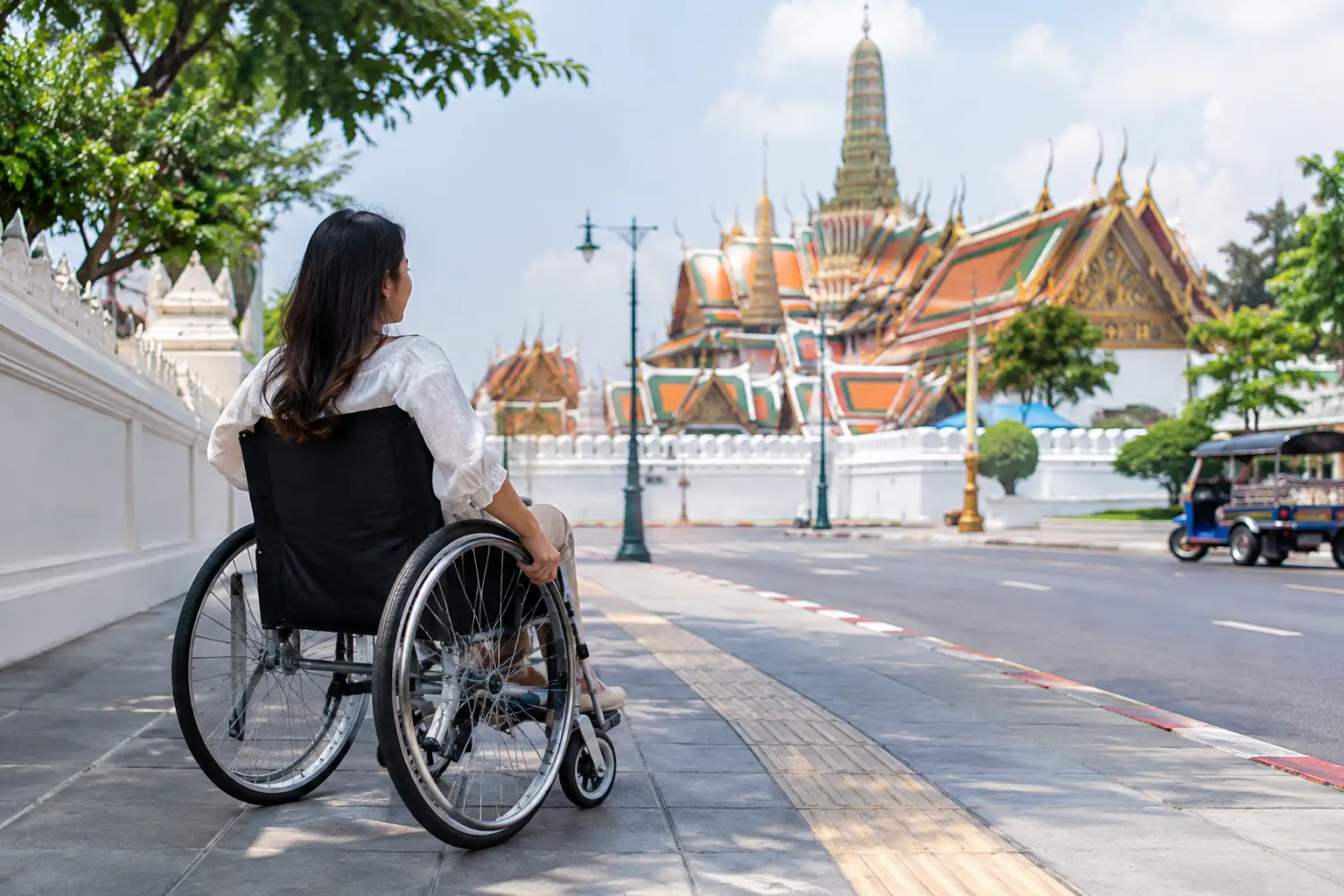
A smart-looking hotel can be completely manageable inside, then leave you facing a broken pavement, an open drain or a kerb with no dropped section as soon as you reach the street. That is the reality of Thailand street accessibility. It does not mean Thailand is off limits for wheelchair users or mobility scooter users. It means the street outside your accommodation deserves as much attention as the room itself.
I have travelled in Thailand using a mobility scooter, and the best advice I can give is to plan for variation rather than expecting one standard. You can have a brilliant, independent day out, but the route may involve using the road for a short stretch, choosing one side of the street over the other, or taking a taxi when the heat and pavement conditions become too much.
Thailand street accessibility is uneven
In the busiest visitor areas, pavements can look promising at first glance. They may be wide, paved and lined with shops, cafés and hotels. The problem is what happens every few metres. A smooth pavement can suddenly be blocked by parked motorbikes, food stalls, signboards, utility poles, bins or a step outside a business.
Dropped kerbs are inconsistent. Where they do exist, they may be steep, narrow, cracked or positioned nowhere near the obvious crossing point. Drainage channels are another issue, particularly on side streets. Some have solid covers; others have gaps that demand care from anyone using small front wheels or a mobility scooter.
This is not a reason to stay in your hotel. It is simply why a route that looks like a ten-minute walk on a map may take longer on wheels. Give yourself time and do not feel pressured to keep up with able-bodied companions. A slower route that is predictable is always better than forcing a difficult shortcut.
The most manageable areas are usually the busiest
Thailand is not one accessibility experience. Bangkok, Pattaya, Phuket, Chiang Mai and smaller resort towns all feel different, and even two streets in the same resort can be poles apart.
In Bangkok, major shopping districts and newer developments are generally the easiest places to get around. Shopping centres often provide level entrances, lifts, accessible toilets and air conditioning - all useful when the pavement outside is difficult or the heat is draining your battery and energy. The streets between them, however, can be the weak point.
Pattaya can work well for scooter users because much of the main seafront area is relatively flat. Yet pavements are still interrupted, busy and variable. The beach road is often easier than back streets, while some areas away from the main tourist strip become less reliable very quickly.
Phuket depends heavily on where you stay. Patong is busy, crowded and mostly usable in places, but the pavement surface and obstacles need constant attention. Quieter beach resorts may have more space but fewer nearby facilities, meaning taxis become more important. In Chiang Mai, the older central areas have charm but can bring narrower pavements, uneven surfaces and busy roads.
The practical lesson is simple: choose a location for the street outside, not just the pool view or hotel photographs.
Check the first 300 metres from your hotel
Before booking, use recent street-level imagery and hotel guest photos to inspect the route from the entrance to the nearest main road, convenience shop, restaurant and taxi pick-up point. Hotel accessibility claims often cover ramps and bedrooms, not whether you can actually leave independently.
Ask the hotel direct questions. Is the pavement outside level? Is there a dropped kerb nearby? Can a wheelchair-accessible or scooter-friendly taxi stop at the entrance? Is there a step between the drive and reception? Do not settle for a vague reply saying the property is suitable for disabled guests.
If you use a mobility scooter, also ask where it can be stored and charged. A ground-floor room near an accessible entrance can be far more useful than a larger room reached by a lift and long corridor. Thailand's heat can reduce battery range, so being able to top up safely during the day is worth considering.
For a longer stay, it can be sensible to arrange an airport transfer, spend the first day checking your immediate area, then decide which trips are genuinely practical. You do not need to cover every attraction to have a good holiday.
Use roads carefully when pavements fail
There will be occasions when the road is the safer surface. This is common where pavements are blocked, badly broken or disappear altogether. It is not ideal, and it requires proper caution.
Keep to the edge where possible, travel facing oncoming traffic if the road layout allows you to see it clearly, and avoid narrow roads with fast-moving vehicles. Thai traffic can be busy and unpredictable, particularly around motorbikes, so never assume a driver has seen you. High-visibility clothing or a small bright flag on a scooter can make a real difference after dark or during heavy rain.
Crossing roads is often harder than travelling alongside them. Look for traffic lights, larger junctions and places where there is enough room to wait safely. A crossing with a dropped kerb on one side is no help if the opposite side ends in a high kerb or blocked pavement. Check both ends before committing.
When travelling with someone, it helps if one person walks slightly ahead at complicated crossings to spot drains, kerbs and approaching traffic. That is not about giving up independence. It is sensible teamwork in an environment that has not always been designed with wheels in mind.
Heat, rain and crowds change the route
Thailand's weather is part of the accessibility calculation. In strong heat, exposed pavements and long detours become tiring quickly. Plan outdoor journeys early in the morning or later in the afternoon, and use shopping centres, cafés or attractions with indoor space to break up the day.
During the rainy season, pavements can become slippery and water can hide uneven surfaces or drainage gaps. A route that was manageable in dry weather may become unsuitable after a heavy downpour. If rain is forecast, keep your plans flexible and avoid relying on poorly surfaced side streets.
Crowds matter too. Night markets, walking streets and popular beachfront areas can be enjoyable, but they are easier at quieter times. Vendors, chairs and people stopping suddenly can leave very little turning space. Arriving early gives you more room and a better chance to judge whether the surface will work for your chair or scooter.
Build in transport as your backup plan
Independent travel does not have to mean travelling every mile under your own power. In Thailand, taxis and private drivers are often the sensible solution for longer distances, inaccessible stretches and days when the weather is against you.
The key question is whether your wheelchair folds, or whether your mobility scooter can be dismantled or transported safely. Larger scooters may require a vehicle with a suitable boot space or a van. Be specific when arranging transport: give the folded dimensions or explain that the scooter does not fold. Do not assume a standard taxi will be suitable.
Public transport can help in parts of Bangkok, especially where stations have lifts, but it should not be your only plan. Lift availability, station layouts and the route from the station to your destination all need checking. A station may be accessible on paper yet still leave you on a difficult pavement at the other end.
For day trips, a private driver can remove a great deal of stress. It gives you a cool place to rest, protects your battery range and means you are not forced to tackle every poor pavement between sights.
What to carry for street-level confidence
A little preparation makes difficult surfaces less daunting. Keep your essentials easy to reach rather than buried in a bag. For Thailand, I would prioritise:
- A charged phone with offline maps and your hotel address saved in both English and Thai.
- A rain cover or waterproof bag for controls, medication and valuables.
- Drinking water, sun protection and a small towel for the heat.
- A basic puncture or repair plan, plus your scooter charger if you will be out for a full day.
Also think honestly about your equipment. Large powered wheelchairs and mobility scooters give excellent independence, but they need more space around obstacles and can struggle with steep kerbs. Smaller scooters may be easier to manoeuvre through crowded areas, although their wheels and ground clearance can be less forgiving on broken surfaces. There is no perfect option - it depends on your needs and the places you intend to visit.
Do not let one bad pavement decide the holiday
Thailand rewards travellers who stay flexible. If a street is blocked, turn back and try the parallel road. If the heat is becoming too much, stop for a cold drink and use a taxi. If a market is too crowded, visit earlier or choose another evening activity.
The aim is not to prove that every pavement is accessible. It is to create a holiday where you remain in control of your choices. With the right hotel location, realistic daily plans and transport ready when you need it, Thailand can still offer the freedom, warmth and memorable experiences that make the journey worthwhile.
0 Comments
Leave a Comment