
Step Free Sightseeing Guide That Actually Helps
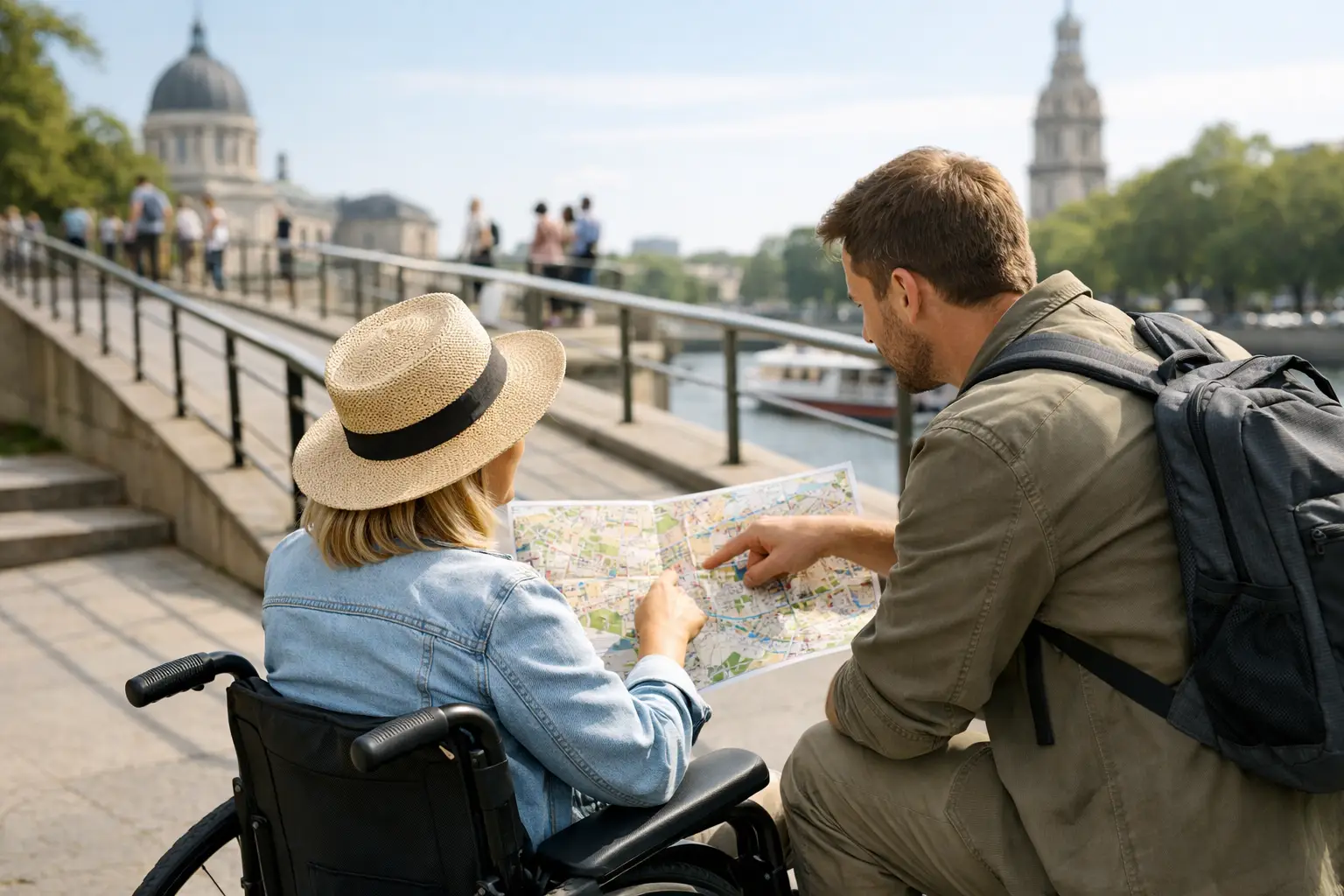
You can waste half a day on a city break because one museum has a side entrance, the lift is out of order, and the "accessible route" turns out to be a steep back street. That is exactly why a proper step free sightseeing guide matters. If you use a wheelchair or mobility scooter, vague accessibility claims are not just annoying - they can wreck the day.
The good news is that step free sightseeing is possible in far more places than many tourist boards suggest. The bad news is that you usually need better information than they provide. Real planning is not about whether a place has a ramp somewhere. It is about whether you can get there easily, enter with dignity, move around without getting stuck, and get back out again without a battle.
What a step free sightseeing guide should tell you
A useful guide starts long before the attraction itself. The biggest barrier is often the bit between the hotel and the entrance. A destination can have accessible museums, river cruises and viewpoints, but if every pavement is broken, every dropped kerb is blocked by parked cars, and every station lift is unreliable, the experience changes completely.
That is why the best step free sightseeing guide looks at the whole route. You need to know how accessible the nearest station is, whether buses take mobility scooters, whether pavements are wide enough, and if there are any steep sections that will leave you avoiding the area altogether. City centres often look flat on a map and feel very different on the ground.
Inside attractions, the detail matters just as much. Step free entry is only the start. Ask whether all public areas are accessible, whether there are lifts to every floor, how large those lifts are, and whether accessible toilets are genuinely usable rather than doubled up as storage cupboards. If you are travelling with a larger scooter, turning space and door width can matter more than whether there is a token ramp at the front.
Start with transport, not the attraction
A lot of people plan sightseeing in the wrong order. They choose the famous places first and only later ask how to reach them. For disabled travellers, transport needs to come first because it decides how realistic the whole day will be.
Rail can be excellent in one city and a complete headache in another. A station may be listed as step free but still involve a long detour, a separate staff-operated lift, or a platform gap that needs assistance. Buses can be more useful than trains for local travel, but only if the operator accepts scooters and the space is not constantly taken by prams. Taxis can solve a problem, although accessible vehicles are not always easy to book at short notice.
If you are planning a full sightseeing day, think in terms of energy as much as distance. A route with one direct accessible bus may be far easier than changing twice on rail. A shorter route across cobbles may be worse than a slightly longer smooth path. Independence is not about doing things the hard way. It is about choosing the option that gives you the least hassle.
Building a realistic route through a city
The easiest mistake is trying to cram too much in. For wheelchair and scooter users, a city route needs to be practical, not ambitious for the sake of it. Two or three properly chosen stops can make a much better day than six rushed attractions with access problems between each one.
Group sights by area so you are not constantly crossing the city. Check whether major attractions are linked by level promenades, accessible shopping centres, riverside paths or pedestrian zones with smooth surfaces. Waterfronts are often better than older historic quarters, although not always. Some heritage areas are manageable with care, while others are a constant fight against uneven stone and awkward gradients.
This is where lived experience beats brochure copy every time. A destination may say the old town is accessible because there are ramps at key buildings. That sounds promising until you find the route between them is all setts, steep lanes and crowded pinch points. Honest route planning means accepting that some famous areas are better admired from the edge than tackled head-on.
Surface, slope and spacing matter more than people think
A five-minute incline can feel a lot longer when you are pushing a manual chair or trying to control a scooter on rough ground. The same goes for paving quality. Smooth tarmac, level concrete and modern promenades usually save energy. Cobbles, gravel and broken flagstones quickly turn a pleasant outing into hard work.
Spacing matters too. If accessible toilets are only available inside one attraction and nowhere else nearby, that shapes the route. If cafés with level access are scarce, your rest stops become limited. A practical day out is built around reliable places to pause, charge devices if needed, and stay comfortable.
Don’t trust the word accessible on its own
This is where many guides fail disabled travellers. "Accessible" is too broad to be useful unless someone explains what they actually mean. One venue may use the word because there is a portable ramp and a disabled loo. Another may mean full lift access, level circulation, hearing loops and generous turning space. Those are very different standards.
When checking attractions, look for specifics. Is the main entrance step free, or are wheelchair users sent round the side? Are lifts available throughout the building? Can you access the viewing platform, restaurant or gift shop, or only the ground floor exhibition? If staff assistance is required, do you need to book ahead? These details decide whether a place feels welcoming or like hard work.
There is also the issue of temporary failure. A lift out of service can wipe out a plan instantly. Where possible, check recent visitor reports or ring ahead on the day if the attraction depends heavily on a single lift. It is not dramatic to do this. It is sensible.
Hotels can make or break step free sightseeing
Sightseeing is easier when your hotel is in the right place. A decent accessible room is not enough if you are stranded miles from the areas you want to visit or reliant on awkward transport connections.
For city breaks, location often matters more than star rating. Staying near an accessible station, flat promenade or central bus route can save a lot of effort. It also gives you flexibility if weather changes or you need to cut the day short. Returning to the hotel should not feel like another expedition.
Within the hotel, check the practical points that affect mornings and evenings. Is there a genuine roll-in shower? Can you move around the room with your equipment? Are there heavy fire doors, awkward breakfast room steps or lifts that barely fit a standard chair? A poor hotel setup drains energy before the sightseeing even starts.
A good step free sightseeing guide includes backup plans
Even the best planning can be caught out by broken lifts, roadworks, weather or crowds. The trick is not to pretend these things will not happen. It is to build options into the day.
That could mean choosing attractions in the same area so one can replace another if access falls through. It might mean keeping an indoor option near an outdoor route in case rain makes surfaces slippery or unpleasant. In some places, simply knowing where the nearest accessible loo, shopping centre or hotel lobby is can rescue the day.
Backup planning is not being negative. It is what gives you freedom. When you know there is another workable option nearby, you are less likely to feel trapped by the first problem.
Why honesty matters more than perfect destinations
There is no such thing as a flawless city for every disabled traveller. Needs vary. A manual wheelchair user may prioritise gentle gradients and smooth surfaces, while a mobility scooter user may focus on transport rules, charging, turning space and pavement width. Someone travelling with a carer may accept a few awkward sections that a solo traveller would quite reasonably avoid.
That is why the most useful guides are honest about trade-offs. A historic city may have brilliant accessible transport but poor surfaces in the centre. A modern waterfront district may be easy to navigate but spread out. A world-famous attraction may be technically step free yet so crowded that visiting early is the only realistic option. None of that means the trip is not worth doing. It means you can plan it properly.
This is the kind of detail that makes accessible travel feel achievable rather than risky. At Andy Wright Travel, that real-world approach is the difference between generic advice and information you can actually use.
The aim is not to wait for perfect access before going anywhere. It is to travel with clear eyes, good information and a route that respects how you move through the world. That is what turns a stressful outing into a proper day out.
0 Comments
Leave a Comment