
Mobility Scooter Friendly Holidays UK
A good UK break can fall apart long before you reach the hotel. One steep ramp, one so-called accessible room with a bathroom you cannot turn in, or one train station with a broken lift can turn a simple trip into hard work. That is why planning mobility scooter friendly holidays UK style needs more than glossy brochure promises. You need straight answers about access, space, transport and how easy it is to get around once you arrive.
The good news is that the UK can work very well for mobility scooter users if you choose the right destination and ask the right questions before booking. The bad news is that "accessible" still means very different things to different businesses. A place might be fine for someone using a walking stick and completely unsuitable for a larger scooter. That gap is where many trips go wrong.
What makes mobility scooter friendly holidays UK worthy?
For me, it starts with what happens beyond the front door. A hotel can have a step-free entrance and still be a poor choice if the surrounding pavements are broken, kerbs are too high, or the nearest accessible toilet is half a mile away. A genuinely scooter-friendly holiday is about the whole journey - accommodation, transport, attractions, town layout and how much effort it takes to move around independently.
Space matters more than many operators realise. You need enough room to enter, turn, park and charge your scooter without it becoming a daily logistical puzzle. Door widths, lift size and bathroom layout can be more important than whether a room is labelled accessible. Wet rooms are often better, but only if they are actually large enough and fitted with practical grab rails and a usable shower seat.
Terrain is the other big factor. Some places are excellent for wheelchairs and compact scooters but harder for larger mobility scooters because of hills, cobbles or narrow promenades. That does not mean you should rule them out. It just means the destination needs to match your equipment, confidence and energy levels.
Start with destinations that are easier to manage
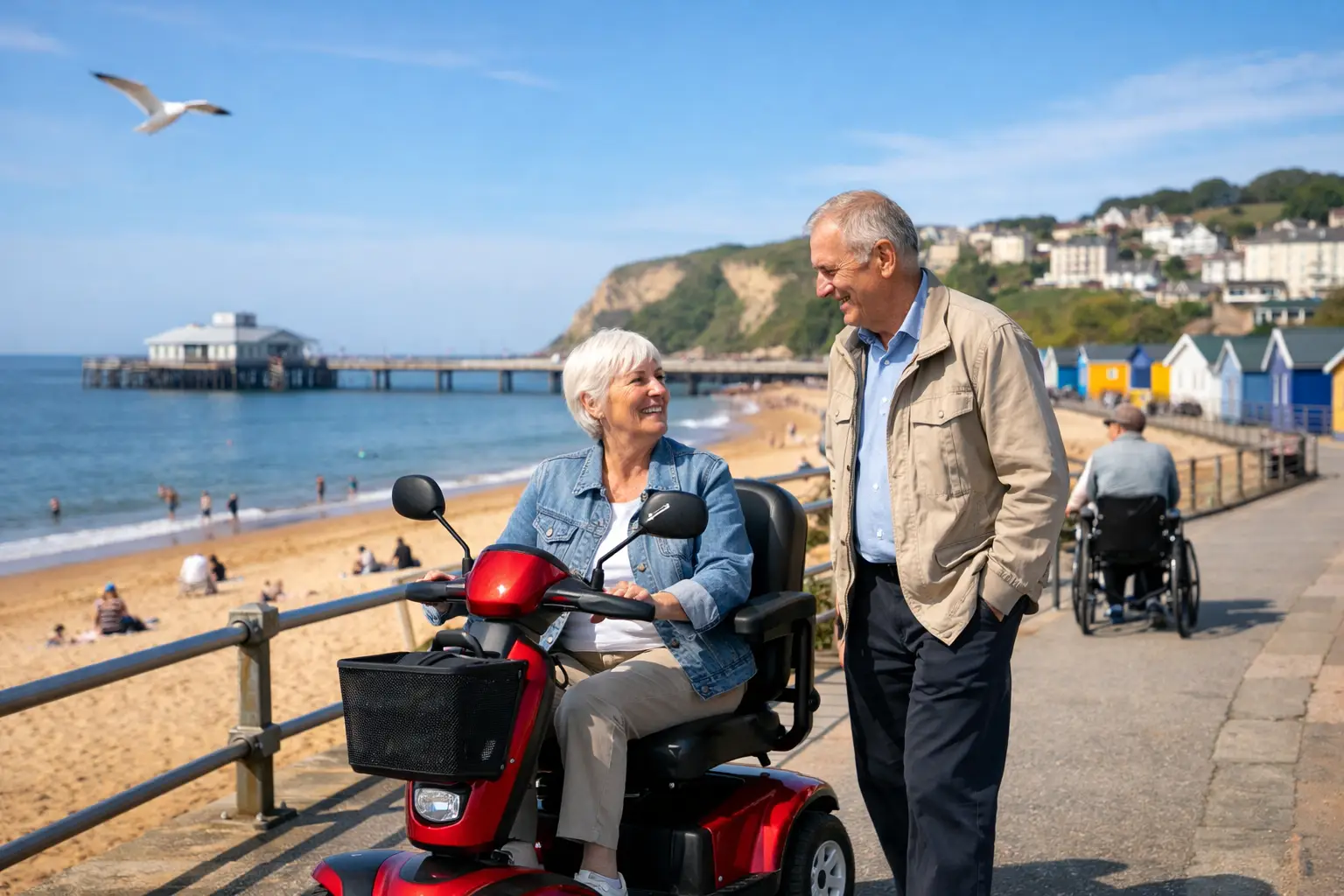
Seaside towns are often a sensible place to begin because many offer long promenades, flatter routes and attractions that understand accessibility better than older inland sites. Not every coastal town is equal, though. One resort may have level seafront access and accessible toilets every few hundred metres, while another has steep approaches from hotel areas down to the front.
Larger cities can work surprisingly well if they have decent public transport and modern redevelopment. Places with accessible buses, reliable lifts at stations and well-maintained pedestrian areas are often easier than pretty historic towns with narrow streets and uneven surfaces. Historic destinations can still be worth visiting, but they usually need more planning and more realistic expectations.
Holiday parks can also be a strong option for mobility scooter users because they often combine parking, accommodation, entertainment and food in one area. The trade-off is that site size matters. Some parks are so spread out that you will rely on the scooter constantly, and gradients around the site can be harder than expected.
The questions to ask before you book
Too many travellers are still expected to accept vague answers. Don’t. If a hotel, cottage or park cannot answer practical access questions clearly, treat that as a warning sign.
Ask whether the route from parking or drop-off to reception is step-free and level, not just whether there is "ramp access". Ask for exact door widths if you use a larger scooter. Ask whether the accessible bedroom is on the ground floor or served by a lift, and whether the lift can take both the scooter and another person. Ask where you can charge the scooter safely overnight and whether there is enough room in the room itself.
Bathroom detail matters just as much. A property may advertise an adapted bathroom, but that could mean nothing more than a grab rail near a standard bath. You need to know whether it has a proper roll-in shower or wet room, whether there is transfer space by the toilet, and whether the sink can be used comfortably from a seated position.
Photos help. If a property is reluctant to provide current pictures of the entrance, bedroom and bathroom, I would be cautious. Clear photos often tell you more than a page of accessibility claims.
Transport can decide whether the holiday works
For many people, driving remains the easiest option for mobility scooter friendly holidays UK wide because it gives you control over timing, charging equipment and how much gear you take. If you drive or travel with someone who does, check parking before anything else. Blue Badge parking, nearby drop-off, and a level route into the accommodation all make a real difference.
Rail travel can be useful, but it depends heavily on station access at both ends of the journey. Passenger assistance is valuable, but do not assume that booking it removes every problem. You still need to check lift availability, platform access and whether your scooter meets train operator limits. A station with one out-of-order lift can derail the whole route.
Coaches and buses are more mixed. Some local bus networks are excellent for wheelchair and scooter users, while others are limited by older vehicles or awkward boarding arrangements. If you are planning to rely on buses at your destination, find out how regular the accessible services are and whether popular tourist routes are fully usable.
Hotels, self-catering or holiday parks?
There is no single right answer. Hotels can be easier if you want staff on hand and fewer daily tasks, but room layouts are often tighter and storage for a scooter can be poor. A good hotel works best when the accessible room is genuinely spacious and the route to dining, bar areas and outdoor spaces is simple.
Self-catering gives you more control, especially if you need room for equipment, medication, food storage or support from a partner or carer. Ground-floor lodges and adapted cottages can be excellent, but outdoor surfaces need checking. Gravel drives and awkward thresholds can spoil what looks perfect online.
Holiday parks sit somewhere in the middle. They can offer adapted units and easy entertainment without constant travelling. The downside is that some accessible caravans still have cramped interiors, and not all parks provide enough detail about paths, gradients and access to facilities.
Attractions and day-to-day access
A destination is only enjoyable if you can actually use it once you get there. Promenades, piers, accessible beaches, gardens, museums and shopping centres can all make a big difference, but only if the route between them is realistic on a scooter.
Look beyond the headline attraction. Check where the nearest accessible toilet is, whether cafés have level access, and whether there are places to sit if a companion is walking beside you. Battery range matters too. A destination may look compact on the map but involve longer detours because of inaccessible routes or dropped kerbs in the wrong places.
Beach access is a good example. Some UK seaside destinations now offer beach wheelchairs, ramps or boardwalks, which is excellent. But if your hotel sits at the top of a steep hill and the only route down is uneven, the accessible beach itself may not solve the bigger problem.
Common mistakes people make
The biggest one is trusting the word "accessible" without testing what it means. The second is focusing only on accommodation and not the surrounding area. The third is underestimating how tiring poor access can be, even if it is technically possible.
Another mistake is trying to pack too much into the trip. A holiday should not feel like an obstacle course. If a destination needs military-level planning just to get from room to breakfast to seafront, that may not be the right choice for this trip.
It also helps to think about backup plans. If the weather turns, is there an indoor attraction nearby with good access? If public transport fails, is there parking close to where you want to go? Resilient planning gives you more freedom, not less.
Choosing mobility scooter friendly holidays UK travellers can trust
The best UK holidays for mobility scooter users are not always the flashiest ones. They are the ones where the basics are right. Level access. Honest room details. Transport that works. Enough space to move without asking for help every five minutes.
That is why experience-led research matters. Generic tourism websites often stop at broad accessibility claims, but disabled travellers need operational detail. Andy Wright Travel has built its audience on exactly that point - showing what access looks like in real life rather than repeating marketing copy.
If you are deciding where to go next, aim for a destination that gives you confidence rather than one that leaves you guessing. You do not need perfect access everywhere. You need a place where the barriers are manageable, the information is honest and the trip still feels like your holiday, not somebody else’s compromise.
A well-planned break in the UK can still give you that feeling every traveller wants - the freedom to get out, see more and enjoy the day without fighting for every inch of it.
0 Comments
Leave a Comment