
Mobility Scooter Battery Guide for Travel Days
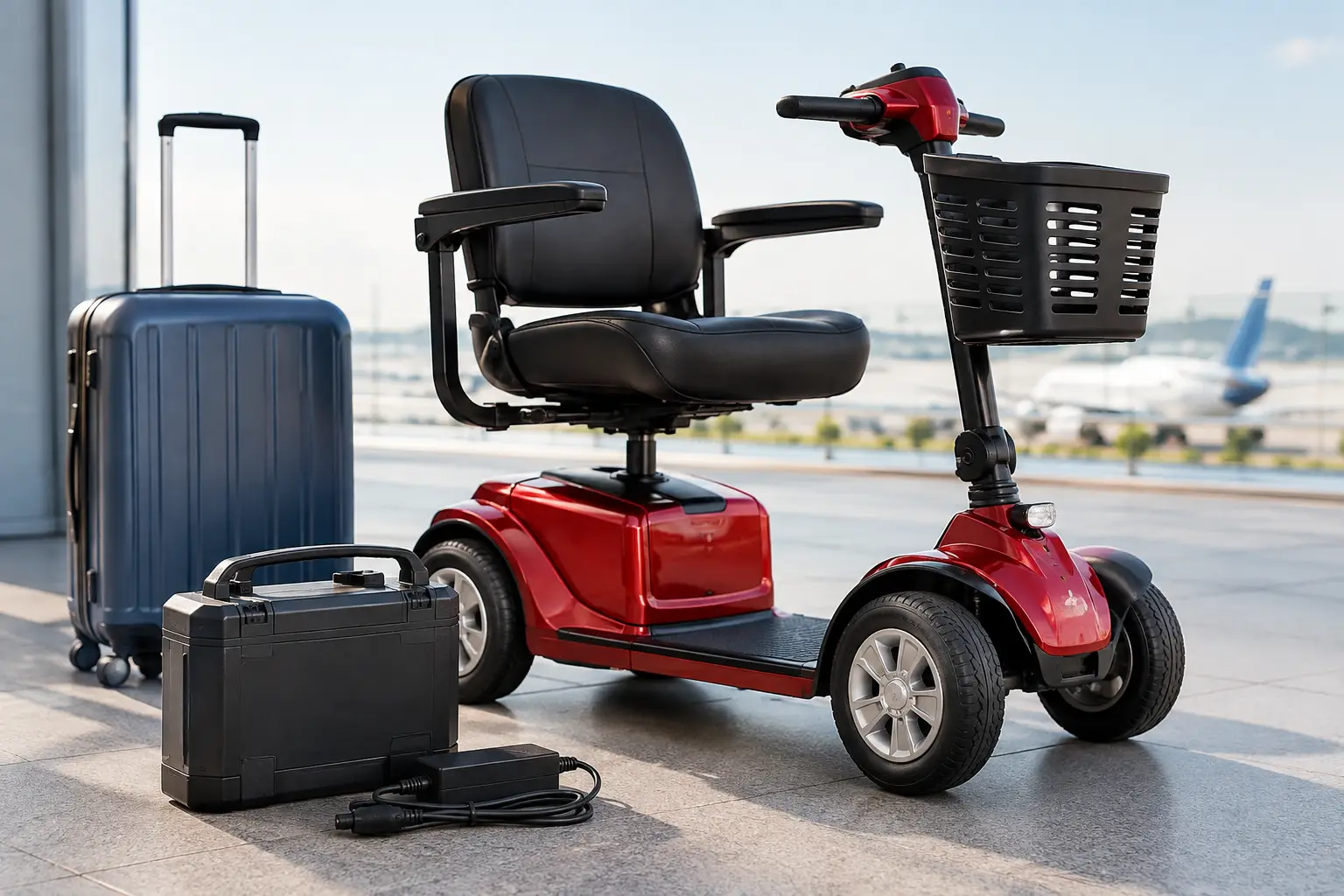
A flat battery can turn a good day out into a very long wait. It does not matter how accessible the hotel, airport or attraction is if your scooter cannot get you back to it. This mobility scooter battery guide focuses on the practical checks that make travelling easier: knowing your real range, charging safely and dealing with airlines, ferries and overnight stops.
Battery planning is not about assuming the figure in a brochure will happen on holiday. Hills, cobbles, loose surfaces, cold weather, luggage and a heavier-than-usual day all take their share. Build a margin into every journey and you will keep far more control of your trip.
Start with the battery you actually have
Before booking transport, find out the battery type, voltage, amp-hour rating and weight. The label on the battery or the scooter handbook should give you the information. Take a clear photo of it and keep the handbook on your phone as well as in your travel paperwork.
Most travel scooters use either sealed lead-acid batteries or lithium batteries. Sealed lead-acid batteries are common, familiar and usually straightforward for everyday use, but they are heavy. Lithium batteries are much lighter and can offer good range for their size, which is a real advantage when lifting parts of a scooter into a car. They also bring stricter airline rules.
Do not rely on the phrase “airline friendly” on a retailer’s listing. It is not a booking confirmation, and it does not tell baggage handlers how your particular scooter should be prepared. Airlines make the final decision, often based on the battery’s watt-hour rating, whether it can be removed and whether the model can be safely loaded.
Know your realistic range
Manufacturers normally quote a maximum range under favourable conditions. Treat it as a best-case figure, not a promise. If your scooter is advertised as managing 15 miles, plan a holiday day around substantially less if you will face slopes, stop-start sightseeing or uneven paving.
Weight matters too. Add your luggage, shopping, rain cover and any equipment carried in the basket. A long promenade may look flat on a map but headwinds and rough surfaces can make the motor work harder. Cold weather can also reduce battery performance, while very hot conditions are not kind to batteries or chargers.
For an unfamiliar destination, plan your route as an outward journey, a return journey and a reserve. The reserve is what gets you around a diversion, a broken lift, an unexpectedly steep ramp or a hotel entrance that is not where the booking photos suggested. It is not wasted range. It is your independence.
Charging on holiday without the guesswork
Charge fully before leaving home, ideally using the charger supplied or approved by the scooter manufacturer. Cheap replacement chargers can have the wrong output or cut-off behaviour, and that is a false economy when you are relying on the scooter away from home.
At your accommodation, check where you can charge before you arrive. A ground-floor accessible room is useful, but only if there is space to park the scooter safely and a socket within reach without creating a trip hazard. Some hotels expect scooters to be kept outside the room, in a corridor or in a storage area. That may be unsuitable if the area is unsecured, exposed to rain or has no power point.
Ask direct questions: can the scooter be brought into the room, is there a charging point, and can it remain connected overnight? Do not accept “we are accessible” as an answer to a battery question. Accessible travel is built from the details.
Use the correct mains adaptor when travelling abroad, but also check voltage compatibility. Many modern chargers accept 100-240V and work with a plug adaptor. Some do not. The label on the charger will state its input range. If it only accepts UK voltage, an adaptor alone is not enough.
Avoid routinely running a battery completely flat. Deep discharges shorten the working life of many batteries and leave you with no margin should the charge point fail. Charging each evening is normally the sensible routine on holiday, even after a shorter day. If you take a break back at the hotel, a top-up can make an evening meal or waterfront stroll far less stressful.
Do not charge a scooter where the charger or cables can get wet, and do not cover the charger while it is running. If a battery becomes unusually hot, smells odd, swells or shows physical damage, stop using it and seek advice from the manufacturer or a qualified mobility technician.
Flying with a mobility scooter battery
Flying is where preparation matters most. Contact the airline's special assistance team before booking where possible, then again after booking. Give them the make and model of the scooter, folded or dismantled dimensions, total weight, battery type and watt-hour rating. Ask for written confirmation that the scooter and battery have been accepted.
Lithium battery rules are particularly strict. Airlines commonly require removable lithium batteries to be taken out of the scooter, protected against short circuit and carried in the cabin. A limit of up to 300 watt-hours is common for a mobility aid battery, but rules vary by airline and route. Some operators may allow a spare battery under specific limits; others will not. Never assume a battery that was accepted on one airline will be accepted on another.
Watt-hours are usually shown on the battery label. If they are not, the basic calculation is volts multiplied by amp-hours. For example, a 24V 10Ah battery is 240Wh. Take photographs of the label and any airline approval with you. A printed copy is worthwhile too, because airport Wi-Fi has a habit of being least helpful when you need it.
Sealed lead-acid and other non-spillable batteries are often permitted when fitted securely to the scooter, with terminals protected and the device prepared for loading. However, the airline still needs advance notice. Tell check-in staff how to switch the scooter off, disengage the motor if required and prevent accidental movement. A short handling instruction attached to the scooter can save a lot of confusion.
Arrive early. Not because disabled travellers should have to spend half a day at the airport, but because battery checks, loading arrangements and gate handovers can take time. Remove loose accessories, keep the key with you, and photograph the scooter from all sides before handing it over. It is practical evidence if damage is found on arrival.
Ferries, trains and coach travel
Ferries are often easier than flying for battery-powered scooters, particularly if you remain with the scooter in a vehicle or use it to board. But ferry operators may have limits on scooter size, weight and where it can be parked during the crossing. Confirm whether you can use the passenger lift, whether the vehicle deck is accessible, and if the crew need the scooter switched off or keys removed.
On UK trains, the bigger issue is often not the battery but the scooter itself. Operators have size and turning-circle limits for their designated wheelchair spaces, and some require a scooter permit. If your scooter must be folded or dismantled, be realistic about whether you can do that independently on a platform. A battery that lasts all day does not solve a scooter that cannot be safely carried on board.
For coaches and accessible taxis, ask whether the scooter travels upright, how it will be secured and whether you can remain seated on it. Do not let anyone improvise with straps around the battery box or control panel. Proper restraint points matter.
Keeping batteries healthy between trips
If the scooter will not be used for several weeks, do not leave it discharged in a shed or cold garage. Follow the manufacturer’s storage instructions, which may recommend a periodic charge. Batteries slowly lose charge even when not in use, and a neglected battery can fail just when you are ready to travel again.
Keep terminals clean and check cables for wear. A loose connection can mimic a flat battery, and it is much easier to spot at home than in a foreign hotel lobby. If your battery is several years old and range has dropped noticeably, test or replace it before a major trip rather than hoping it will manage one more holiday.
The best travel battery plan is simple: start full, know your limits, charge where you sleep and keep enough range in hand for the unexpected. That margin is what lets you enjoy the journey rather than constantly watching the battery gauge.
0 Comments
Leave a Comment