
Manual Wheelchair vs Mobility Scooter for Travel
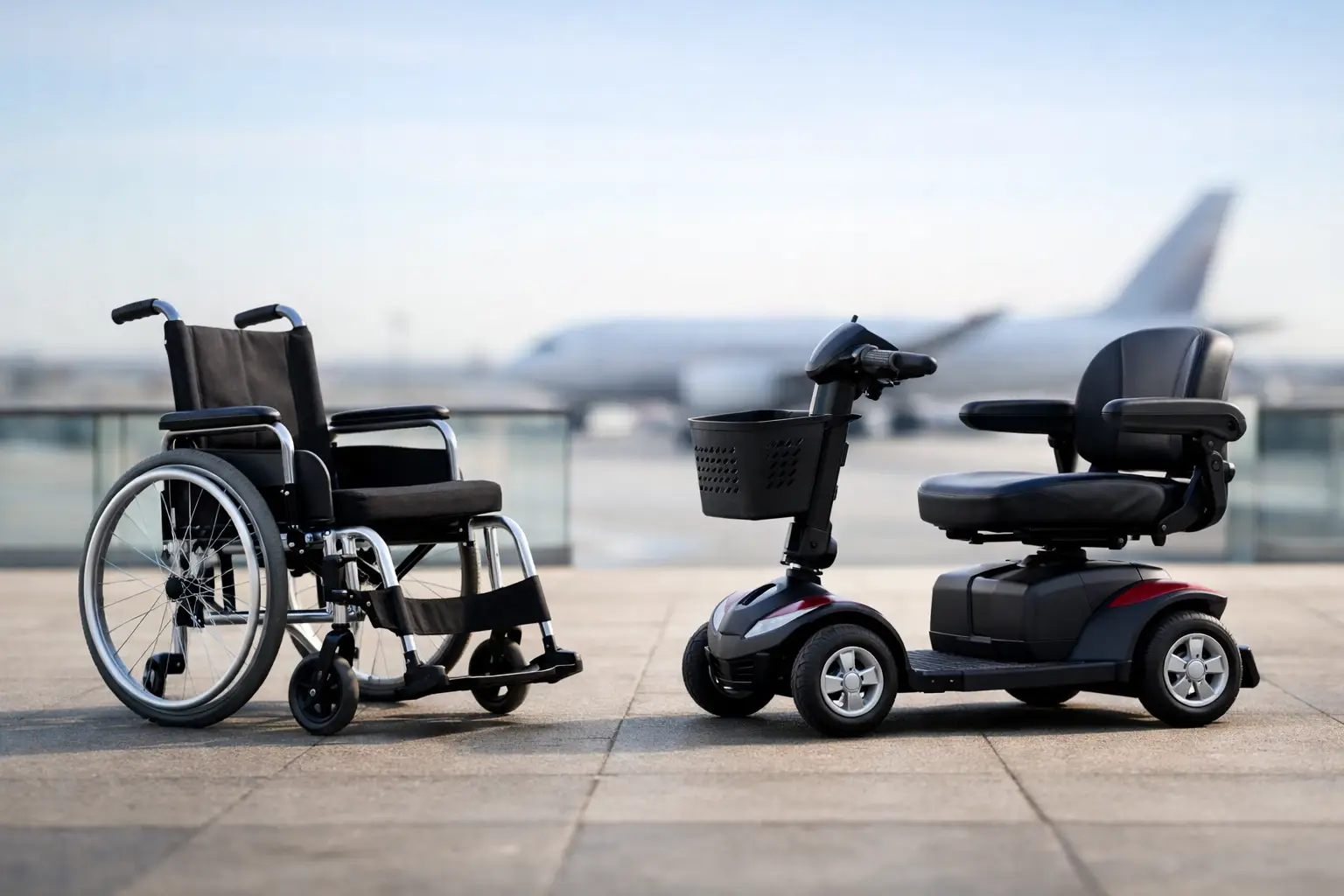
A mobility aid that works perfectly around your local shops can become a real problem halfway through a holiday. A steep cobbled street, an inaccessible taxi, a hotel room with no charging point near the bed or an airline battery rule can quickly change the plan. The manual wheelchair vs mobility scooter decision is therefore not just about comfort at home. For travel, it is about how you will get from front door to airport, hotel, attraction and back again without losing the independence you set out to enjoy.
Neither option is automatically better. The right choice depends on your energy, upper-body strength, the destination, the length of your days out and whether somebody is travelling with you. The honest answer is that some trips are far easier with a scooter, while others are much simpler in a manual wheelchair.
Manual Wheelchair vs Mobility Scooter: The Travel Difference
A manual wheelchair is usually the easier option to lift, fold, store and take through tight spaces. A lightweight folding chair can fit in many car boots, go into the luggage hold of a coach and be handled more easily by hotel staff if needed. It also avoids the battery restrictions that can make flying with a mobility scooter more complicated.
The trade-off is effort. If you self-propel, long distances, hills, rough paving and hot weather can be exhausting. A chair may be compact, but that does not make a hilly old town or a large airport manageable. If someone else will push, think honestly about their ability too. Pushing a wheelchair over gravel, sand, kerbs and steep ramps is hard work, particularly for several hours a day.
A mobility scooter gives many people the freedom to cover far more ground without using all their energy before lunch. That matters on a city break, at a theme park, around a large resort or when an attraction involves a long walk from the entrance to the main site. For travellers who can transfer independently and need support with walking rather than seating, a scooter can be the difference between seeing a destination and staying close to the hotel.
But scooters are larger, heavier and less forgiving. A compact boot scooter may be relatively easy to dismantle, although the heaviest component can still be too much for one person to lift safely. A road or pavement scooter offers better range and comfort, but it may be impractical for taxis, narrow hotel lifts and small cruise-ship cabins. It can also be difficult to find safe overnight storage and reliable charging when you are away.
Start With the Journey, Not the Destination
Before choosing which aid to take, map the whole journey. It is no good booking a scooter-friendly hotel if the transfer vehicle cannot carry it, or taking a manual wheelchair if the station assistance route includes a long outdoor push over uneven ground.
For UK rail travel, both wheelchairs and scooters can be used, but scooter rules vary by operator. Some services require a permit, restrict the size or weight of scooter, or only accept smaller Class 2 models. Do not assume that because a scooter fits through the station gate it will be accepted on the train. Arrange Passenger Assist and confirm the exact model, dimensions and weight before travel.
On coaches, a folding manual wheelchair is often more straightforward because it can usually be stored in the luggage hold. Scooter acceptance is much less consistent. Some accessible coaches have a lift and designated space, but not all routes use them, and operators may set battery and size limits.
Flying requires the most preparation. Airlines generally carry wheelchairs and mobility scooters as mobility equipment, but they need advance notice. The key detail is the battery type. Lithium batteries are subject to strict rules, while sealed lead-acid and gel batteries are handled differently. You will normally need the make and model, dimensions, weight, battery type and watt-hour rating where relevant. Take a photo of the manufacturer’s label and keep the information with your booking documents.
A manual wheelchair may be easier to manage at the airport, especially if it folds. However, do not hand it over without checking how it will be protected. Remove loose cushions, side guards or detachable footplates where possible, label the chair clearly and photograph it before it goes into the hold. The same applies to scooters, with extra care needed for keys, chargers and any removable battery.
Think About What Happens on the Ground
Travel websites often describe somewhere as wheelchair accessible when they mean there is a ramp at the entrance. That tells you almost nothing about the pavements outside, the accessible toilet, the distance from parking, the lift size or whether your mobility scooter can turn inside the café.
A manual wheelchair has an advantage in tight historic centres, small museums and older restaurants. It is easier to pivot, can be folded for a taxi if necessary and is less likely to be refused because of its size. It can also cope better with a sudden change of plan, such as taking a small accessible vehicle rather than waiting for a larger one.
A scooter comes into its own when distances are the barrier. Seafront promenades, large zoos, major attractions and modern city centres can be excellent scooter territory, provided the surfaces are sound and dropped kerbs are frequent. A scooter can also make it possible to stay out for a full day rather than having to return to the hotel after an hour because walking has become painful or unsafe.
Terrain is the deciding factor more often than people expect. Smooth pavements and level indoor attractions are suitable for both. Loose gravel, steep hills, deep cobbles, mud and soft sand challenge both aids in different ways. A manual chair may need assistance, while a scooter can lose traction, struggle with kerbs or use far more battery than expected. Beach access is a separate question altogether. Unless a destination provides beach wheelchairs, matting or a firm accessible route, neither a standard manual chair nor scooter should be expected to travel on sand.
Hotel Practicalities That Can Make or Break the Trip
When booking accommodation, ask more than whether there is an accessible room. For a manual wheelchair, confirm the width of bedroom and bathroom doors, turning space beside the bed, shower access and whether the route from reception is step-free. If you are travelling with someone who will push, make sure there is room for both of you to move around the bed and bathroom safely.
For a mobility scooter, add storage and charging to the conversation. Ask whether the scooter can be taken into the room, whether there is a secure ground-floor storage area and where it can be charged overnight. Never rely on charging in a corridor or fire escape. It may block an evacuation route, be removed by staff or leave your equipment exposed to theft and weather.
Also ask about lifts, not just whether one exists. A lift that takes a compact wheelchair may be too short or narrow for a scooter. Likewise, an accessible room can be on an upper floor with a lift that is awkward to enter, especially with a larger model. Specific measurements are far more useful than a reassuring but vague answer.
Match the Aid to Your Independence, Not Other People’s Expectations
There can be pressure to take the aid that looks less conspicuous or seems easier for everyone else. That is the wrong starting point. Travel is tiring enough without making yourself walk beyond your limits or depending on a companion to push you all day because a scooter felt like too much trouble to organise.
If you use a manual wheelchair confidently, have support where needed and expect tight spaces or mixed transport, it may be the most flexible travel companion. A power-assist attachment can also be worth considering for hills and longer days, although it brings some of the same transport and battery questions as a scooter.
If walking distance is your main restriction and you can transfer safely, a scooter may protect your energy and keep you in control of the day. Choose a model with realistic range, suitable tyres and a weight you can actually transport. Manufacturer range figures are usually based on ideal conditions, not hills, cold weather, luggage or a full day of stop-start sightseeing.
Whichever you choose, test it before the trip. Practise folding it, removing parts, checking tyre pressure, using ramps and estimating how long the battery lasts on your usual routes. Carry a simple repair kit if appropriate, keep your charger accessible and have a backup plan for a flat battery, damaged tyre or inaccessible taxi.
The best travel aid is the one that gives you the most freedom with the least avoidable hassle. Plan around the reality of your journey, ask direct questions before you book and do not settle for vague accessibility promises. With the right equipment and proper information, the destination becomes the adventure rather than the obstacle.
0 Comments
Leave a Comment