
How to Travel With Mobility Scooter
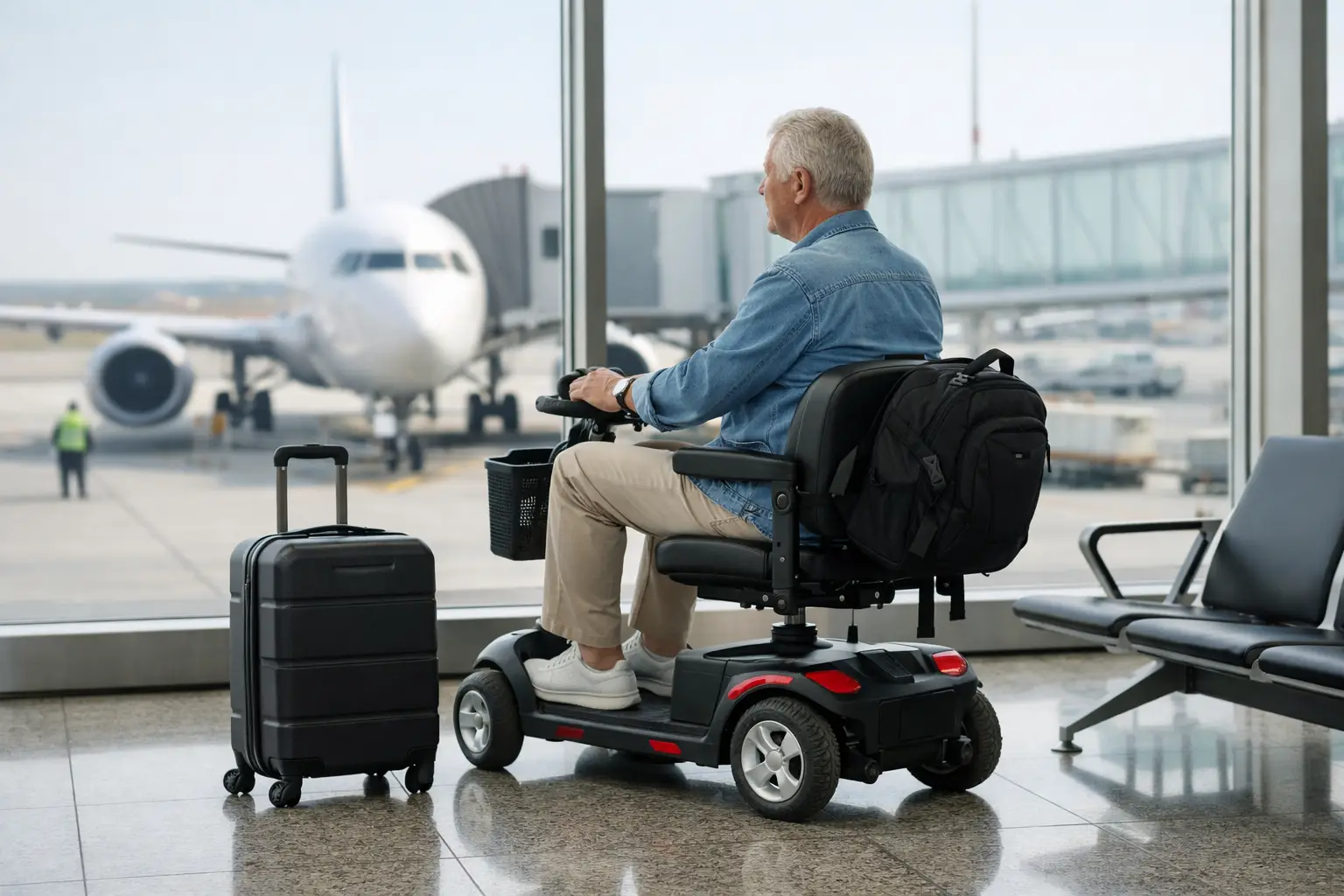
The awkward bit about planning a trip with a scooter is that the big questions are rarely the ones travel companies answer properly. They will happily tell you a hotel is "accessible" or a station has "step-free access", but that does not tell you whether your scooter fits in the lift, whether the transfer vehicle has a ramp, or whether your battery type will be accepted on a flight. If you are working out how to travel with mobility scooter, the difference between a good trip and a stressful one usually comes down to those small operational details.
That is the good news as well. Most travel problems for scooter users can be reduced with the right checks before you book. You do not need perfect accessibility everywhere. You need accurate information, a realistic plan, and enough backup options to keep your independence when things are not quite as advertised.
How to travel with mobility scooter starts before booking
The biggest mistake is choosing the destination first and asking access questions later. For mobility scooter users, the smarter order is transport, accommodation, local terrain, then everything else.
Start with your scooter itself. Know the make, model, length, width, weight, turning circle and battery type. Keep the manual saved on your phone and carry a printed copy if you are flying. If your scooter dismantles or folds, know exactly how long that takes and whether you can do it without help. If it does not, you need to be much stricter about taxi space, hotel storage and lift sizes.
Then look at the type of trip you are taking. A city break with trains, pavements and tight hotel rooms needs a different setup from a beach holiday or a cruise. A large road scooter may be excellent outdoors but awkward in older stations, small lifts and crowded restaurants. A smaller boot scooter is easier to transport but may struggle on cobbles, steep inclines and rough promenades. There is no perfect scooter for every trip. There is only the one that suits that journey best.
Flights: the part that needs the most checking
Flying with a mobility scooter is possible, but airlines vary and airport staff knowledge can be patchy. Never assume that because one airline accepted your scooter before, another one will do the same.
Before booking, ask for written confirmation that your scooter can be carried. You need to give the airline the dimensions, total weight and battery details. This is where many problems start. Some staff will simply ask whether it is a mobility aid and stop there. Keep going until they confirm the battery rules and loading arrangements.
Lithium batteries are often the sticking point. Some airlines accept removable lithium batteries up to a certain watt-hour limit, while others are more restrictive. Gel and AGM batteries are usually more straightforward, but they still need to be declared. If your battery can be removed, ask whether you must carry it in the cabin and how it should be protected. If it cannot be removed, check whether the airline permits that exact setup.
At the airport, arrive earlier than you think you need to. Mobility assistance can work well, but it can also be slow, especially at larger airports. Put clear instructions on the scooter for staff - how to switch to freewheel, where the battery is isolated, how the tiller folds, and which parts should not be lifted. If your scooter has removable cushions, basket or key, take them with you.
There is also a trade-off worth being honest about. Flying may be the fastest option, but it usually gives you the least control over handling. If your scooter is heavy, non-folding or difficult to replace if damaged, rail or ferry travel may be the less stressful choice.
Trains, coaches and ferries
Train travel in the UK can be very good for scooter users, but only when the operator knows what you are bringing. Some train companies have size and turning restrictions for mobility scooters, particularly on older rolling stock. Book assistance in advance where possible and ask specifically about ramp access, boarding points and whether your scooter can stay with you during the journey.
Stations described as accessible can still be awkward. A step-free route may involve long detours, separate entrances or lifts that are out of service. Check your interchange stations as carefully as your departure and arrival points. One inaccessible connection can wreck an otherwise easy route.
Coaches are more hit and miss. Some can take folded scooters in the luggage hold, but larger scooters are often a no. If you rely on your scooter and cannot transfer easily, coach travel may not be practical unless the operator gives you very clear confirmation.
Ferries can be one of the better options because you usually keep more control over your equipment, but the details matter. Ask about boarding ramps, lift access between decks, accessible cabins and whether vehicle decks are used during embarkation for foot passengers with scooters.
Choosing accommodation that actually works
A so-called accessible room is only useful if you can move around it with your scooter and charge it safely. The two questions many travellers forget are: where will the scooter be stored, and where will it be charged?
Ask for door widths, lift dimensions and photos of the room entrance, bathroom, bed clearance and route from reception. If the hotel says there are steps at the entrance but staff can help, treat that as a warning sign rather than a solution. You need reliable independent access, not goodwill that may disappear on a night shift.
Charging is a practical issue, not a minor one. If the scooter has to be left in a corridor, outbuilding or luggage room, ask whether there is power there and whether access is secure. Some hotels will refuse charging in bedrooms for safety reasons, particularly with larger batteries. Better to find that out before you arrive than after a long day of travelling.
Location matters as much as the room. A fully accessible hotel on top of a steep hill or down a badly paved side street can still be a poor choice. Check the immediate area on street-level imagery if you can. Kerbs, gradients and broken pavements matter more than glossy lobby photos.
Packing and paperwork
When people ask how to travel with mobility scooter, they often think first about the scooter itself. In reality, the supporting kit matters nearly as much.
Take your charger, any battery documentation, a spare key, basic tools if allowed, and a note of your scooter serial number. If parts detach easily, label them. A lightweight waterproof cover is worth having even if the forecast looks good. British travellers know better than to trust the forecast entirely, and plenty of overseas destinations produce sudden rain that can catch you out.
If you are hiring an adapted vehicle, taking a taxi from the airport or using private transfers, send a photo of the scooter as well as the measurements. Many drivers hear "mobility scooter" and picture something much smaller than what arrives.
Travel insurance is also worth reading properly rather than skimming. Check that your medical conditions are declared, that mobility equipment is covered, and that the policy does not quietly exclude damage in transit by an airline or transport provider.
On-the-ground access: where plans meet reality
This is the stage where honest expectations help most. Even in very accessible destinations, not every restaurant, attraction or beach access point will suit every scooter. You do not need to scrap the trip because one place is awkward. You need enough alternatives nearby.
Build your days with flexibility. If the old town is all cobbles, maybe the waterfront, museum quarter or shopping area works better. If a historic site has partial access only, decide in advance whether that is still worth the effort. Accessible travel is not about pretending barriers do not exist. It is about planning around them without losing the point of the trip.
Battery management matters more than many people expect. Long seafronts, steep resorts and big transport hubs can use more charge than a normal day at home. Charge whenever you can, and do not assume that an all-day outing will be fine just because the scooter usually manages it locally.
It also helps to have a simple script ready when asking staff for information. Something direct works best: I use a mobility scooter. Is there step-free access all the way in? Are there any steep ramps? Is the accessible toilet on the same level? Clear questions usually get clearer answers.
If something goes wrong
Even with good planning, lifts break, airline staff misunderstand instructions, and hotels overstate their access. The aim is not to prevent every problem. It is to avoid being stranded by one.
Have a fallback transport option, keep important confirmations in writing, and save local taxi numbers or transfer details before you travel. If a place turns out not to be workable, move on quickly rather than wasting energy arguing with reality. That is not giving in. That is protecting your holiday.
Sites like Andy Wright Travel exist because generic accessibility claims are not enough for real-world travel. People need specifics, not vague reassurance.
Travelling with a mobility scooter does take more planning than it should, but it is still very achievable. The more you treat each trip as a practical exercise in fit, storage, charging and route planning, the less intimidating it becomes. Freedom rarely comes from blind optimism. More often, it comes from knowing your kit, asking better questions, and backing yourself to go anyway.
0 Comments
Leave a Comment