
How to Check Beach Wheelchair Access Properly
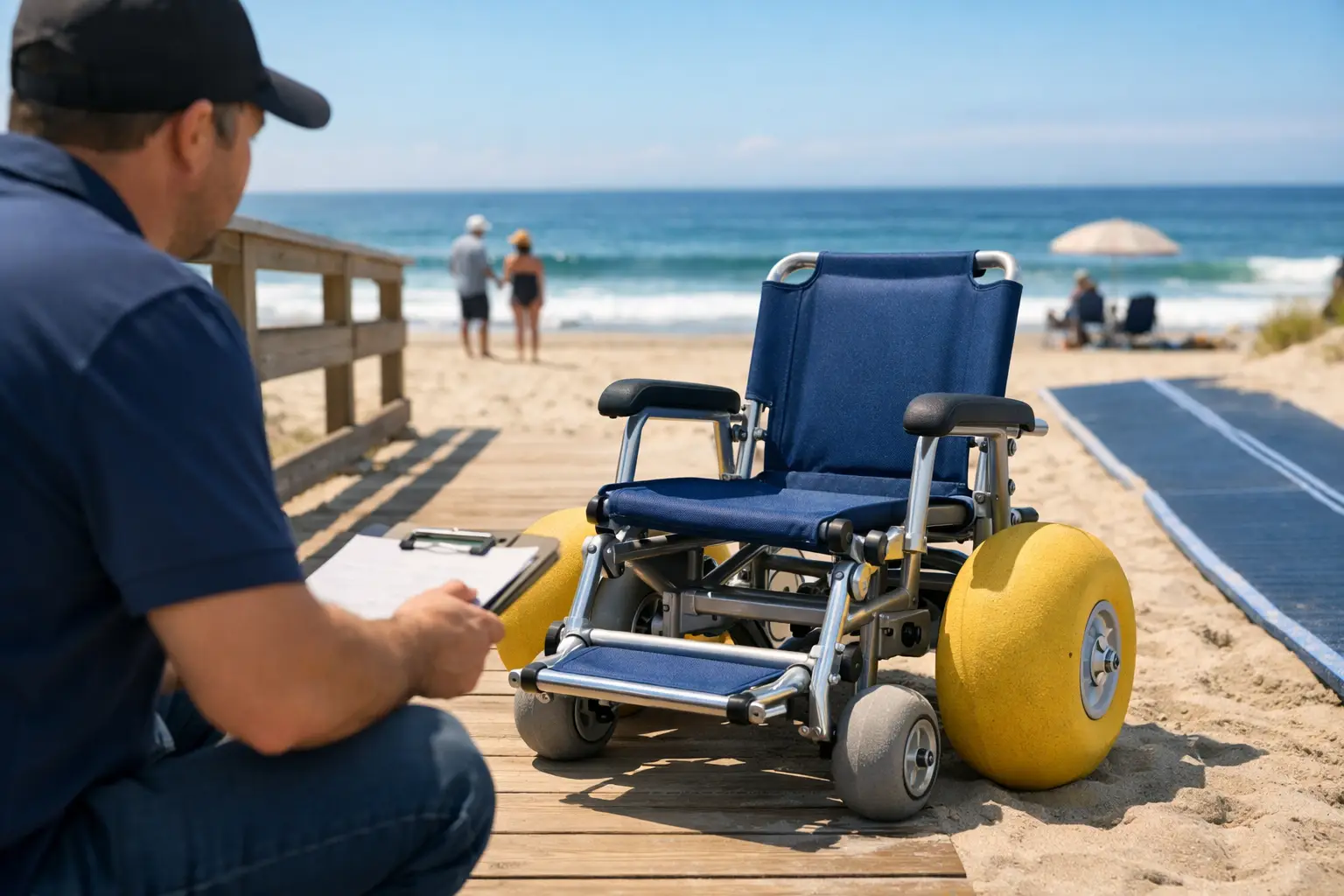
A beach can be described as “accessible” and still be impossible to enjoy in a wheelchair or mobility scooter. A ramp to the promenade is not much help if the only route onwards is loose shingle, a steep drop onto soft sand, or a beach wheelchair that must be booked three weeks ahead. Knowing how to check beach wheelchair access properly means looking past the badge and finding out what the day will actually be like for you.
For many disabled travellers, the aim is not simply to see the sea from a distance. It is to park without a struggle, reach the front safely, use an accessible toilet, sit comfortably and get back again before tiredness, tide or a dead battery turns the trip into a problem. That takes a little research, but it is research worth doing.
Start with the route, not the word “accessible”
The first question is simple: how far can you travel on a hard, level surface from your vehicle or accommodation to the beach itself? Look for a continuous promenade, boardwalk, concrete path or firm matting. A destination may have step-free access to a viewing point but no usable way onto the sand.
Check a map, recent visitor photographs and the local authority’s beach information. Photos are often more revealing than polished accessibility statements. You can see whether a ramp ends on sand, whether there are railings that narrow the route, and whether the promenade is busy or uneven. A satellite view can also show the distance between the car park, toilets and seafront, although it cannot tell you how steep the ground is.
Be wary of vague wording such as “disabled access available” or “suitable for wheelchairs”. It should prompt more questions, not provide the answer. Ask exactly where the accessible route begins and ends, what surface it uses, and whether it is open all year.
How to check beach wheelchair access before booking
The most reliable approach is to contact the people responsible for the beach or nearby facilities. That could be the local council, beach management team, visitor centre, lifeguard service, harbour office or a beach equipment charity. Explain what you use rather than asking a general question about disability access.
For example, say whether you have a manual wheelchair, powered chair or mobility scooter, and give the approximate width, length and weight if relevant. A route wide enough for a standard manual chair may be too narrow for a Class 3 scooter. If you cannot transfer independently, say that too. A beach wheelchair is only useful if there is a safe way to transfer into it and somebody available to assist where needed.
Ask for an honest answer rather than reassurance. A good question is: “Could a person using this type of chair reach the water’s edge independently at low tide?” If the answer is unclear, follow up. Staff may be trying to help, but they may not know the difference between firm wet sand and deep, soft dry sand.
Questions worth asking directly
Before setting off, get clear answers on these practical points:
- Is there designated Blue Badge parking, how many spaces are there, and is it close to the accessible route?
- Are there dropped kerbs, level paths and a boardwalk or beach mat from the car park or promenade towards the sand?
- Is an accessible toilet open on the day you plan to visit, and does it have enough turning space and an appropriate transfer arrangement?
- Is a beach wheelchair available, what type is it, does it need booking, and can it be taken near the water?
- Are there seasonal restrictions, gates, steps, steep slopes, tidal cut-offs or closures after bad weather?
Do not assume that summer information applies in April, October or during a winter break. Boardwalks are sometimes removed outside the main season. Toilets can be locked. Beach wheelchairs may be stored away, and lifeguard staff may not be there to help with equipment.
Check the surface and the gradient
Sand is not one thing. Firm, compact sand near the water can be manageable for some chairs, while dry sand above the high-tide line can stop even a powerful scooter within metres. Shingle is usually harder again. Large pebbles shift under wheels, increase the risk of getting stuck and make transfers awkward.
If you are taking your own powered wheelchair or scooter, check the manufacturer’s advice before going onto sand. Saltwater and sand are not kind to motors, bearings, brakes or electrical connections. Even if the chair has good ground clearance, the route back may be harder after the wheels have sunk in or the tide has changed the surface.
A boardwalk makes a huge difference, but inspect its details. Is it wide enough to turn? Does it have raised edges? Is it level, or does it slope sharply down towards the beach? Temporary roll-out matting can be useful, yet it may buckle, collect sand or stop well short of the firmer area. A quick mobile phone call can establish whether the matting is currently in place and how far it runs.
Gradients matter just as much as surface. A long, gentle slope may be manageable but still drain a manual wheelchair user or scooter battery on the return. If the only accessible toilet sits at the top of a hill, factor that into the day rather than treating it as a minor detail.
Treat beach wheelchairs as equipment you need to verify
Beach wheelchairs usually have large balloon-style wheels designed to float over soft ground. Some are pushed by another person; others can be self-propelled or powered. They can make a beach possible, but they are not all the same and availability is far from guaranteed.
Find out whether the chair has armrests, a supportive seat, a lap belt, head support or a tilt function if these affect your comfort. Ask about weight limits and whether it can be used in shallow water. A chair designed for dry sand may not be suitable for entering the sea, even with support.
Booking is often essential, especially at popular resorts and during school holidays. Confirm the collection point, opening times, hire cost, deposit and whether staff can help transfer or simply hand over the chair. If you need a hoist, changing place or assistance from a companion, plan around that reality. There is no shame in deciding a beach is not suitable if the safe transfer option is missing.
Plan around tide, weather and energy
Tide times can change the whole layout of a beach. At high tide, the accessible route may end close to the water but leave little room to sit. At low tide, the sea may be a long way across uneven sand. On some coasts, incoming water can cut off sections of beach or cover the lower promenade.
Wind matters too. Strong gusts make a manual chair harder to control and can blow dry sand into eyes, controls and bags. Heavy rain may leave a firm path slippery, while a hot day can make exposed promenades uncomfortable and increase battery drain. The most accessible route on paper is no good if the conditions make it unsafe for you.
Give yourself more time than you think you need. Arrive before the busiest part of the day, particularly if accessible parking is limited. Keep your mobile phone charged, take water and any essential medication, and agree a simple plan with your companion in case you get stuck or need to return quickly. For powered equipment, begin with a fuller battery than you would need for an ordinary pavement trip.
Use recent disabled traveller evidence where you can
Official information is useful, but a recent report from another wheelchair or scooter user can fill in the gaps. Look for dates, photographs and details about the exact access route rather than a simple star rating. A report saying “great beach for wheelchairs” is encouraging; a report saying “the boardwalk is 1.5 metres wide, starts beside the west car park and ends 20 metres from firm sand” is planning information.
The best evidence combines both. Use the council or operator to confirm current facilities, then compare that with recent real-world experience. If the two do not match, trust neither blindly. Call again, describe what you have seen and ask what has changed.
At Andy Wright Travel, the principle is always the same: practical details beat broad claims. A beach does not need to be perfect to be worth visiting, but you deserve to know its limits before you make the journey.
Have a sensible fallback plan
Even careful research cannot control a broken beach lift, a full car park, a closed toilet or a sudden weather change. Build in an alternative such as an accessible seafront café, level pier, harbour walk or nearby promenade where you can still enjoy the coast without forcing your equipment over unsuitable ground.
That is not settling for less. It is travelling with control. When you know the route, the surface, the facilities and the conditions, the beach becomes far more than a hopeful stop on an itinerary. It becomes a place where you can spend your time looking at the sea rather than wondering how you will get back to the car.
0 Comments
Leave a Comment