
Hotel Wetroom Versus Roll-In Shower: Which Works?
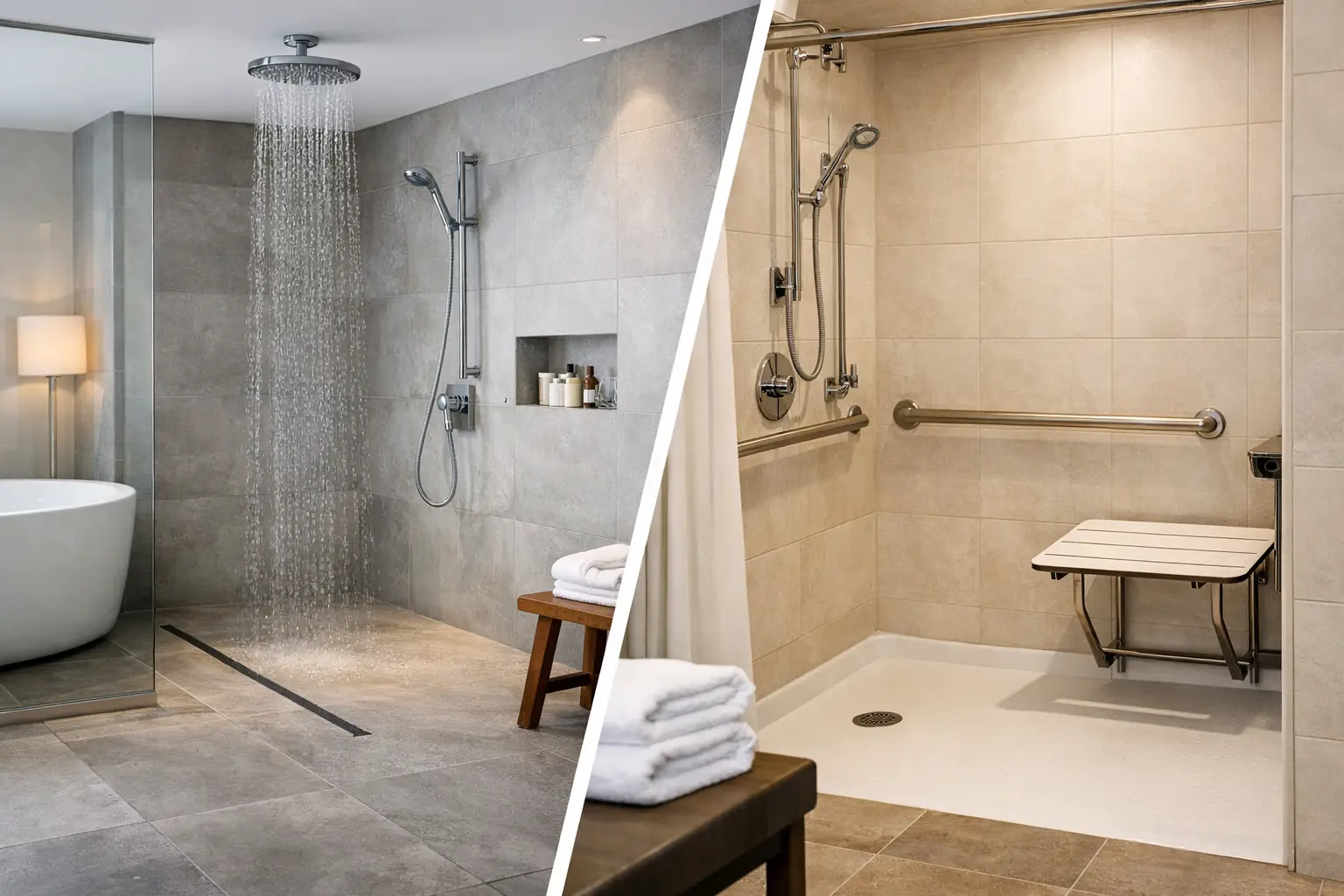
A bathroom can make or break a hotel stay. That is why hotel wetroom versus roll-in shower is not a question of preferred décor or whether you like a glass screen. For a wheelchair user, someone with limited balance, or a traveller who needs space for a carer, the layout decides whether you can wash independently, safely and with dignity.
The problem is that hotels use both terms loosely. A room labelled “accessible wetroom” may have a high shower tray, a fixed screen blocking the transfer area, or barely enough room to turn a wheelchair. A “roll-in shower” may be excellent, but it can also mean only that there is no step into the shower enclosure. Never treat either phrase as a guarantee.
Hotel wetroom versus roll-in shower: the practical difference
A true hotel wetroom is a fully waterproof bathroom with a level, gently sloping floor. The shower is open to the room, or separated only by a curtain. Water drains through a floor drain, and there should be no tray, lip or raised edge to cross.
For many wheelchair users, this is the most flexible arrangement. You can usually bring a shower wheelchair close to the shower controls, position a portable shower chair where it works for you, and have more room for assistance if needed. It can also suit people using crutches or walking frames, as there is no awkward step over a tray.
A roll-in shower is normally a dedicated shower space with level access. It may be open, partly screened, or set behind a curtain. The key point is that a wheelchair can roll into it without crossing a raised threshold. Unlike a wetroom, the rest of the bathroom floor may stay dry because the shower area has its own drainage and may be slightly recessed.
Neither design automatically wins. A well-planned roll-in shower can be better than a poorly designed wetroom. If the roll-in area is large, has a fold-down seat, sensible grab rails and easy-to-reach controls, it may offer a very straightforward shower. Equally, a spacious wetroom with good drainage can give you the freedom to set things up around your own needs.
Why the label is not enough
Hotels often work from a tick-box description provided when the room was built. Years later, a new shower screen, vanity unit or towel rail can quietly remove the space that made the room usable. Photographs can be misleading too. A wide-angle image makes a compact bathroom look generous, while the only useful angle - the route from the door to the toilet and shower - is rarely shown.
The biggest difference is often not wetroom versus roll-in shower at all. It is whether the room works for your body, your chair and the way you transfer.
Someone who transfers independently sideways onto a fixed shower seat needs clear space beside it. A person who uses a shower wheelchair may need a completely open floor and no fixed seat in the way. If you travel with a partner or carer, you may need enough room for two people to move safely without one of you standing in pooled water.
For mobility scooter users, remember that most scooters are not suitable for the wet bathroom environment. You may need to park outside the bathroom and use a wheelchair, walking aid or the hotel’s shower chair. This makes the bathroom door width, turning room just outside the door and the distance from bed to bathroom just as relevant as the shower itself.
What a usable wetroom looks like
A good wetroom has a genuinely level route from the bedroom into the bathroom and across to the shower. The floor should drain properly, with a slope that does not leave water spreading across the toilet area. A little water outside the shower is normal. An entire bathroom floor remaining wet for hours is not.
Look for a handheld shower head on a rail, with controls you can reach from a seated position. The controls should be on the open side of the shower, not hidden behind you or positioned so high that you need to stand to operate them. A thermostatic control is also a real safety feature, particularly where dexterity is limited or assistance is required.
A fold-down shower seat can be useful, but check its location. It needs enough clear space beside it for the transfer you use, and it must not be so close to the wall that your wheelchair cannot line up. Some travellers prefer to bring their own shower chair because hotel seats vary greatly in height, depth and stability.
Grab rails need to be where they help, not simply where they look compliant. A rail beside the shower seat and a sensible support rail near the toilet matter more than a random rail fixed to the furthest wall. If you need a particular configuration, ask rather than hoping it will be similar to the last hotel you used.
When a roll-in shower may be the better choice
A roll-in shower can be preferable when you want to contain water. This matters if you are travelling alone and need the toilet area to remain dry, or if a carer needs firm footing. A shower curtain or partial screen can also give a little privacy without becoming a barrier.
The best roll-in showers have enough depth for a shower wheelchair to enter, turn or reverse comfortably, with the drain positioned so water does not collect under the chair. The entrance should be truly flush. A narrow metal strip or a small lip might seem minor in a hotel description, but it can stop small front castors or create a trip risk.
Be cautious with glass screens. A fixed panel can reduce splash, but it can also block the approach to the shower seat and restrict assistance. Doors are often worse. Even if they open outward, they may leave too little room to manoeuvre around them. An open entry with a curtain is often more practical than a stylish enclosure.
The questions to ask before booking
Do not settle for “yes, it has an accessible bathroom”. Call or email the hotel and ask for details of the specific room being offered. Accessible rooms are rarely identical, even within the same property.
Ask whether the bathroom is a full wetroom or a separate roll-in shower area, and whether there is any lip at the entrance. Confirm the clear width of the bathroom door, not just the overall door size. Ask whether the shower has a fixed or movable seat, what type of shower controls it has, and whether there is a curtain, screen or door.
You also need to know whether there is clear transfer space around the toilet and shower. If you use a shower wheelchair, ask for the internal shower dimensions and whether it is possible to enter and turn. If you require hoisting, a lowered basin, a right- or left-hand transfer, or a profiling bed, say so clearly. “Wheelchair accessible” is far too broad to cover these needs.
Request current photographs taken straight on, including the bathroom doorway, toilet, shower seat, controls and floor. A short video walkthrough is even better. It reveals thresholds, tight turns and fixed fittings that still photos can hide. If staff cannot provide this information, that does not always mean the hotel is unsuitable, but it does mean you are booking with less certainty.
Finally, make sure the accessible room is actually reserved in your name. Some booking systems let anyone select it, while others treat it as a preference rather than a confirmed room type. Get the room features noted on the booking and reconfirm before travel, especially during busy periods.
Small details that change the stay
A shower that looks accessible can still be frustrating because of everyday details. Is there a shelf low enough for toiletries? Can you reach the towels from a seated position? Does the bathroom door stay open when you need it to, or swing back into your chair? Is the mirror usable, and is there a socket positioned safely for charging equipment outside the wet area?
Think about drainage and cleaning too. A musty smell, stained grout or water that does not clear quickly can indicate a wetroom that is not being maintained properly. Report it early. You should not have to spend a holiday asking for extra towels to mop up a flooding bathroom.
A hotel may have a wetroom that is ideal for one guest and completely wrong for another. The most useful accessibility information is specific: measurements, layout, photographs and honest answers. That is the standard worth asking for.
When choosing between a wetroom and a roll-in shower, book the one that supports how you actually wash, transfer and travel - not the one with the most reassuring label.
0 Comments
Leave a Comment