
Hotel Accessibility Guarantees: What They Mean
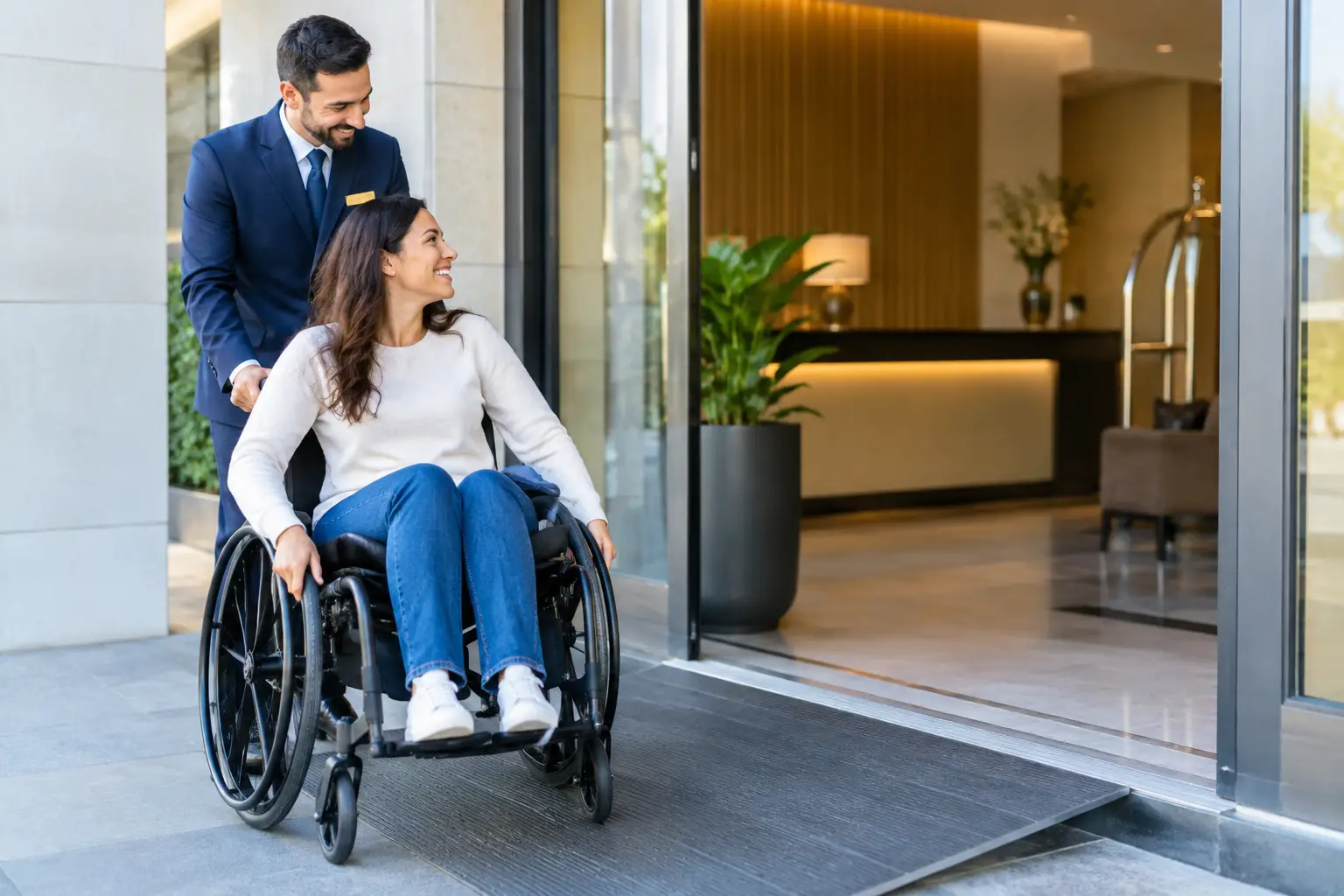
A hotel can call a room “accessible” and still leave a wheelchair user unable to get into the bathroom, reach the bed, or charge a mobility scooter safely. That is why hotel accessibility guarantees matter - but only when the guarantee is clear, written down and tied to the features you actually need.
For disabled travellers, a booking is not just a bed for the night. It is whether you can enter independently after a long journey, use the loo with dignity, shower safely, get to breakfast, and leave your scooter somewhere secure. A vague promise from a reservations team is not enough when your holiday depends on it.
What hotel accessibility guarantees usually mean
There is no single, universal hotel accessibility guarantee. One hotel may mean it guarantees an adapted room type if you select it during booking. Another may mean it will try to meet your access request. Those are very different commitments.
The strongest guarantee is specific: the hotel confirms a particular room, on particular dates, with stated features. For example, a ground-floor room or one reached by a lift that fits your chair, a step-free bathroom, a roll-in shower, grab rails, adequate turning space and a bed at a usable height. Ideally, the confirmation also records any essential equipment or arrangements, such as a shower chair, fridge for medication, adjacent accessible parking or permission to store and charge a scooter.
Be careful with phrases such as “subject to availability”, “request noted” or “accessible room preferred”. They are not guarantees. They tell you the hotel has received the request, not that it has assigned the room.
A guarantee also has limits. Hotels can have genuine problems: a room may suffer damage, a lift may break down, or a booking system may wrongly show a room as available. What matters is what happens next. A decent hotel should contact you before arrival, offer a genuinely suitable alternative, and discuss practical solutions rather than expecting you to make do with a standard room.
Why an accessible room label is not enough
Accessible rooms vary wildly, even within the same chain. A room may have grab rails but a bath instead of a level-access shower. It may have a wide door but no turning circle beside the bed. It may be technically adapted while being at the far end of a corridor, reached by a heavy fire door or an unreliable platform lift.
For mobility scooter users, the biggest omissions are often outside the room. Can the scooter get from the car park or taxi drop-off to reception without steps? Is there a dropped kerb? Are the corridors wide enough? Is there a lift with enough depth and weight capacity? Where can it be charged without blocking an escape route or being left outside in the rain?
This is where generic booking filters are weak. They often show a wheelchair symbol without explaining what it represents. It could mean step-free access to reception, not an accessible bedroom. It could mean a lift, not a bathroom you can use. Treat the filter as a starting point, never as proof.
How to get a meaningful guarantee before you pay
Book direct with the hotel where possible, even if you have first found it on a comparison site. Third-party platforms can be useful for prices and availability, but access details do not always pass accurately between their systems and the hotel’s own room inventory.
Before paying, contact the hotel by email or through its written messaging system. A phone call can help you judge whether the team understands the question, but follow it up in writing. You need a record of what was promised and who promised it.
Do not ask, “Is the hotel wheelchair accessible?” The answer will almost always be “yes”, and it may tell you nothing useful. Explain how you travel and ask questions that match your non-negotiables. Say whether you use a manual wheelchair, powered wheelchair or mobility scooter, and include its width, length and weight if lifts or storage are a concern.
Ask whether the exact room being held has a roll-in or level-access shower, not merely an “adapted bathroom”. Ask for the clear width of the entrance and bathroom doors, whether there is step-free access from arrival to the room, and whether the bed can be approached from both sides. If you need a shower chair, ask whether one is provided, what style it is, and whether it is fixed or movable.
Photos are worth requesting, particularly of the bathroom, shower threshold, toilet area, entrance and route from reception. Hotel photos can be flattering, so look for measurements and practical angles rather than glossy images. A photograph showing the whole bathroom tells you more than a close-up of a grab rail.
If a scooter is involved, be direct about charging. Some hotels will allow it in the room; others have a designated space. Either can work if it is secure, accessible at the times you need it and has a suitable socket. Never assume you can charge in a corridor, stairwell or public area. Hotels may refuse that for fire safety reasons, and you do not want to discover it after arriving with a low battery.
Once the hotel replies, ask it to add the agreed details to your reservation and send confirmation. Keep that email, plus any room photos, with your travel documents. This is not about being difficult. It gives the duty manager something concrete to work from if the information has not reached the reception team.
Questions worth putting in writing
Your questions will depend on your needs, but these are the details most likely to prevent a nasty surprise:
- Is the specific accessible room guaranteed for my dates, rather than simply requested?
- Is the route from drop-off or accessible parking to the room completely step-free?
- Does the bathroom have a level-access shower, and is there a lip at the entrance?
- What are the door widths, lift dimensions and weight limit?
- Where can a mobility scooter be stored and charged safely overnight?
- Are the restaurant, bar, breakfast area and accessible toilet reachable without steps?
The final question matters more than hotels often realise. A room you can use is only half the job if you cannot reach breakfast, the terrace, the pool, or the accessible toilet in public areas.
If the hotel cannot guarantee the right room
A hotel that says it cannot guarantee an accessible room may still be honest, rather than unhelpful. This sometimes happens where rooms are allocated on arrival, where a small independent hotel has only one adapted room, or where an online system cannot lock a particular room category.
You then have a choice. If the trip is flexible and the hotel has a strong record of helpful communication, you may decide the risk is acceptable. For a one-night stay close to home, that could be manageable. For an overseas holiday, a late arrival, or a trip where you cannot transfer safely without the right bathroom, it is usually better to keep looking.
Do not be persuaded by “we will do our best” when the feature is essential. Staff may genuinely mean it, but goodwill does not create a roll-in shower or make a narrow lift bigger. Independence is worth protecting at the booking stage.
What to do if the promise is not met on arrival
First, stay calm but be clear. Ask to speak to the duty manager and show the written confirmation. Explain the practical problem: “I cannot get my wheelchair through this bathroom door” is stronger and more useful than “This room is not accessible.” Ask what suitable room or immediate alternative they can provide.
Take photographs and make notes of the time, names and what was said. If the hotel offers another property, ask how you will get there, whether it has been checked for your specific needs, and who is covering any extra cost. Do not accept a move to a room that is merely less bad if it still leaves you unable to wash, use the toilet or access the hotel safely.
In the UK, service providers have duties under the Equality Act 2010 to make reasonable adjustments for disabled people. That does not mean every building can be made fully accessible overnight, particularly older properties, but it does mean a hotel should not dismiss the issue or rely on misleading information. If you believe a hotel has failed to provide what was booked, keep every email, receipt and photograph before raising a formal complaint.
For trips abroad, consumer protections and accessibility rules differ. Your strongest position is still a clear written record from the hotel or package organiser. If you are booking a package holiday, send the same access requirements to the organiser as well as the hotel and ask who is responsible for confirming them.
Build certainty into the rest of the stay
The best accessible hotel room cannot fix a destination with no accessible transport, steep pavements or an airport transfer that cannot take your scooter. Check the full journey: parking or transfer, hotel entrance, bedroom, meals, local transport and the places you actually want to visit.
That may sound like extra work, but it is the work that buys you freedom once you arrive. A proper guarantee is not a tick beside a wheelchair symbol. It is a hotel understanding what you need, confirming it clearly, and treating your independence as part of the booking rather than an afterthought.
When a hotel answers detailed questions properly, saves the right room and gives you a named contact, that is a very good sign. You should be able to spend your holiday deciding where to go next, not whether you can get back into your own room.
0 Comments
Leave a Comment