
A Practical Guide to Accessible Beach Wheelchairs
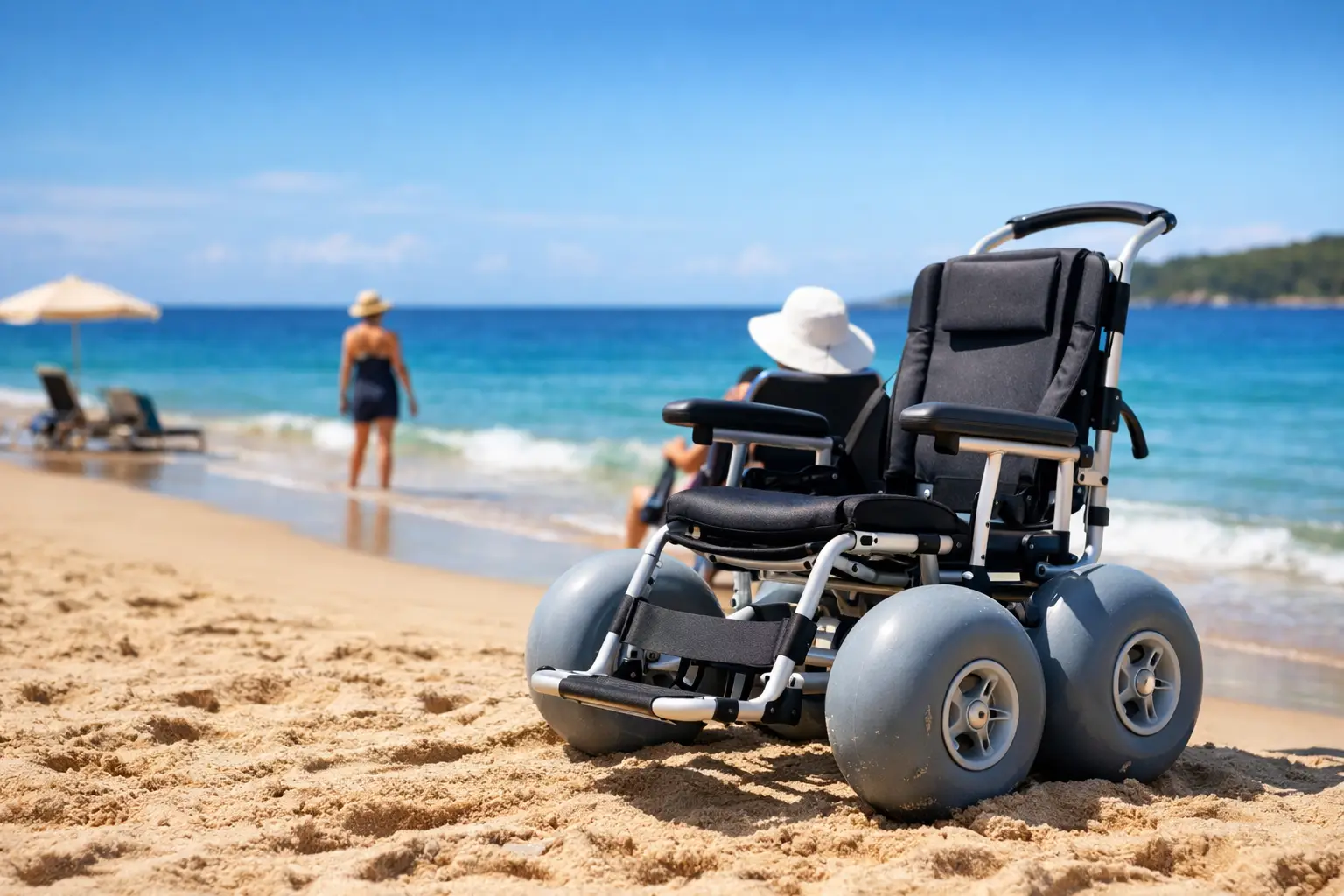
A beach can look completely accessible from the promenade, then become impossible the moment your front castors hit soft sand. That is why a proper guide to accessible beach wheelchairs needs to cover more than whether a beach says it has disabled access. The practical questions are: can you get to the chair, transfer safely, reach the waterline if you want to, and get back again without relying on luck?
Beach wheelchairs can make a huge difference, but they are not all the same and neither are the beaches that provide them. A little planning gives you far more freedom than turning up and hoping a blue badge space means the whole place is usable.
What is an accessible beach wheelchair?
An accessible beach wheelchair is designed to travel over sand, shingle and other loose surfaces that would stop a standard wheelchair or mobility scooter. Most use wide balloon-style wheels, which spread weight across the sand rather than digging in. They are usually manually pushed, although some destinations have powered all-terrain chairs or tracked mobility equipment.
The most common chairs have a supportive seat, armrests and large wheels. Some are built for a self-propelling user, but many are attendant-propelled. This matters. A chair may give you access to the beach, yet still require a family member, carer or beach staff member to push it throughout the visit.
There are also floating beach wheelchairs designed for shallow water. These can be brilliant for someone who wants to get beyond the dry sand, but they are not a substitute for a safe transfer plan or supervision. Sea conditions, tide and the user’s confidence in water all matter.
Do not assume your own powered wheelchair or mobility scooter will cope just because the sand looks firm. Salt, sand and seawater are hard on electronics, bearings and moving parts. Even a capable outdoor chair can get stuck quickly on soft sand, and recovery can be difficult when the tide is moving in.
Choosing the right chair for your needs
The best option depends on how you transfer, the support you need and what you want from the day. If you can transfer independently and have someone able to push, a standard beach wheelchair may be enough. If you need head support, pressure relief, a harness or a tilt-in-space position, the usual hire chair may not be suitable.
Ask for photographs and dimensions before setting off. In particular, check the seat width, seat height, back support, armrest arrangement, footrest type and maximum user weight. A chair that is technically available but unsafe or painful for you is not accessible in any meaningful sense.
If you use a hoist for transfers, ask whether one is available at the beach facility. This is still unusual, so be prepared for the answer to be no. Some people can use a transfer board; others need to remain in their own chair until a specific transfer method is in place. Be honest about this before booking rather than trying to manage a risky transfer on an uneven surface.
For children and smaller adults, check whether the chair has adjustable supports. A large adult beach chair can offer poor positioning for a smaller user, even if the headline weight limit is fine.
The beach itself matters as much as the wheelchair
A beach wheelchair cannot solve every access problem. The route from the car park to the sand is often where a trip succeeds or fails. Look beyond the word “accessible” and ask what it actually means on that site.
Start with parking. Is there designated accessible parking close to the entrance, and is the surface level and firm? A car park can be near the beach on a map but still involve a steep path, loose gravel or a long stretch of uneven promenade.
Then check the route to the chair collection point. Some beach wheelchairs are kept at a lifeguard station, visitor centre or café rather than on the sand. Find out whether that building has step-free access, accessible toilets and enough room to transfer or wait out of the weather.
Beach access matting is a major advantage. These firm temporary pathways can take a wheelchair from the promenade over sand towards the shoreline. But do not assume the mat reaches the sea, remains in place all year, or is usable after storms. On some beaches it only runs during the main season, while others remove it at high tide or when weather conditions are poor.
Shingle is a separate challenge. Wide-wheel beach chairs may manage compacted shingle with assistance, but deep or loose stones can be punishing even for strong pushers. If a beach is described as “sand and shingle”, ask which surface lies between the access point and the water.
Booking an accessible beach wheelchair
Where a beach wheelchair is available, book it whenever possible. Popular seaside towns may have only one or two chairs, and good weather brings demand quickly. Some are free to use but require a refundable deposit or proof of identification. Others are operated by a charity, local council, leisure centre or private beach operator and have set opening hours.
When you contact the provider, get clear answers on the practical points:
- whether advance booking is essential and how long you can use the chair
- where you collect and return it, including the exact route from accessible parking
- whether an attendant is supplied or you must bring someone to push
- the chair’s dimensions, weight limit and support features
- whether beach matting, accessible toilets and changing facilities are open on your visit date
Also ask what happens if conditions change. High winds, heavy rain and unusually high tides can make a beach unsafe or simply unusable. A sensible provider will cancel access when necessary. It is frustrating, but it is better than being stranded on an exposed beach in a chair that cannot be moved safely.
Plan for the tide, not just the forecast
The weather forecast is only half the story. Tide times can dramatically alter the distance to the water, the firmness of the sand and the usable width of the beach. At low tide, you may find miles of hard-packed sand - or a very long push to reach it. At high tide, the accessible route may be narrow or disappear altogether.
For a first visit, aim for a period when the tide is not rapidly coming in. Give yourselves time to collect the chair, transfer without rushing and find a comfortable spot above the waterline. If you are using a floating chair, speak to staff about the safest entry point and never rely on a route that will be cut off by the tide.
Wind deserves respect too. Sand blowing into eyes, controls, cushions and bags can quickly spoil a day. Bring a cover for your own chair or scooter, a towel for drying hands and equipment, and something to secure loose items. A beach wheelchair often has limited storage, so keep essentials simple and within reach.
Taking your own wheelchair or scooter to the coast
Many people want to stay in their own chair as long as possible. That makes complete sense, especially where seating, posture or controls are highly individual. A promenade, pier or compacted coastal path may be ideal for your usual wheelchair or scooter even if the beach is not.
The sensible approach is to separate the two experiences. Use your own equipment for the journey, facilities and promenade, then transfer to a hired beach chair only for the sand. This reduces the risk of damage and means your familiar chair is waiting on firm ground for the return journey.
If you take a mobility scooter near sand, avoid parking it where the tide, blowing sand or soft ground can cause trouble. Keep keys, chargers and removable controls protected. Saltwater exposure should be dealt with promptly according to the manufacturer’s guidance, particularly around metal components and electrical connections.
Make the day easier for everyone
Accessible beach trips work best when the whole party understands the plan. Decide who is pushing, who is carrying bags, where the nearest accessible toilet is and what the fallback option is if the beach access does not work out. The fallback might be a level seafront café, harbour walk or viewpoint - not as a consolation prize, but as part of a good day out.
Do not be embarrassed to ask staff direct questions. “Can this chair be pushed across the sand today?” is more useful than “Is the beach accessible?” The people managing the chairs often know exactly where the soft patches are, whether the matting has shifted and when the tide starts affecting the route.
For independent travellers, the key is not pretending you can do every part alone. It is knowing precisely where assistance is needed, arranging it properly and keeping control of the day. That is the difference between access being a vague promise and access that genuinely lets you enjoy the coast.
A well-planned beach visit should leave you thinking about the sea air, the view and the fish and chips afterwards - not the effort it took to reach the sand.
0 Comments
Leave a Comment