
The Future of Accessible Tourism Must Be Practical
A hotel can call itself accessible because it has a ramp at reception, yet still put the only step-free room behind a heavy fire door, provide a bathroom with no turning space, or rely on a lift that will not take a mobility scooter. That gap between the promise and the reality is exactly where the future of accessible tourism will be decided.
For wheelchair users, mobility scooter users and the people travelling with them, the biggest change needed is not a clever slogan or a special menu. It is reliable information, facilities that work in practice, and staff who understand that access is part of the journey rather than an optional extra.
Accessible tourism needs to move beyond the tick box
The travel industry has become much better at using the word “accessible”. Unfortunately, the word is still often doing too much work. A property may have an accessible room, but that tells a traveller almost nothing useful. Is the entrance step-free from the car park? Is there a dropped kerb outside? Can a scooter fit in the lift? Is the bed high enough for a transfer? Is the roll-in shower actually level, or is there a lip at the door?
These are not fussy questions. They decide whether a holiday feels freeing or becomes a daily battle.
The future should be less about broad labels and more about clear, standardised detail. Hotels, cruise lines, attractions and transport operators need to describe access in the same practical way people plan their trips. Measurements matter. Photos matter. So do honest notes about gradients, cobbles, narrow doors, beach terrain and the distance between a room and the dining area.
A traveller should not need to phone three times, explain their needs from scratch and hope the person answering has seen the room in question. Good information allows people to make their own decision. That is independence.
First-hand detail will matter more than glossy claims
There is a reason disabled travellers increasingly look for reviews from other wheelchair and scooter users. A polished accessibility statement cannot show how rough a promenade feels after rain, whether a supposedly flat route has a steep camber, or whether an adapted taxi has enough space for a larger powered chair.
The most useful travel content will increasingly be specific and experience-led. Video walkthroughs of hotel rooms, station platforms, attraction entrances and accessible toilets can answer questions that a booking page ignores. A short clip showing a scooter entering a lift can be worth more than a paragraph claiming “full access”.
This does not mean every destination has to be perfect before it can welcome disabled visitors. Very few places are. Historic towns have cobbles, older buildings have limitations, and remote destinations may have fewer adapted vehicles. What matters is honesty before booking. If a route is difficult, say so. If a beach wheelchair must be reserved, explain how. If an accessible room is a long way from facilities, make that clear.
False reassurance is worse than a limitation stated plainly. Travellers can plan around a challenge when they know it exists.
Better booking systems, not more forms
Technology can help, but only when it removes work rather than creating another obstacle. Booking systems should let travellers search for features that genuinely affect them: step-free routes, wet rooms, ceiling hoists, accessible parking, bed height, charging space for mobility equipment and room for a carer.
At present, many sites treat accessibility requests as an afterthought. You book a room, then send a message, then wait to learn whether the feature you need is available. That is backwards. Access requirements should be visible at the point of booking, confirmed clearly, and passed properly to the hotel or operator.
There is also a trade-off. Automated tools and virtual tours can provide useful information, but they cannot replace someone checking that a lift is working or that an accessible room has not been used as storage. Technology is only as good as the information put into it.
Transport is where independence is won or lost
You can have an excellent accessible hotel, but the trip falls apart if you cannot get from the airport, station or port to the front door. The future of accessible tourism depends heavily on joined-up transport.
For UK breaks, that means more reliable step-free rail journeys, straightforward help at stations and clear information when lifts are out of service. It also means accessible taxis that can be booked without a long wait or an argument over whether a scooter will fit.
For international travel, the pressure points are usually airports, transfers and equipment handling. Airlines need to treat wheelchairs and scooters as essential mobility equipment, not awkward luggage. Damage can take away someone’s independence the moment they arrive. Better loading procedures, trained teams and a clear process when something goes wrong are basic expectations, not luxury extras.
Destination transfers deserve more attention too. A resort may advertise adapted rooms while offering only standard minibuses from the airport. Travellers then face an expensive private transfer, a long delay, or a vehicle that is unsuitable for their chair. Accessible transport must be planned as part of the holiday package from the beginning.
Destinations should design for ordinary days
A truly welcoming destination is not defined by one accessible attraction. It works when an ordinary day is manageable: leaving the hotel, crossing the road, finding an accessible loo, stopping for lunch, getting to the waterfront and returning after dark.
This is where councils, visitor organisations and local businesses have a real role. Pavements need sensible dropped kerbs and usable widths. Outdoor dining should not block the only level route. Accessible toilets must be open, clean and easy to locate. Charging points for powered wheelchairs and scooters will become increasingly useful, particularly in large towns, attractions and transport hubs.
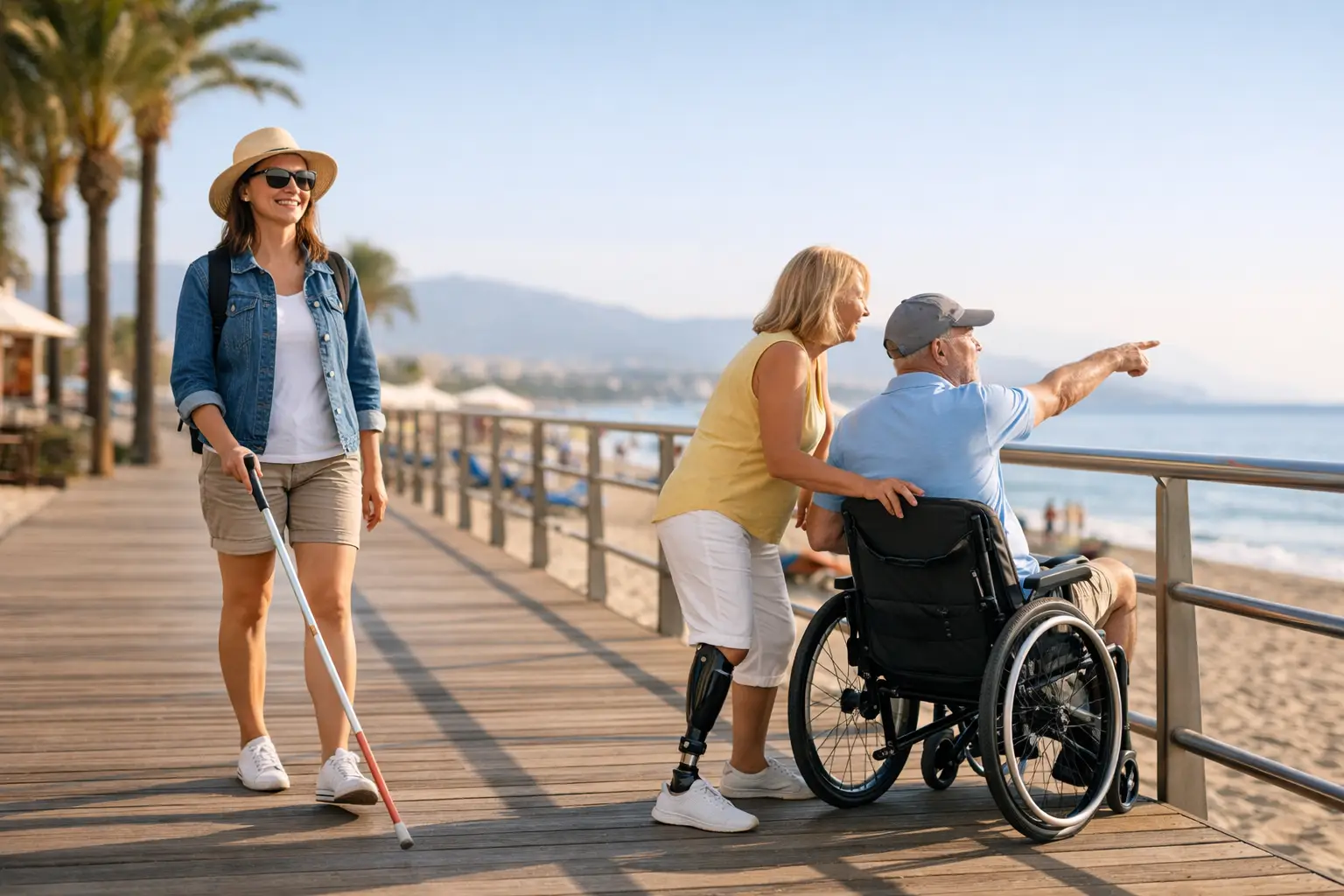
Beach holidays are a good example. A resort can promote beautiful sand and sunshine, but access depends on whether there is a firm pathway, beach wheelchair hire, a suitable changing place and an accessible toilet nearby. The same applies to countryside breaks. A “nature trail” is not accessible simply because it starts on level ground. Surface, gradient, gates, passing places and parking all count.
The best destinations will understand that disabled visitors are not a small, separate market. They travel with partners, friends, children and carers. When access improves, it often helps older visitors, parents with pushchairs and anyone carrying luggage as well.
Staff confidence is as valuable as a ramp
Physical changes matter, but people can make or break an experience. Staff do not need to know every answer instantly. They do need to listen, avoid assumptions and know where to get accurate help.
Too many travellers are still spoken to through their companion, told they “cannot” enter without anyone checking, or offered assistance that removes their choice. Good service starts with a simple principle: ask what help is wanted, rather than deciding for someone.
Training should include real situations, not just a short online module. Can staff explain the step-free route? Do they know how to store a mobility scooter safely? Can they respond calmly if an accessible toilet is locked or a lift fails? These everyday details build trust.
What travellers can expect next
Progress will not arrive evenly. Some major brands will improve quickly because they have the money and systems to do so. Smaller independent hotels and attractions may take longer, especially in older buildings. But small businesses can still make a major difference by being honest, taking accurate photographs and responding properly to practical questions.
The strongest push for change will come from disabled travellers continuing to share what works and what does not. Every detailed review, video and direct conversation raises the standard. It tells the industry that a ramp alone is not enough, and that independence should not depend on luck.
When planning your next break, keep asking the useful questions before you book. Request measurements, ask for current photographs, check the full route from arrival point to room, and do not be afraid to walk away from vague answers. The right holiday is not the one that merely says it welcomes everyone. It is the one that gives you enough information to travel with confidence and enjoy the journey on your own terms.
0 Comments
Leave a Comment