
Do Hotels Provide Shower Chairs?
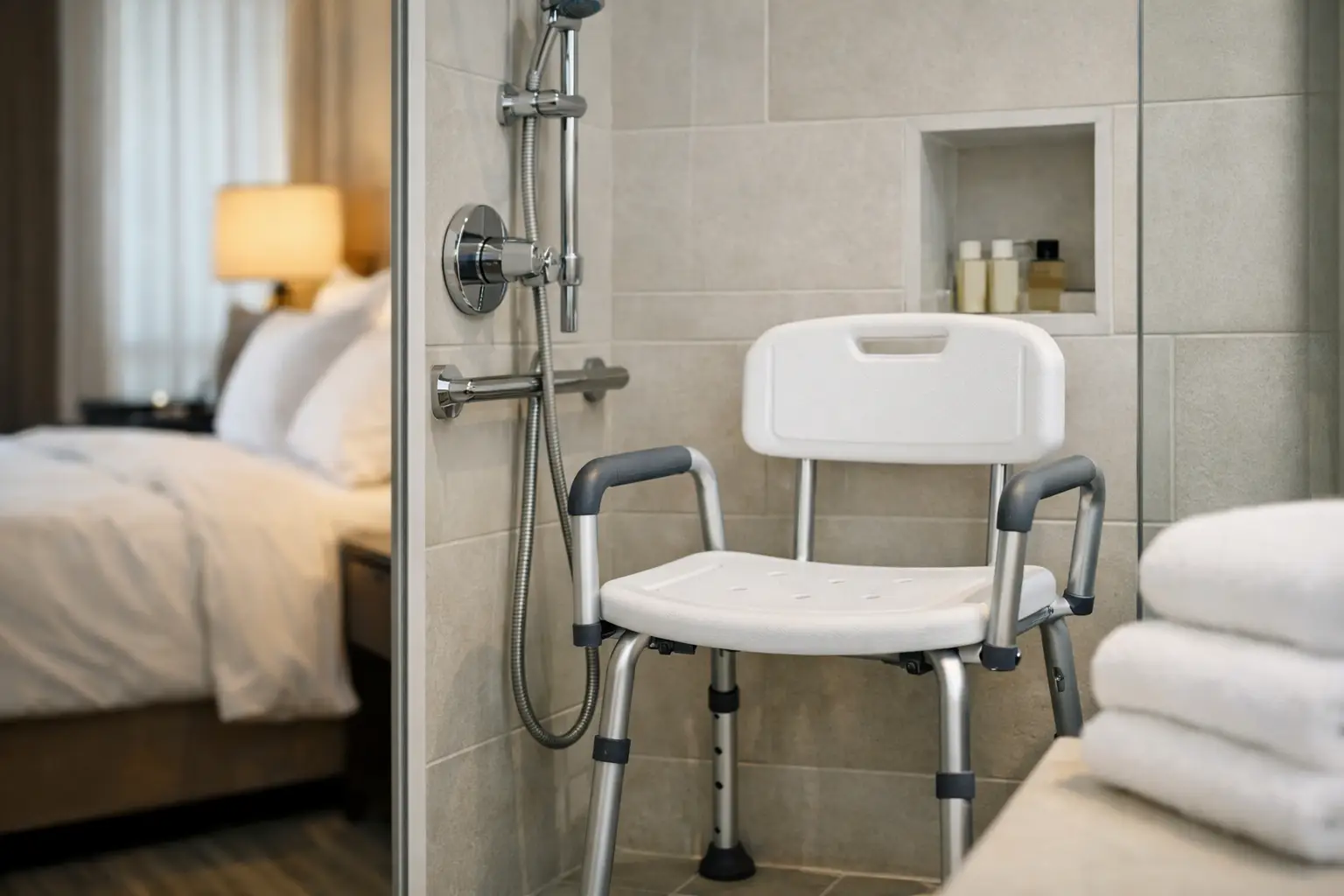
You do not want to find out whether a hotel has a shower chair after a long journey, when you are tired, sore and standing in a bathroom that clearly was not designed with real access in mind. That is why the question do hotels provide shower chairs matters so much. It is not a small extra. For many disabled travellers, it is the difference between a workable stay and a hotel room that is effectively unusable.
The short answer is yes, some hotels do provide shower chairs. The honest answer is that it depends on the hotel, the room type, the country, and how well the property understands accessibility in practice rather than on paper. Some hotels keep proper shower chairs ready for accessible rooms. Others offer a basic plastic seat only if you ask in advance. Some say they are accessible but only provide a grab rail and expect that to cover everything.
Do hotels provide shower chairs in accessible rooms?
Sometimes they do, but do not assume it will automatically be in the bathroom when you arrive. Even in an accessible room, a shower chair may be stored elsewhere and brought in on request. That means if you book online and simply tick an accessible room, you could still turn up and find the chair missing, unsuitable or unavailable because nobody noted your requirement.
This is where hotel accessibility information often falls apart. A listing might mention a roll-in shower, step-free entrance and wider doors, which all sound promising. But there is a big gap between a room being technically accessible and it being usable for your needs. A wheelchair user who can transfer independently may need a very different setup from someone who needs more support, a larger seating surface, armrests or a particular transfer side.
A decent hotel will understand that. A poor one will just repeat that the bathroom is adapted.
Why the answer is often frustratingly vague
Hotels are not consistent. Large chains tend to have clearer policies, but even then standards vary from one property to another. One branch may have fixed fold-down seats attached to the wall. Another may use portable shower chairs. Another may have neither and class the room as accessible because of a low-level bath or handrails.
Independent hotels can be excellent, especially if the team knows the property well and gives straight answers. They can also be the hardest to pin down if the person answering the phone has never looked closely at the bathroom setup. If you get told, "It should be fine," that is not a proper answer.
The issue is not just whether a chair exists. It is whether it is safe, stable, the right height, fits inside the showering space, and leaves enough room for turning and transfers. Those details matter far more than a simple yes or no.
What to ask before you book
If you need a shower chair, contact the hotel directly before paying. Not after. Before. Booking first and sorting details later is risky, especially in busy periods when accessible equipment may be limited.
Ask whether the room has a roll-in shower or a shower over a bath. Then ask exactly what kind of shower chair is provided. Is it a freestanding plastic chair, a shower stool, or a fixed fold-down seat? Does it have a backrest? Does it have arms? What is the maximum user weight? Can they confirm the seat height?
It is also worth asking whether there is space beside the chair for a side transfer from a wheelchair. A hotel may say the bathroom is large, but that does not always mean the layout works. Sometimes the toilet, sink or shower screen gets in the way.
If you use a mobility scooter, mention that too. A hotel may be fine for a manual wheelchair but awkward for a larger powered chair or scooter, particularly in the bathroom approach or bedroom turning circle.
The photos you should ask for
If the hotel website does not show the accessible bathroom properly, ask for photos. Not brochure shots. Ask for clear pictures of the actual shower area, the chair or seat, the toilet, the sink, and the bathroom entrance.
This saves a lot of guesswork. A fold-down seat might look fine until you realise it is mounted in a corner with no transfer space. A portable chair might be usable, but only if the shower lip is low enough to get it in place. If there is a glass screen instead of an open wet room layout, that can make access much harder.
Photos also help you judge whether the chair looks sturdy or like a lightweight afterthought. There is a world of difference between equipment chosen with disabled guests in mind and something bought to tick a box.
When hotels say they can "arrange one"
That phrase can mean several different things. In the best case, it means the hotel already has suitable equipment on site and will place it in your room before arrival. In the worst case, it means they have never done this before and are hoping to borrow something from elsewhere if you turn up.
If a hotel says it can arrange a shower chair, ask where it comes from, whether there is a charge, and whether it will definitely be in the room on arrival. Get the request added to your booking notes and ask for written confirmation by email.
This is one of those moments where being direct helps. You are not being awkward. You are making sure the room is usable.
Fixed seat or portable shower chair?
Neither is automatically better. It depends on how you transfer and what support you need.
A fixed fold-down seat can be very helpful if it is mounted at the right height and leaves enough room around it. It tends to feel more stable than a lightweight portable chair. But some are too small, too low, or set in awkward positions.
A portable shower chair gives more flexibility. The hotel can move it into the best position, and some travellers find that easier for side transfers. But portable chairs vary hugely in quality. Some feel solid and safe. Others wobble, slide or sit too low for comfort.
That is why asking for specifics matters. "Shower chair available" tells you almost nothing on its own.
International travel makes things even less predictable
If you are travelling outside the UK, the phrase accessible room may not match what you expect at home. Standards differ, building stock differs, and so does staff understanding of disability access. In some countries, accessible bathrooms are genuinely excellent. In others, you may find a handheld shower next to a toilet with a drain in the floor and no proper seat at all.
This is where detailed checking becomes even more important. If possible, ask simple, direct questions and request measurements. Do not rely entirely on translated booking descriptions. They often smooth over practical problems.
For longer trips, some travellers choose to bring their own portable shower equipment if airline baggage allowance and transport arrangements make that realistic. It is not ideal, but sometimes it gives more confidence than gambling on what a hotel thinks counts as suitable.
What to do if you arrive and the chair is wrong or missing
Go back to reception straight away and be specific. Explain that the room is not usable as supplied and remind them what was agreed. If the chair is missing, ask them to bring it immediately. If the one provided is unsafe or unsuitable, say exactly why.
Sometimes hotels can move you to a different accessible room with a better setup. Sometimes they can source different equipment quickly. Sometimes, frankly, they cannot fix it properly. That is why advance checks matter so much.
Take photos if the setup does not match what you were promised. If you need to raise a complaint later, clear evidence helps.
The real answer to do hotels provide shower chairs
Yes, many do. But the better question is whether they provide the right shower chair, in the right room, with the right layout around it. That is where accessible travel planning often stands or falls.
A hotel saying "accessible" should never be the end of the conversation. Ask awkwardly specific questions. Request photos. Get confirmation in writing. It takes a bit more effort, but it is far easier than arriving somewhere that leaves you stuck.
Disabled travellers already deal with enough uncertainty on the road. Your hotel bathroom should not be one of the biggest risks. A bit of persistence before you book can protect your comfort, safety and independence - and that is always worth it.
0 Comments
Leave a Comment