
Do Accessible Rooms Have Wetrooms? What to Check
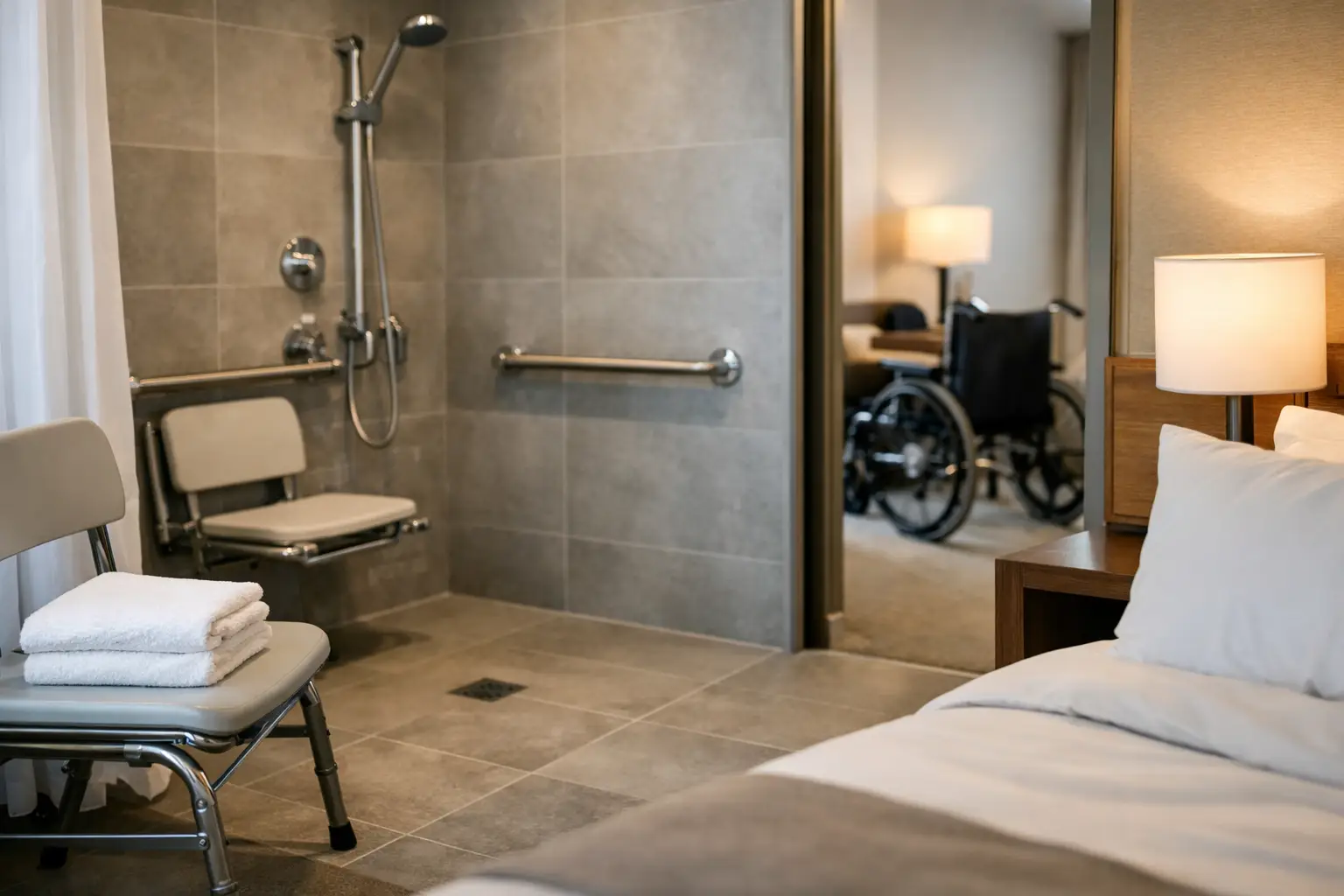
The short answer to “do accessible rooms have wetrooms?” is no - and assuming they do is one of the easiest ways to book a hotel room that does not work for you. An accessible room may have a level-access shower, a shower tray with a small lip, a bath with grab rails, or a bathroom that is simply larger than standard. The label tells you very little unless you know exactly what to ask.
For a wheelchair or mobility scooter user, the bathroom can make or break a holiday. You might manage the entrance, the lift and the bedroom perfectly, only to find a shower you cannot get into, a toilet with no usable transfer space, or a wet floor that makes independent use difficult. The room needs to suit your mobility, not a hotel’s broad definition of accessibility.
Do accessible rooms have wetrooms as standard?
No. Some accessible rooms have full wetrooms, but many do not. There is no universal hotel rule that an accessible bedroom must include one, particularly when you are comparing older UK properties, converted buildings and hotels abroad.
A proper wetroom usually has a fully level floor, with the shower area open to the rest of the bathroom and water draining away through a floor gradient. There may be a fixed or fold-down shower seat, grab rails, a handheld shower head and enough turning space for a wheelchair. This can be an excellent arrangement, especially for guests who need to roll directly into the shower area.
But even the word “wetroom” needs checking. Some hotels use it to describe a shower with a low tray. Others have a level floor but a fixed glass screen that blocks a wheelchair transfer. A room may have a shower chair, yet leave no space beside the toilet. Photographs can look promising while hiding the one detail that matters.
The same applies to the term “disabled access room” or “adapted room”. Hotels often use these labels honestly, but they are not a guarantee that the layout will meet every guest’s needs. Accessibility is not one-size-fits-all.
Why a wetroom can be useful - and when it is not
For many travellers, a level-access shower removes the biggest physical barrier in a hotel bathroom. There is no shower tray edge to negotiate, no need to lift legs over a bath, and usually more room to position a wheelchair or bring in a carer. A fold-down seat can be useful if you can transfer sideways, while a portable shower chair may suit other people better.
That said, a wetroom is not automatically the best option. If the floor drainage is poor, water can spread across the bathroom and leave the toilet area slippery. If you use a mobility scooter, you may not be able to take it into the bathroom at all, even in an accessible room, because of the doorway width or tight turning circle. Some people also need a shower chair with arms and back support rather than a wall-mounted seat.
A bath can work for a traveller who can step in safely and only needs grab rails. For somebody who cannot manage a step or needs a carer close by, it is likely to be a non-starter. The point is not to chase a particular label. It is to confirm the setup against the way you transfer, wash and move around.
What to check before booking an accessible hotel room
Do not rely on a booking site filter alone. “Accessible” may refer to step-free access to the building, not the bathroom. Before paying, contact the hotel directly and ask for current photographs of the exact room type and bathroom. A quick call is often better than a message because you can ask follow-up questions when an answer is vague.
Explain how you travel: whether you use a manual wheelchair, powered wheelchair or mobility scooter; whether you can walk short distances; and whether you need a carer in the bathroom. You do not need to share more personal detail than you are comfortable with, but a clear picture helps the team check the right room rather than give a generic answer.
Ask about these practical points:
- Is the shower completely level access, or is there a tray, lip or step? Ask for its height in centimetres if there is one.
- Is there a fixed shower screen, and can a wheelchair enter and turn within the shower area?
- Is a shower chair or fold-down seat provided? Check its position, size, weight limit and whether it has arms or a back.
- Are grab rails fitted by the shower and toilet, and on which side is the clear transfer space?
- What are the bathroom door width and the clear space beside the toilet?
- Can the room accommodate your wheelchair or scooter, including beside the bed and when opening the bathroom door?
If the hotel says, “It should be fine,” treat that as a prompt to ask again. You need measurements, photographs or a member of staff who has physically checked the room. This is not being difficult. It is sensible trip planning.
The bathroom is only one part of the room
A usable wetroom will not solve a room with a bed that is too high to transfer onto, sockets behind furniture, or a route from reception that includes a heavy fire door. Check the full journey from arrival to bed.
For mobility scooter users, ask whether scooters are permitted in bedrooms and where they can be charged. Some hotels have restrictions because of fire safety policies, and you do not want to discover them at check-in. If you use a larger powered chair or scooter, confirm lift dimensions and whether there are any narrow corridors or tight corners on the route to your room.
It is also worth asking whether the accessible room is a double, twin or family room. Hotels sometimes have only one accessible option, and it may not match the bed arrangement you need. If you are travelling with a partner, friend or carer, make sure there is realistic space for both of you to move around rather than just enough room for the furniture.
Common wording that can catch travellers out
“Roll-in shower” is usually encouraging, but it still does not confirm a truly level entrance or adequate toilet transfers. “Walk-in shower” often means there is no bath, but may still mean a raised tray. “Wheelchair-friendly” is marketing language unless backed up by dimensions and photographs.
“Ground-floor accessible room” can also sound ideal while hiding a long outdoor route, uneven paving or a heavy entrance door. If you are booking overseas, standards and terminology vary even more. Request measurements rather than trying to translate labels from one country to another.
Older hotels can be particularly mixed. A listed building may offer a genuinely excellent adapted room, but it may be reached by a platform lift, through a separate entrance or across uneven surfaces. That does not make it unsuitable, but you need the details before you arrive.
How to make booking less stressful
Keep a short note on your phone with the questions you need answered and the measurements that matter to you. This saves repeating yourself and makes it easier for a hotel to pass the request to its reservations or maintenance team. If possible, ask for written confirmation of the agreed room type and key features.
When you arrive, check the bathroom before unpacking. Test the route, look at the shower setup and make sure any shower chair is stable. If something is clearly different from what you were told, raise it straight away while the hotel may still have options. Waiting until the next morning rarely improves the situation.
There are excellent accessible rooms with wetrooms, and there are excellent rooms without them. There are also rooms carrying an accessibility label that will not work for everyone. The difference comes down to honest information, proper measurements and asking the questions that protect your independence. A few minutes spent checking before booking can leave you free to focus on the part of the trip that matters - getting out and enjoying it.
0 Comments
Leave a Comment