
Disabled Travellers Beach Access Guide That Works
A beach can look perfectly accessible in a glossy brochure, then turn out to have a steep shingle slope, a locked accessible toilet and a promenade kerb you cannot get over. This disabled travellers beach access guide is about cutting through that guesswork. A good beach day is absolutely possible, but it depends on checking the details that matter to wheelchair and mobility scooter users before you leave.
Start with the route, not the sea view
The first question is not whether the beach has an accessible symbol on a website. It is whether you can get from your vehicle, bus stop or accommodation to the sand without facing an obstacle that stops the day before it starts.
Look at the whole route in stages: disabled parking, the distance to the promenade, dropped kerbs, surface condition, gradients, access gates and the final route onto the beach. A seafront can be level for miles but still have steps at the one point you need to reach the sand.
Satellite images and street-level images can be useful, particularly for seeing where parking sits in relation to the promenade. They are not a replacement for current information, though. Coastal paths change, barriers appear, construction work starts and winter weather can damage surfaces. Ring the local council, beach operator, visitor centre or nearby café if you need a straight answer.
Ask specific questions. “Is it accessible?” usually gets a vague reply. Ask whether a mobility scooter can travel from the Blue Badge bays to the accessible toilet, whether there is a beach access mat, and how wide it is. Ask if the route is firm enough for a manual wheelchair. Details get better answers.
Beach access for disabled travellers: know the surface
Not all sand is the same, and neither is shingle. Firm, compact sand at low tide can be manageable with the right equipment, while dry soft sand can stop even a powerful scooter within a few metres. Shingle is often harder still. It shifts under wheels, makes pushing difficult and can hide uneven ground.
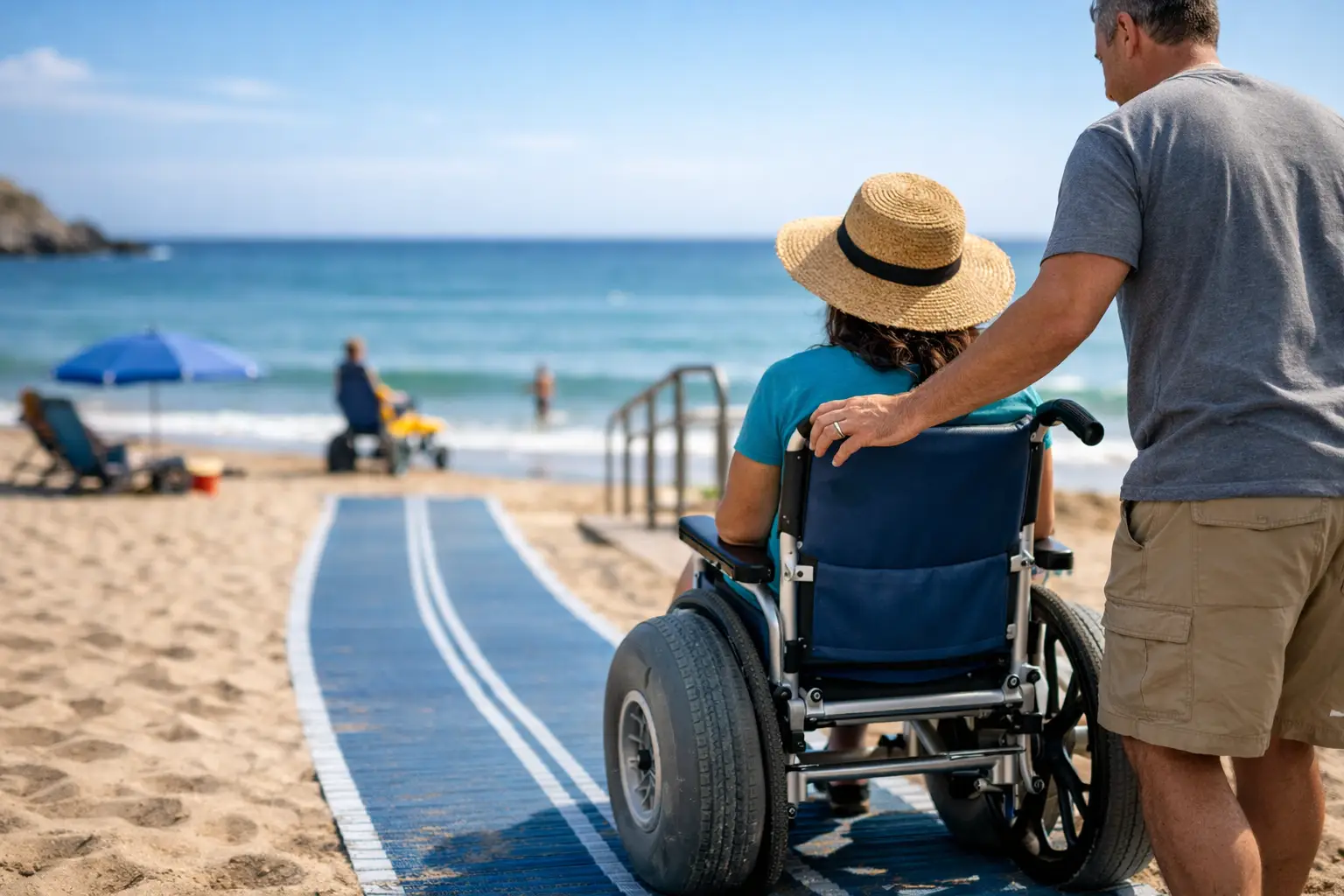
A beach access mat or roll-out pathway makes a real difference. These are usually temporary or seasonal, so never assume they will be in place just because you saw it mentioned online. Find out where it begins and ends. Some mats take you only to a viewing point above the sand; others continue far enough to reach the water’s edge at certain tides.
If you use a mobility scooter, check the manufacturer’s guidance before taking it off the promenade. Sand, salt water and damp can cause damage, and getting stuck can be more than inconvenient if the tide is moving in. A larger all-terrain chair or beach wheelchair may be the safer option, but availability varies widely and advance booking is often required.
Beach wheelchairs commonly have large balloon-style tyres designed to float over sand. Some are self-propelled, while others need someone to push. That distinction matters. If independent movement is essential, confirm the exact model rather than relying on the phrase “beach wheelchair available”.
Parking can make or break the visit
A disabled bay beside the seafront is only useful if it is available when you arrive and if the route out of it is step-free. Popular beaches fill quickly on sunny weekends, school holidays and during local events. If there are only two or three bays, arrive early or choose a quieter beach with more realistic parking.
Check the parking rules as well. Some coastal car parks still require a ticket even when using a Blue Badge, and others have height barriers that can catch out adapted vehicles or roof-mounted equipment. It is also worth finding out whether there is space alongside the bay to transfer safely from a vehicle.
Do not overlook the turning space. A car park may technically have accessible spaces but be so tight, steep or potholed that using a wheelchair lift or scooter hoist becomes awkward. This is exactly the sort of operational detail that generic accessibility pages miss.
Toilets, changing places and the practical basics
An accessible toilet should be close enough to reach without turning the visit into an expedition. Check opening hours, whether it needs a RADAR key, and whether it is seasonal. Public toilets on the coast are often closed in the evening or outside peak months.
For some travellers, a standard accessible loo is not enough. A Changing Places toilet with an adult-sized changing bench and hoist can determine whether a full day out is possible. They are still not available everywhere, so plan around them rather than hoping to find one when you arrive.
Think through the other basics too. Is there sheltered seating if the weather changes? Can you get into a café without a step? Is there drinking water nearby? A beach can be wonderfully open, but exposure to wind, heat and sun is more tiring when you cannot simply move quickly across the sand.
Bring any medication, charging kit, rain cover and mobility aid essentials with you. Salt air and blowing sand are not kind to electrical equipment. A small towel and soft brush are useful for removing sand from footplates, joystick areas and wheel hubs before getting back into a car.
Tides are an accessibility issue
Tide times are not just for swimmers and anglers. They can change how far you need to travel across sand, whether a firm route exists, and whether the beach wheelchair can safely get near the water.
At low tide, the sea may be hundreds of metres away. That can create wide, compact sand in some places, but it can also leave you far from the promenade with a long return journey. At high tide, the accessible area may shrink dramatically or disappear against sea defences. On some beaches, a ramp onto the sand is usable only for a short window.
Check the forecast as well as the tide table. Strong wind can make a flat promenade uncomfortable and can turn a simple transfer into a struggle. On hot days, sand and boardwalk surfaces can become painfully warm. A shorter visit at the right time is often better than forcing an all-day plan.
Call ahead and ask questions that matter
Before a first visit, a five-minute phone call can save a wasted journey. Speak to someone responsible for the beach, not just a general booking line where possible. Be clear about the mobility equipment you use and what you need to do independently.
Useful things to confirm include:
- whether beach wheelchairs or mobility equipment must be booked in advance
- the width, length and current condition of any access mat
- the location and availability of Blue Badge parking
- accessible toilet opening times and RADAR key requirements
- whether staff can help in an emergency if you become stuck or unwell
- current works, storm damage, closures or event restrictions
If the person cannot answer, ask who can. It is better to be persistent before travelling than to arrive and be told that the accessible route was removed weeks ago.
Have a sensible Plan B
Even the best preparation cannot control weather, crowds or a mat being washed away after a storm. Build a nearby alternative into the day. That might be an accessible seafront café, a level pier, a harbour promenade or an attraction with proper facilities.
Plan B is not giving up on the beach. It gives you control if conditions are wrong. You can still enjoy the sea air, meet family and have a proper day out without being stranded on an exposed promenade waiting for everyone else to finish on the sand.
If you are travelling with friends or family, agree the plan beforehand. They may be happy to spend an hour on the beach while you use a nearby accessible route, then meet again for lunch. Independence also means being able to make choices that work for you, rather than pretending a difficult route is fine.
A better way to judge an “accessible beach”
The best accessible beach is not always the one with the biggest marketing claim. It is the one where the route is clear, the equipment is actually available, the toilet is open, and you can enjoy the day without relying on luck or being carried over an obstacle.
Keep notes after every visit. Record where you parked, how the surface felt, whether staff were helpful and what the tide was doing. Your own experience is valuable, and it makes the next trip easier. The right beach is out there - choose one that lets you spend your energy enjoying the coast, not fighting to reach it.
0 Comments
Leave a Comment