
Choosing an Accessible Hotel or Holiday Rental
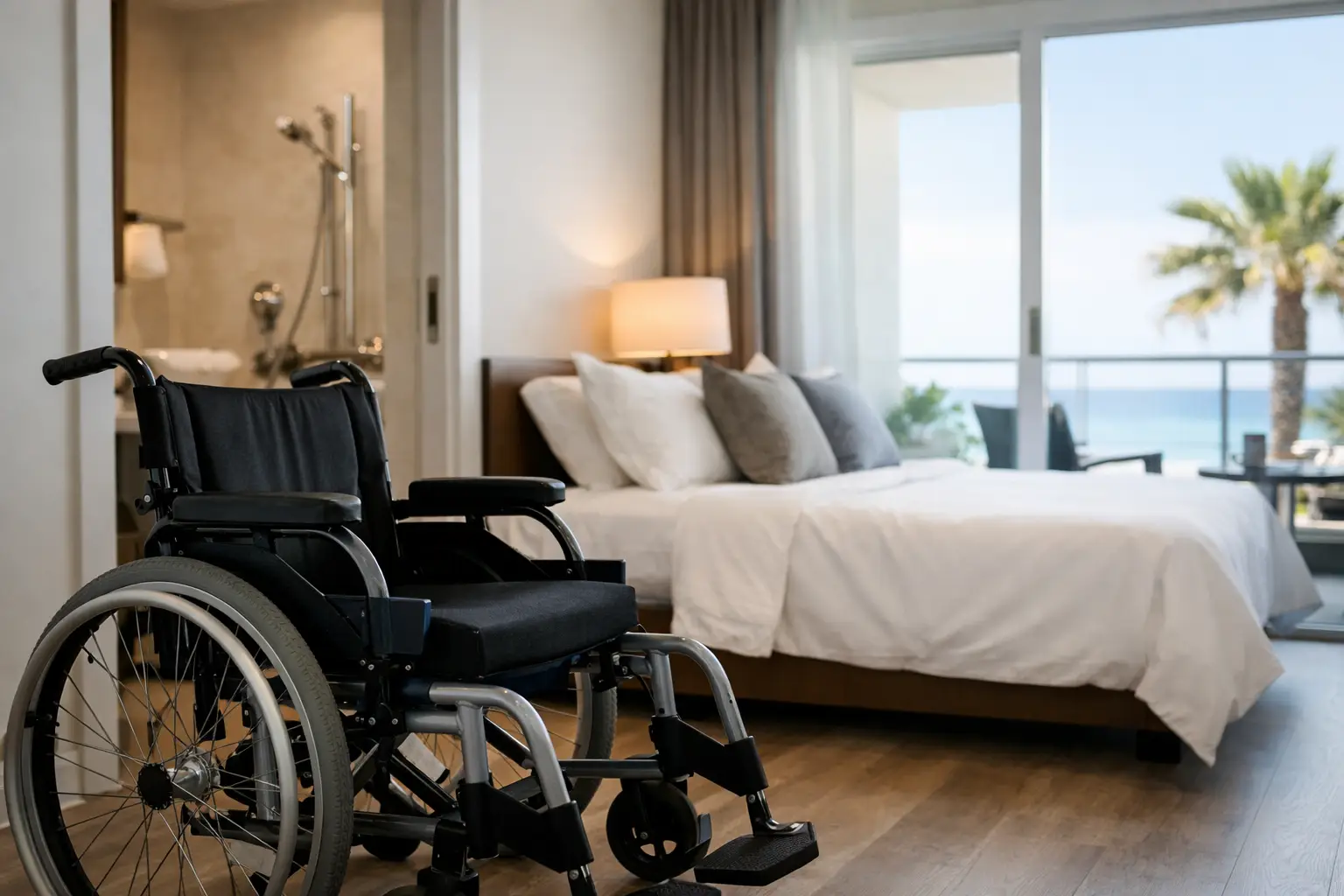
Plenty of places call themselves accessible. Far fewer tell you whether you can actually get through the front door, turn your wheelchair in the bathroom, charge a mobility scooter safely, or reach breakfast without meeting a surprise step. That is the real challenge when booking an accessible hotel or holiday rental.
The problem is not just bad design. It is vague wording, staged photos, and accessibility pages written by people who do not use the space the way disabled travellers do. If you use a wheelchair, mobility scooter, walker, or need step-free access with minimal distances, a nice-looking room means very little until the practical details are clear.
What makes an accessible hotel or holiday rental genuinely usable?
A genuinely accessible stay is about the whole journey through the property, not one adapted bathroom. You need to think about arrival, entry, circulation, sleeping, washing, dining and leaving the building in an emergency. If one part fails, the whole stay can become stressful.
Start with the entrance. A place may have an accessible room, but if the route from parking to reception includes loose gravel, steep ramps or heavy manual doors, that room is already less useful than advertised. The same goes for lifts that are too small for a larger powerchair or corridors that force awkward turns.
Bathrooms are where many bookings fall apart. "Accessible bathroom" can mean anything from grab rails beside a standard bath to a proper roll-in wet room. If you need to transfer sideways, use a shower chair, or require enough floor space for a carer to assist, you need exact measurements and clear photos. General promises are not enough.
Bedroom layout matters just as much. Can you get both sides of the bed? Is the bed height workable for transfers? Is there space to turn beside the wardrobe, or has the furniture been squeezed in to tick a box? Small details become big issues once you are in the room and tired from travelling.
Hotels and holiday rentals are accessible in different ways
Hotels can work well if you want predictable support. Reception staff are on site, breakfast may be easier, and if something goes wrong there is usually someone to speak to straight away. For shorter stays, that can remove a lot of hassle.
But hotels also come with trade-offs. Many accessible rooms are limited in number, often in the least attractive part of the building, and sometimes have connecting doors, awkward layouts or noisy positions near lifts. You may also find the bedroom is adapted but the bar, spa or outdoor areas are not.
A holiday rental can offer more freedom. If the layout is right, you get more space, your own routine, and often better value for a longer stay. For families, carers or anyone travelling with equipment, that extra room can make the trip much easier.
The catch is consistency. One owner’s idea of accessible may simply mean "ground floor". A rental might suit a manual wheelchair user perfectly but be impossible for a mobility scooter because of narrow internal doors or no secure charging space. You often need to do more checking yourself.
Questions to ask before you book
This is where no-nonsense planning saves you grief. Ask direct questions and be specific about your needs. Do not ask, "Is it accessible?" Ask whether the entrance is step-free from the car park, whether the shower is level access, and what width the bathroom door is at its narrowest point.
You also need to ask about the route, not just the room. Is there an accessible parking bay, and is it actually close enough to be useful? Are there dropped kerbs between parking and reception? Is the lift available to guests at all times? If meals are included, can you reach the dining area without steps?
For scooter users, charging and storage are often overlooked. Ask whether there is ground-floor storage, whether charging in the room is allowed, and whether there is enough space to manoeuvre the scooter indoors. Some properties say yes to scooters, then expect you to leave one in a hallway or carry batteries up stairs. That is not realistic.
If you need equipment such as a hoist, profiling bed or shower chair, never assume it will be there because the room is labelled accessible. Ask what is provided, what can be hired locally, and whether staff have handled those arrangements before. Experience matters.
Photos matter more than marketing copy
If a property has one wide-angle photo of an accessible bedroom and no bathroom image, that tells you something. Good accessibility information is usually specific because the property has thought about it properly. Vague information often means the opposite.
Ask for recent photos of the entrance, bathroom, bed area and parking. You want to see thresholds, floor finishes, grab rail placement and turning space. A smart-looking room can still be impractical if the toilet is boxed in on one side or the shower screen blocks transfer space.
Videos are even better when available. A quick walk-through shows gradients, door weights and how spaces connect. This is one reason experience-led accessible travel content is so useful - you can often spot problems in thirty seconds that a glossy brochure would never mention.
Location can make or break the stay
A perfectly adapted room is only part of the picture. If the hotel is on a steep hill, the dropped kerbs are poor, or the nearest accessible parking is two streets away, the trip becomes harder than it needs to be.
Check the immediate area as carefully as the property itself. How far is it from accessible public transport? Are pavements wide enough for a scooter? Is the route to local restaurants manageable after dark or in rain? In many destinations, especially older towns, the street access can be tougher than the accommodation.
This matters even more if you are booking a holiday rental. A lovely accessible cottage can still leave you isolated if the driveway is rough, local taxis cannot take a wheelchair, or the nearest shop is inaccessible. Independence depends on the surroundings as much as the bedroom.
Red flags to watch for
Some phrases should make you pause. "Suitable for the elderly" tells you almost nothing. "A few steps" might be completely manageable for one guest and impossible for another. "Wheelchair friendly" can simply mean the lobby is flat.
Be cautious if staff cannot answer basic access questions, or if every answer sounds like guesswork. If they need to "check with maintenance" whether there is a step into the shower, that is not a great sign. The same goes for listings that avoid measurements altogether.
Another red flag is when accessibility features come with caveats that were not obvious upfront. For example, a step-free room that is only reachable through a separate side entrance, or parking that is accessible only if another guest has not taken the nearest bay. Small catches like that can completely change whether a stay works.
Why your own access needs must lead the booking
There is no single version of accessibility. A room that works for a couple with a folding wheelchair may not work for a solo powerchair user. A wet room may be ideal for one guest and unhelpful for another who needs a bath seat or higher toilet.
That is why copying someone else’s booking without checking the detail can backfire. Reviews are useful, but your equipment, transfer method, stamina and support needs are your own. The best booking decisions come from matching the property to how you actually travel.
For many disabled travellers, that also means being completely honest about energy levels. A property might be technically accessible, but if it involves a long route from parking, a big push up a ramp, or a complicated layout, it may still not be right for you. There is no prize for forcing a stay to work.
Booking with more confidence
The best approach is simple. Start early, ask exact questions, request photos, and trust your instincts when the answers are vague. If a property is genuinely suitable, it will usually be able to explain why in clear language.
An accessible hotel or holiday rental should give you freedom, not another puzzle to solve after arrival. You are not being difficult by asking about ramp gradients, toilet clearances or scooter charging. You are doing what every disabled traveller has learned to do - replacing guesswork with facts.
That is how more trips become possible. Not through optimistic labels, but through honest information that lets you book with confidence and get on with enjoying the journey.
0 Comments
Leave a Comment