
How to Charge Your Mobility Scooter Abroad
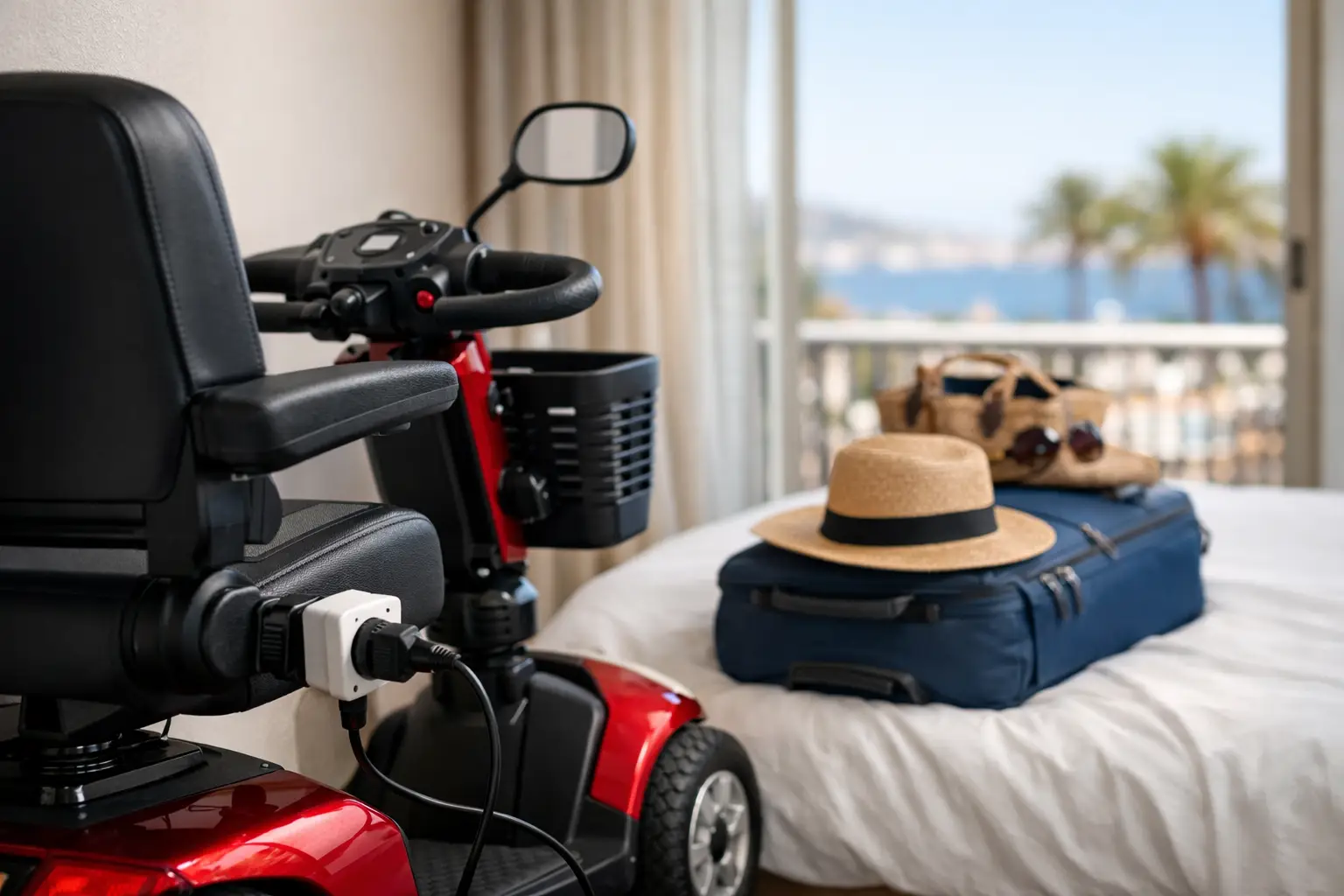
A flat scooter battery can turn a good day out into a very long wait for help. When you are travelling, charging is not a small detail to sort out when you arrive. It affects where you stay, how far you can go and whether you can travel independently. Knowing how to charge a mobility scooter abroad starts with checking your charger, not guessing at the socket on the wall.
The reassuring news is that many modern mobility scooter chargers are designed for international use. The less reassuring news is that not all of them are. A plug adaptor changes the shape of the plug. It does not change the electricity coming from the mains. Get that distinction wrong and you could damage the charger, the battery or both.
Check your charger before you book
Look at the label on the charger itself. You are looking for its input voltage, usually shown as something like `100-240V, 50/60Hz`. If your charger says this, it is normally suitable for use in countries with different mains supplies, including much of Europe, North America, Australia and Thailand. You will only need a suitable plug adaptor for the country you are visiting.
If the label says `220-240V only`, it may not be suitable for countries using a 110-120V supply, such as the USA and Canada. In that situation, a basic adaptor is not enough. You would need to speak to the scooter manufacturer or charger supplier about a compatible charger or a properly rated voltage converter. Do not buy a cheap travel converter and assume it will cope. Mobility scooter chargers draw power over a sustained period and need equipment designed for that job.
Take a clear photograph of the charger label before you leave. It is useful if airline staff, hotel staff or a local electrical shop need to see the specifications. Also photograph the scooter's battery label and keep the charger make and model in your phone notes. These small bits of preparation are far easier at home than when you are tired after a flight.
Adaptor, converter and charger are different things
These terms are often used as though they mean the same thing, but they do not.
An adaptor lets a UK plug fit into a foreign socket. It does not alter voltage. A converter changes voltage, but may not be appropriate for battery charging unless it is correctly rated and suitable for continuous use. The charger is the unit supplied for your scooter, which regulates the charge going into the batteries.
For most UK travellers, the best arrangement is simple: an original charger rated 100-240V plus a quality country-specific adaptor. Avoid relying on universal adaptors with loose fittings or multiple USB ports if they look flimsy. Your scooter charger is too important to be supported by a wobbly plug connection.
Plan where you will charge a mobility scooter abroad
A hotel can describe itself as accessible and still make charging awkward. The room may have no socket near the door, the only usable plug may be behind a heavy bed, or the charging point may be in a corridor where the scooter cannot safely be left. Ask the question before booking: can the scooter be brought into the room and charged there overnight?
Be specific. Tell the hotel the approximate scooter dimensions and ask whether there is level access from the entrance to the room, enough turning space inside and a mains socket within reach of where the scooter can be parked. If you use a larger Class 3-style scooter, do not assume it will fit in a lift just because the building has one.
Some properties ask guests not to charge mobility equipment in bedrooms because of their fire policy. Others provide a designated charging area. A designated area can work well if it is secure, indoors, accessible outside reception hours and has a socket that is not shared with cleaning equipment. It may be less useful if it means leaving your only means of independence locked in another part of the building overnight.
If you are on a cruise, check charging arrangements before committing. Cabins can be tight, socket positions vary and corridors are not an acceptable place to charge or store a scooter. The same applies to holiday flats: confirm indoor storage and charging rather than treating a balcony, garage or communal hallway as a fallback.
Charge little and often when the days are long
On holiday, scooters tend to work harder. You may cover more distance than usual, tackle hills, use rough pavements, stop and start in busy attractions, or run lights in the evening. Heat can also affect battery performance. A range figure quoted in ideal conditions is not a promise for a hot city, a steep resort or a full day at a theme park.
Start each day with a full charge where possible. If you are out for a long time, identify a realistic rest point with an indoor socket, such as a museum, visitor centre or accessible café, but always ask permission before plugging in. Never trail a cable across a public walkway. It creates a trip hazard and can lead staff to refuse charging altogether.
Do not run the battery down deliberately because you want to “make the most of it”. Lead-acid batteries in particular are happier when regularly recharged. Lithium batteries have different characteristics, but the manufacturer’s guidance still comes first. If your scooter has a battery gauge, treat it as an estimate rather than laboratory-grade information. Hills, temperature and battery age can make it drop quicker than expected.
A practical routine is to keep your daily route within a comfortable return range, not the maximum range advertised in a brochure. Leave capacity for a diversion, a closed accessible entrance, a missed bus or simply the fact that the pavement turns out to be far rougher than expected.
Keep charging safe in unfamiliar accommodation
Charge in a dry, ventilated space on a firm surface. Keep the charger away from bedding, towels, curtains and luggage. It can become warm during normal use, so do not cover it or wedge it behind furniture. If a socket is loose, cracked or visibly damaged, do not use it. Ask reception for another room or a safe alternative.
Use the charger supplied or approved by the scooter manufacturer. It can be tempting to borrow a charger from another scooter user when yours is lost, but similar-looking connectors do not guarantee compatible voltage, current or charging profile. That can shorten battery life or create a genuine safety risk.
Most chargers have indicator lights. Check the manual so you know what the colours mean before travelling. A green light might mean fully charged, mains connected or no battery detected depending on the model. If the charger behaves differently abroad, first check the adaptor is firmly fitted and the socket is live. Then stop using it if there is a burning smell, excessive heat, buzzing, sparking or damaged cable insulation.
Unplug by gripping the plug, not pulling the cable. This sounds basic, but hotel sockets can be tight and charging leads are easily damaged when luggage, beds or scooters are moved around them.
Do not forget the flight rules
Charging arrangements and flying arrangements are connected because the battery type determines what airlines will accept. Airlines generally require advance notice for powered mobility equipment. They will ask for battery type, watt-hour rating for lithium batteries, whether the battery is removable and how the scooter can be made safe for carriage.
Do not assume a battery can travel because the scooter is small, or because another airline accepted it previously. Rules and handling procedures vary. Carry the battery documentation, charger details and instructions for placing the scooter into freewheel or transport mode. If the battery is removable, confirm exactly whether it must travel in the cabin and how its terminals need protecting.
It is also worth considering the journey after landing. If the airline returns your scooter at the aircraft door, you can usually get moving straight away. If it goes to the baggage hall, you may need to cover a substantial airport distance before you can charge again. Begin the outbound journey with a full battery and keep some range in reserve for delays.
Build a backup plan, not just a charging plan
Pack your charger in your hand luggage if airline rules and space allow. It is much better protected there than in a suitcase that could be delayed or misplaced. Put the adaptor, charger lead and any detachable charging cable in the same bag. A charger in one case and its essential lead in another is an avoidable problem.
For longer trips, consider taking a spare approved adaptor. They are small, inexpensive and easy to lose. A short extension lead can be useful in a hotel room, but only use one in good condition, with the correct plug type and an appropriate fuse. Do not daisy-chain extension leads or overload sockets.
Before setting off each morning, check the charge level, weather, distance and terrain. If the route has steep hills or no obvious indoor stops, shorten the plan. Independence is not about proving how far you can push a battery. It is about giving yourself enough margin to enjoy the day without worrying about the journey back.
The best accessible holidays are built on these unglamorous details. Check the charger label, confirm where the scooter will sleep and charge, then give yourself more battery range than you think you need. That preparation leaves you free to focus on the destination, rather than the nearest wall socket.
0 Comments
Leave a Comment