
Can Mobility Scooters Use Buses? UK Rules
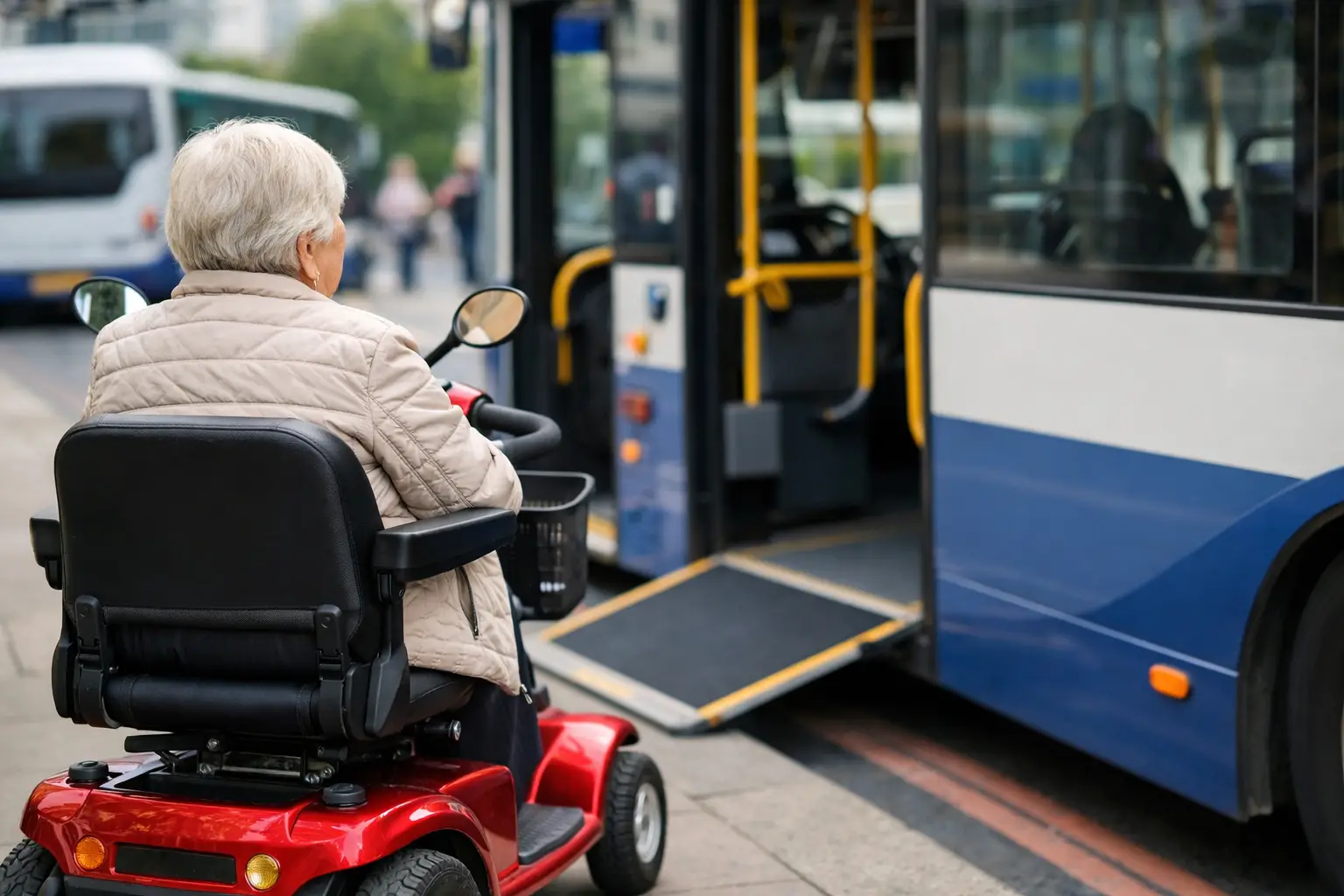
A low-floor bus arriving at the stop can look like freedom - right up until you are left wondering whether the driver will actually let your scooter on. So, can mobility scooters use buses? Sometimes, yes. But it is not an automatic right, and the answer depends on your scooter, the bus operator, the route and the space available at that moment.
For many scooter users, buses are a useful way to get around locally without relying on lifts, taxis or family. The key is treating bus travel as something to check before you set off, not something to gamble on at the kerb.
Can mobility scooters use buses in the UK?
Most modern local buses have a low floor, ramp and a designated wheelchair space. That does not mean every mobility scooter can use it. Bus operators set their own scooter policies, and many only accept scooters that have passed their own assessment or meet a published specification.
The usual reason is safety, not a judgement on whether you need the space. A scooter has different handling, weight distribution and braking from a wheelchair. It must get up the ramp safely, turn within the available room and remain stable while the bus moves, brakes and corners.
Some operators run a mobility scooter permit scheme. You take your scooter to a depot or arranged assessment, where staff check its dimensions, turning circle and manoeuvrability. If it passes, you receive a permit or card to show the driver. Other operators publish limits but do not require a formal permit. A few do not accept mobility scooters at all, even if they carry wheelchairs.
This is why a generic answer is not enough. A scooter accepted on one town's buses may be refused by an operator a few miles away.
The bus space is not simply a scooter bay
The marked area on a bus is generally a wheelchair space. It may be fitted with a backrest, restraint system or fold-up seats, depending on the vehicle. Wheelchair users have priority for that space, and an accessible bus can still be unable to take you if it is already occupied.
That can be frustrating, particularly when you have planned carefully. But it is worth building that possibility into your journey rather than assuming the first bus will always work. If you have an appointment, aim for an earlier service where possible. At busy times, allow extra time or consider whether an accessible taxi is the more dependable option.
You should also expect the driver to make a safety decision. Even with a permit, a driver may be unable to deploy the ramp because of where the bus has stopped, a badly parked car, a high kerb or lack of room around the doors. Those are real barriers, not excuses, but they can affect what is possible on the day.
What makes a scooter suitable for bus travel?
There is no single UK-wide maximum size that applies everywhere. However, operators commonly look at the same practical points: overall length and width, total weight, turning ability, ground clearance, battery type and whether the scooter can be positioned safely in the wheelchair space.
Small, compact Class 2 scooters are often the best prospect. They tend to fit through the doorway, manage the ramp and turn more easily. Larger road-legal Class 3 scooters, particularly long models with high-backed seats or large baskets, are much less likely to be accepted. Their size and weight can make them difficult to turn or safely secure inside a bus.
Do not rely on the fact that your scooter folds down, either. A bus operator may still treat it as a mobility scooter rather than luggage, especially if you intend to remain seated on it. Folding scooters can be a good option for certain journeys, but only if you can fold, lift and manage them safely without blocking the aisle.
Before applying for a permit or travelling, have your scooter's specifications ready. Measure it yourself as well. Manufacturer figures can exclude accessories that matter on a bus, such as a rear bag, walking-stick holder, canopy or large shopping basket.
Check these details before you travel
The most useful check is with the operator running the route, not just a general journey planner. Ask whether mobility scooters are accepted, whether you need a permit and which vehicle types normally run on your service. Routes can use different buses at different times, so a low-floor bus today does not guarantee the same vehicle tomorrow.
Ask specifically about the maximum permitted dimensions and weight. Clarify whether the stated weight includes you, your shopping and any equipment. If you use a heavy powered scooter, this point matters. The ramp may be able to take the scooter alone but not its fully loaded weight.
If an assessment is required, book it well before your first journey. Take the scooter exactly as you use it day to day, including any accessories. This avoids passing with a stripped-back scooter and then finding your normal setup will not fit.
It is also sensible to ask what proof the driver needs to see. Keep a permit easy to reach, rather than buried in a bag under the seat. Drivers see many different mobility aids, and a clear permit can save an awkward conversation at the stop.
How to board safely with a mobility scooter
When the bus arrives, make yourself visible to the driver and indicate that you need the ramp. Do not try to squeeze through the doors before the driver has stopped, lowered the bus or deployed the ramp. Wait for their instruction.
Drive slowly and straight up the ramp. Keep bags secure and avoid carrying loose shopping on your lap. Once inside, follow the driver's direction on where and how to position the scooter. You may need to reverse into the wheelchair space so that your back is against the support, but this varies by vehicle and operator.
Switch the scooter off if instructed and apply the parking brake. Keep your speed control centred and make sure nothing projects into the aisle. A stick, crutch, bag or basket that seems harmless at a standstill can become a hazard when the bus brakes sharply.
If you are nervous, practise reversing and turning your scooter in a quiet, open area before your first bus trip. The confined space inside a vehicle is not the place to discover that your turning circle is wider than expected.
If the driver says no
A refusal does not always mean you have done anything wrong. The wheelchair space may be occupied, your permit may not cover that service, the bus may not be suitable, or the ramp may be blocked by the street layout. Ask calmly why the scooter cannot be carried and, if practical, note the route number, time and vehicle details.
If you believe you were refused despite meeting the operator's policy, contact the bus company afterwards. Explain that you use a mobility scooter, give the journey details and ask for a clear explanation. Specific information is far more useful than being told only that scooters are "not allowed".
Where a route repeatedly causes problems, try to identify an alternative stop. A stop with a clear kerb, no parked cars and enough pavement space can make boarding far easier. It is an irritating bit of route planning, but it can turn an unreliable journey into a workable one.
Planning beyond the outward journey
Do not stop your checks once you know you can board. Think about the return leg, evening services and what happens if your battery is low. A bus journey may be short, but getting to the stop, waiting in poor weather and travelling between connections all use charge.
Check where you will get off, too. A bus may set you down safely but leave you on a narrow pavement, beside a dropped kerb that is blocked, or on the wrong side of a busy road. The best accessible journey is the one that works door to door, not merely from bus stop to bus stop.
A bus can be a brilliant tool for independence when the operator, vehicle and scooter are a good match. Make the checks, carry the right proof and allow a little breathing room in your plans. That preparation gives you the best chance of spending your day where you intended, rather than stranded at the stop.
0 Comments
Leave a Comment