
Can Mobility Scooters Go on Trains?
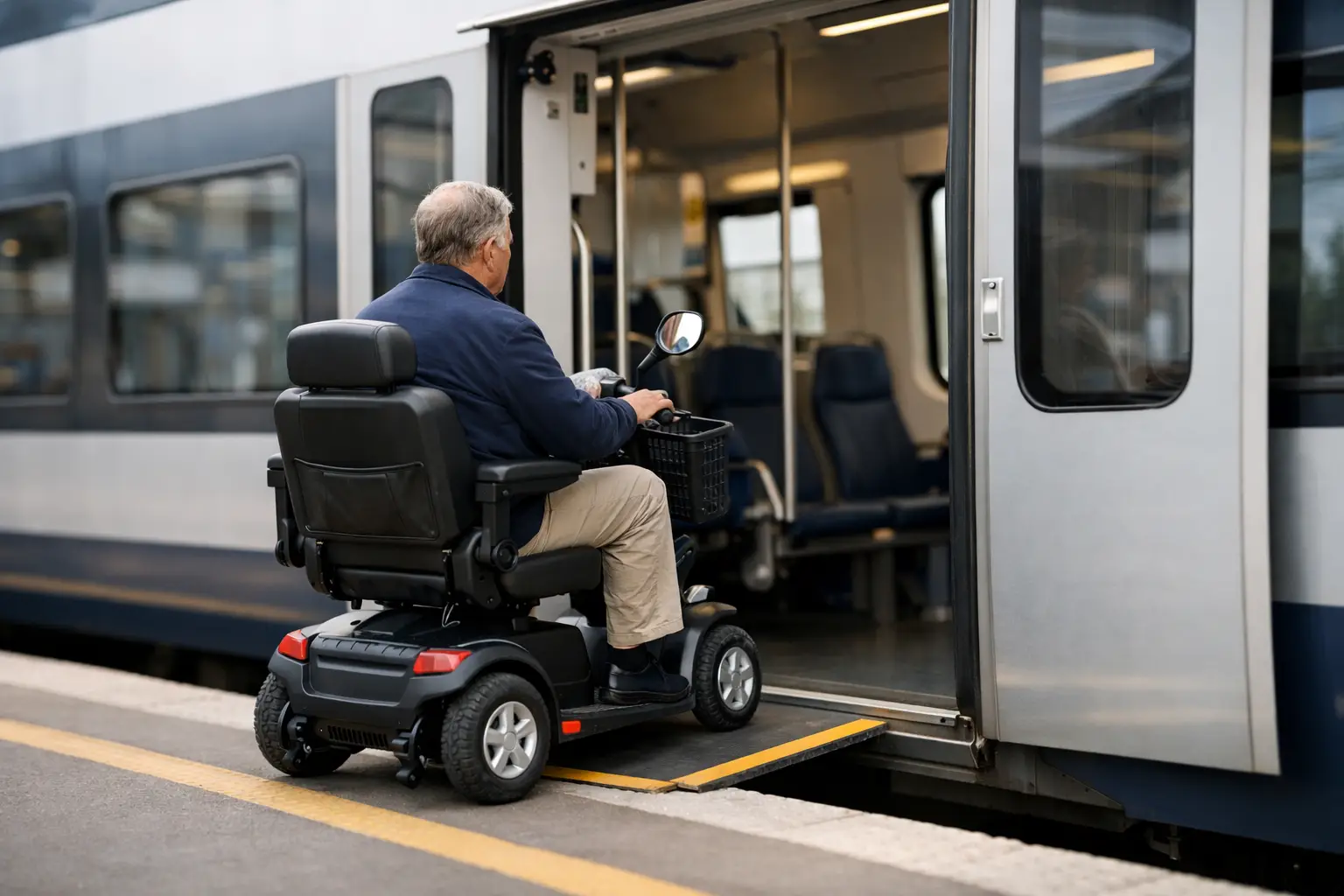
You do not want to find out on the platform that your scooter is too big for the train, the station lift is out of order, or the staff booked assistance for the wrong service. If you are asking, can mobility scooters go on trains, the honest answer is yes, often they can - but only if your scooter, the train operator and the station all line up.
The YouTube playlist Trains, Planes and Automobiles is all about travelling on public transport. It shows rail and bus journeys predominantly, but also air travel.
That is the bit of generic advice often missed. Rail travel with a mobility scooter is possible across much of the UK, but it is not one simple yes or no. It depends on scooter size, turning space, station layout, ramp availability, and whether the operator allows scooters in the wheelchair space. If you know what to check before you travel, you can avoid a lot of stress.
Can mobility scooters go on trains in the UK?
In many cases, yes. A lot of UK train operators will carry mobility scooters, but usually only if they fit within their stated limits for size and weight. That matters because train aisles, doorways and wheelchair bays are not all the same, especially on older rolling stock.
The usual rule is that your scooter must fit within the operator's wheelchair and scooter dimensions. Many operators work to a limit close to 700mm wide and 1200mm long, with a combined weight limit for user and scooter often around 300kg. That said, there is no single nationwide rule that every train company applies in exactly the same way.
Some operators are more scooter-friendly than others. Some ask you to transfer to a train seat unless your scooter is specifically approved for travelling occupied. Others may allow you to remain on the scooter in the wheelchair space if it fits safely. That is why checking with the train company for your exact route is not optional - it is part of the journey planning.
The real question is not just can mobility scooters go on trains
The more useful question is whether your specific scooter can go on your specific train from your specific station.
A compact boot scooter might be accepted where a larger road-style mobility scooter is not. A modern step-free station might be straightforward, while a rural station with a footbridge and no lift can stop the journey before it starts. Even where the train itself is accessible, the route through the station can be the weak point.
This is where lived experience matters. Disabled travellers often get told a place is accessible when what that really means is somebody saw a ramp once. In practice, you need to know whether there is level access to the platform, whether the gap between train and platform is manageable with staff assistance, and whether there is enough room to get on and off without a stand-off with luggage, buggies and bikes.
What train companies usually check
Before allowing a mobility scooter on board, operators are normally looking at a few practical points.
First is size and weight. If the scooter is too long, too wide or too heavy, it may not fit safely in the wheelchair area or over the boarding ramp. Second is manoeuvrability. A scooter that technically meets the measurements can still be awkward if it cannot turn in tight spaces.
Third is battery type and general condition. This is less often an issue, but staff may refuse equipment that looks unstable or unsafe. Finally, they consider the route itself. Some services use trains with better wheelchair spaces than others, and some stations are much easier than others for boarding.
If you have a larger Class 3 scooter, you need to be especially cautious. Those are brilliant for outdoor independence, but they are often too bulky for rail travel. Smaller Class 2 scooters are usually more realistic for trains, though again there are exceptions both ways.
Booking assistance makes a huge difference
If you are travelling by train with a mobility scooter, book passenger assistance every time, even if you think you may not need it. It gives the operator notice, means ramps should be ready, and reduces the risk of staff being surprised when you arrive.
In the UK, assistance can usually be booked in advance through the operator or through the national rail assistance system. Give them the dimensions and weight of your scooter, the exact stations, and whether you plan to stay on the scooter or transfer to a seat. Be direct. Ask them to confirm that your scooter is accepted on every leg of the journey, not just the first train.
I would also keep a note of the booking reference and the name of the person or service that confirmed it. If something goes wrong on the day, having that information to hand can save time and arguments.
Station access can be harder than the train
A lot of people focus on whether the scooter can fit on the train, but station access is often the bigger challenge.
Some stations have step-free access from street to platform, decent lifts and clear routes. Others have step-free access only to one platform, long detours between platforms, steep ramps, or lifts that are frequently out of service. At smaller stations, there may be no staff present at all for parts of the day.
Check whether both your departure and arrival stations are fully step-free, and do not forget any interchange station if you are changing trains. A route with one awkward change can turn a manageable journey into a nightmare. If there is any doubt, ask the operator to talk you through the route through the station itself, not just the train booking.
What to do before you travel
Measure your scooter properly. Do not guess and do not use rough numbers from memory. You need width, length, turning circle if possible, and total weight including batteries. If the operator gives a user-plus-scooter limit, make sure you are working to that figure too.
Then check the train company's scooter policy. If your journey involves more than one operator, check all of them. It is no use being accepted on the first train if the connecting service refuses your scooter.
Plan for the practical bits as well. Make sure your battery is fully charged, especially if the station layout means a longer route than expected. Carry your charger if you are travelling a long distance. Keep essential medication, your mobile phone and any booking details easy to reach rather than packed away under the seat or in a bag hanging off the back.
If your scooter can be switched to freewheel mode, know how it works before the day of travel. Hopefully you will never need it, but if staff need to help reposition the scooter, it is better not to be learning on the platform.
Common problems on the day
The most common issue is booked assistance not appearing as planned. The second is being told the train is accessible, but finding the wheelchair bay already occupied. The third is discovering that engineering works have replaced part of the route with a rail replacement coach that cannot take scooters.
That last point catches people out all the time. Coaches are a different story from trains, and many cannot carry mobility scooters at all, especially larger ones. If there is any chance of replacement transport on your route, ask about it before you set off.
Another problem is platform changes at short notice. For non-disabled passengers this is annoying. For scooter users it can wreck the connection if there is no working lift or not enough time to get across the station safely.
If your scooter is too large
If your mobility scooter is not accepted on trains, that does not automatically mean rail travel is off the table. Some people choose to transfer to a manual wheelchair or powerchair that fits the operator's limits. Others travel with a folding scooter for train journeys and keep a larger scooter for local use at the destination.
That is not ideal, and it is fair to say the system still leaves some disabled travellers with fewer options than they should have. But if your usual scooter is a bigger model, having a second travel setup can open routes that would otherwise be impossible.
A realistic way to think about train travel with a scooter
Train travel with a mobility scooter is absolutely possible, but it works best when you treat it like a planned operation rather than a casual hop on and go. That may sound unfair, and frankly it is, but it is the reality many of us deal with.
The good news is that once you know your scooter's measurements, know which operators work for you, and know how to book assistance properly, the process becomes much easier. Confidence comes from detail. The more specific your planning, the more freedom you usually get back.
If you are determined to keep travelling independently, do not let the uncertainty put you off. Ask the awkward questions, get the measurements, pin down the access details, and make the railway give you a clear answer before you leave home. That is often the difference between a stressful journey and one that simply gets you where you want to go.
0 Comments
Leave a Comment