
Best Mobility Scooter Airports for Easier Flying
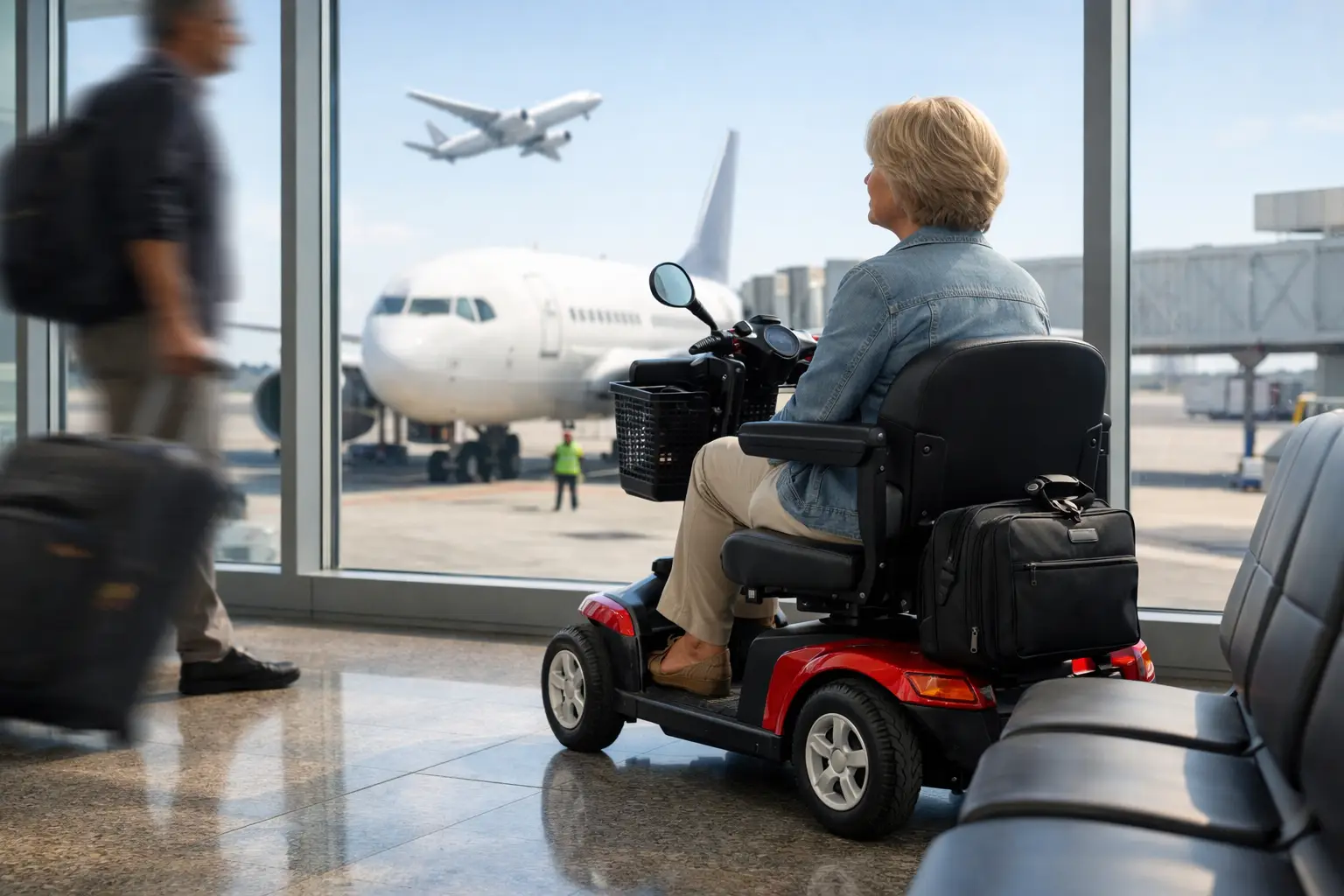
A good airport can make the difference between starting a holiday confidently and starting it exhausted. The best mobility scooter airports are not simply the newest or biggest. They are the ones where assistance is properly organised, distances are manageable, accessible toilets are easy to find, and staff understand that your scooter is part of your independence - not just another item of luggage.
No airport is perfect, and a smooth experience still depends heavily on your airline, battery paperwork and the assistance request attached to your booking. But some airports are generally better set up than others for travellers using mobility scooters and wheelchairs.
What makes an airport scooter-friendly?
A glossy accessibility page is not enough. What matters is what happens from the moment you arrive at the terminal: can you find the assistance point without crossing a car park alone, are there clear signs, is there somewhere safe to wait, and will somebody actually help when your booked assistance has not appeared?
The most useful airports tend to have step-free routes throughout the terminal, frequent accessible toilets, low or accessible service desks, plenty of seating near gates and trained special-assistance teams. Clear communication is just as valuable. When staff can tell you where your scooter will be collected, whether it can be returned at the aircraft door and where to go after landing, it removes a lot of unnecessary stress.
For mobility scooter users, the baggage process matters more than most people realise. You need an airport and airline operation that takes battery details seriously without treating every scooter as a problem. Staff should know the difference between a sealed lithium battery, a removable lithium battery and a non-spillable battery. That knowledge is not a luxury. It protects your equipment and stops last-minute arguments at check-in.
Best mobility scooter airports: strong options to consider
The right airport depends on your route, airline and whether you are flying direct. A direct flight from a decent airport is usually a safer bet than a cheaper itinerary involving a tight connection through a supposedly excellent hub. With that said, these airports have strong reputations or practical features that make them worth considering.
London Heathrow
Heathrow is enormous, busy and can involve long distances, so it is not automatically the easiest airport. Yet it is often one of the more workable choices for travellers who need assistance because it handles large numbers of disabled passengers every day and has established support systems across its terminals.
The biggest advantage is choice. Heathrow has extensive direct routes, which can remove the risk of changing aircraft and handing your scooter over twice. Its terminals have accessible toilets, lifts, step-free routes and assistance desks, although the walk from check-in to security or the gate can still be considerable if you are not using assistance.
Build in extra time and make sure your terminal is confirmed before you travel. Heathrow’s size is its trade-off: good facilities do not prevent long queues or a lengthy transfer between areas. If your scooter is essential right up to the aircraft door, state that clearly when requesting assistance and again at check-in.
London Gatwick
Gatwick can feel more straightforward than Heathrow because its layout is easier to understand, particularly when travelling through a single terminal. It is a sensible option for many European and leisure routes, and the station connection can be practical for travellers coming from London or the South East.
Its North and South Terminals are linked by an accessible shuttle, but do not assume you will have time to move between them during a connection. If you need special assistance, ask where to report when you arrive and whether you should remain on your scooter until boarding begins.
Gatwick’s value is often simplicity rather than luxury. If it offers a direct flight at a sensible time, that can be more useful than travelling across the country to use a larger hub.
Manchester Airport
For travellers in the North of England, Manchester can avoid the extra journey south and offers a wide range of direct flights. The airport has been improving parts of its terminal experience, but it remains a large, busy airport where planning matters.
The practical win is location. Starting nearer home can mean arriving less tired and having more flexibility if you need a family member or carer to help with drop-off. Pre-book assistance well in advance, allow a generous margin before departure and keep your scooter battery information printed as well as saved on your phone.
Terminal works and changing layouts can affect routes, so check your specific terminal shortly before you leave. Never rely on a description you read months earlier when booking the holiday.
Edinburgh Airport
Edinburgh is a useful gateway for Scotland and is generally more compact than the largest London airports. That does not mean there are no distances involved, especially after security, but a smaller footprint can make the process less daunting for some passengers.
For a straightforward point-to-point trip, Edinburgh can be a practical option. It has step-free access and assistance provision, and its manageable size can help when travelling with a companion who is also handling bags, medication and travel documents.
The main consideration is route choice. A direct flight is ideal; if you need to connect, be realistic about the time available and avoid the shortest advertised connection whenever possible.
Amsterdam Schiphol
Schiphol is a major European connection airport with a long-standing focus on accessible passenger handling. It has a strong infrastructure of lifts, accessible toilets and mobility assistance, and it is often used by travellers changing flights between the UK and long-haul destinations.
The catch is that Schiphol is vast. A connection that looks comfortable on paper can still involve substantial distances, security checks and passport control. If you are connecting there with a mobility scooter, book assistance for every flight sector and do not assume it carries over automatically because it appeared on the first booking.
It can be an excellent hub when the connection is generous. It is less attractive when you have 50 minutes, a gate change and no room for disruption.
Singapore Changi
Changi is frequently praised for its organisation, signage and passenger facilities. For a long-haul stopover or connection, those details matter. Accessible toilets are plentiful, routes are generally level and staff are accustomed to supporting international passengers with different mobility needs.
It is also a large airport, so do not confuse good design with short walking distances. Use assistance if fatigue, pain or battery range could become an issue. Long-haul travel is demanding enough without trying to prove you can manage a terminal on your own.
For travellers heading to Asia or Australia, Changi is often a strong option where flight schedules allow. A longer connection here may be far more comfortable than a rushed change elsewhere.
Questions to ask before choosing an airport
The airport is only one part of the chain. Before booking, contact the airline and ask whether your exact scooter model can travel, what battery documentation they require and whether the battery must be removed. Get the answer in writing where possible. Check the dimensions and weight, including the heaviest individual part if it can be dismantled.
Ask whether you can ride your scooter to the aircraft door and whether it will be returned there on arrival. Door delivery is not guaranteed, particularly where safety rules, stairs or airport equipment make it impossible, but it is always worth requesting. If the scooter is sent to baggage reclaim, ask how you will get there and how long the wait usually is.
Also check the airport’s assistance booking deadline. Many request at least 48 hours’ notice, but earlier is better. Your travel agent, airline or airport may be able to add the request, yet you should still check that it appears on the booking. Do not leave this to chance.
Plan for the bits that usually go wrong
Arrive with time to spare, but do not arrive so early that you are left waiting for hours with limited seating or access to food and medication. For most flights, the airline’s recommended arrival time plus a sensible buffer is the right approach. Keep medication, charger leads, removable battery equipment and scooter documents in hand luggage.
Take photographs of your scooter before handing it over, including the control panel, tyres, armrests and battery compartment. Attach a simple label with your name, mobile number, destination and basic handling instructions. If there is a key, remove it. If the scooter has a freewheel setting, make sure you know how it works and show ground staff if necessary.
A bright bag or ribbon can help you spot the scooter when it is returned, but do not cover essential safety labels or battery information. Most importantly, speak up early if something does not look right. It is much easier to resolve a missing assistance request at check-in than at the gate when boarding has started.
The best airport for you is the one that gives you the calmest, most realistic route from your front door to your destination. Choose direct flights where you can, allow proper connection time where you cannot, and treat your scooter paperwork as seriously as your passport. That preparation keeps control in your hands - where it belongs.
0 Comments
Leave a Comment