
Best Accessible Resorts for Families
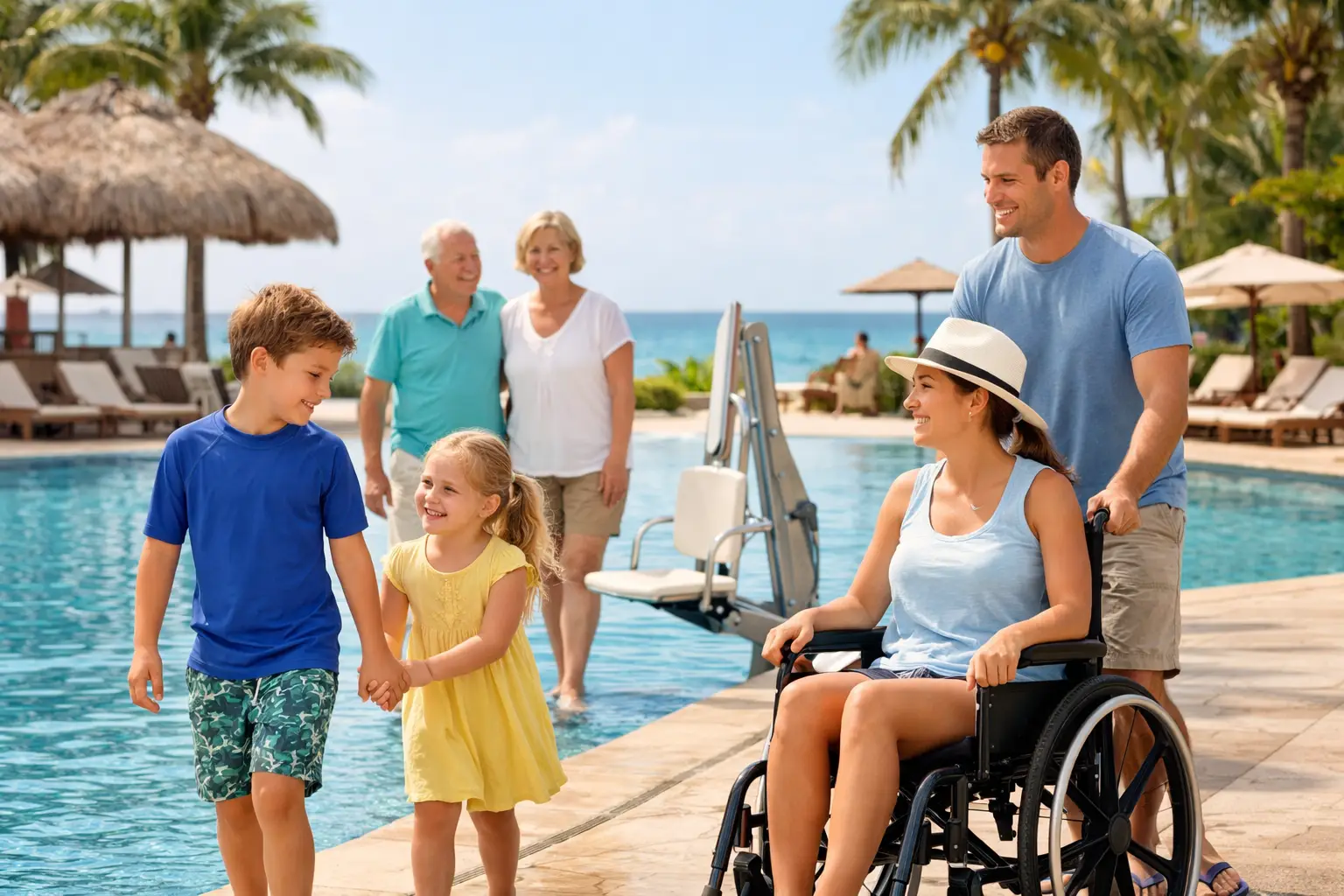
Booking a family resort looks simple until accessibility gets reduced to one vague sentence on a booking page. If you are trying to find the best accessible resorts for families, you already know the real questions are never answered upfront. Can a wheelchair or mobility scooter get around the site without a fight? Is the pool access usable in practice? Will the so-called family room actually fit the equipment you need and still leave space to move?
That is where a lot of glossy resort advice falls apart. A good family resort is not automatically a good accessible one, and a resort with an adapted room is not necessarily workable for a disabled traveller once you factor in gradients, distances, transfers, beach access and how much energy it takes to get from breakfast to the evening entertainment. For families, those details matter even more because one access failure can throw off the whole trip.
What makes the best accessible resorts for families?
The starting point is simple: access has to work across the full holiday, not just inside the bedroom. An adapted bathroom and a wider door are useful, but they are only one part of the picture. Family resorts are often large sites. That can be brilliant if paths are smooth, gradients are manageable and there is reliable step-free access to restaurants, pools, kids' clubs and communal spaces. It can be exhausting if the resort is spread across hills, broken paving or long distances that are awkward for wheelchair users and tiring for anyone with limited mobility.
For families, the best resorts usually get the basics right in a practical way. That means level or ramped access around the main areas, enough room in restaurants to move without knocking into tables, lifts that are genuinely usable, and staff who understand that access requests are not special extras. If you are travelling with children, there is another layer as well. You need enough convenience built into the resort so you are not constantly planning military-style routes just to get from one activity to the next.
Accessible family travel also depends on what kind of support you need. Some travellers can manage a standard family resort with one suitable room and decent pathways. Others need hoists, roll-in showers, pool lifts or beach wheelchairs. Neither approach is more valid than the other. It just means the phrase best accessible resorts for families will mean different things depending on your mobility, equipment and how independent you want the stay to be.
Start with the resort layout, not the brochure photos
One of the biggest mistakes families make is focusing on room photos before checking the site plan. In practice, layout often decides whether a resort feels relaxing or like hard work. A large resort with step-free routes, buggy transport and sensible spacing can be easier than a small boutique property with awkward thresholds and cramped public areas.
Look closely at where the adapted rooms sit in relation to the main facilities. If the accessible room is at the far edge of the property and the restaurant, pool and reception are all uphill, that matters. The same goes for beach resorts. "Beachfront" sounds ideal, but if the accessible route stops at a raised promenade or a deep sand stretch with no beach access matting, the beach may remain something you can only look at.
This is where honest, experience-led research helps. Reviews from disabled travellers often reveal the reality far better than official descriptions do. At Andy Wright Travel, that lived detail is what makes trip planning easier, because the difference between possible and enjoyable often comes down to the bits the hotel never mentions.
Room access matters, but bathroom design matters more
Families often search for larger rooms first, which is understandable. But for wheelchair and scooter users, the bathroom can make or break the stay. A room can be spacious and still fail completely if the shower has a lip, the toilet transfer space is blocked, or the sink placement makes it difficult to use independently.
When checking a resort, ask for actual measurements where possible. Door widths, bed height, turning space and shower access are all more useful than the word adapted. If you use a mobility scooter, ask where it can be stored and charged safely. Some resorts are perfectly happy with scooters in rooms. Others have tight access, poor charging arrangements or policies that become a problem after arrival.
For families, connecting rooms or larger family rooms can sound like the best option, but they are not always the most accessible. Sometimes the genuinely accessible room is smaller or configured differently. That creates a trade-off between space for the family and proper access for the disabled guest. It is better to know that before booking than to discover on the first night that everyone fits in theory but nobody can move around properly.
Pools, beaches and kids' facilities need proper scrutiny
A family holiday is usually built around shared activities, so accessibility to leisure spaces matters just as much as the room. Pools are a common weak point. A resort may advertise an accessible pool area because there are no steps around the edge, but that does not help much if there is no pool hoist, no graduated entry and no practical way to transfer safely.
The same goes for splash parks, playgrounds and kids' clubs. If you are a disabled parent or grandparent travelling with children, you need to know whether you can actually get to those spaces and use them without being blocked by steps, narrow gates or rough surfaces. If the children in your family are disabled, the question becomes wider again. Are the facilities inclusive, or merely present?
Beach resorts can be brilliant, but they require more digging. Useful questions include whether there is a promenade lift, a ramp to the sand, beach wheelchairs, accessible toilets near the beach and a firm route across the sand. Without those, a beach resort may still work as a base, but it may not deliver the holiday you had in mind.
Best accessible resorts for families are usually in the right destinations too
A great resort in a poor-access destination can still feel limiting. Families often focus heavily on the hotel and forget the wider setting. If you want to go beyond the resort, check pavements, transport, dropped kerbs, accessible taxis and whether nearby attractions are realistic for wheelchair or scooter users.
This is especially relevant in older Mediterranean destinations, where resorts can be more accessible than the towns around them. You may be perfectly comfortable on site but struggle the moment you want a meal out, an accessible excursion or a look around the local area. That does not make the trip a bad choice, but it does change expectations.
In general, larger modern resorts in destinations with stronger tourism infrastructure tend to give families more room to manoeuvre. Purpose-built resort areas in parts of Spain, Portugal and some long-haul destinations can offer better pathways and more consistent access than older resort towns with steep streets and uneven surfaces. Still, broad assumptions only get you so far. One excellent accessible resort can sit next to three poor ones.
Questions worth asking before you book
The best booking move is often the least glamorous one: email or ring the resort and ask direct questions. Not generic ones. Specific ones. Ask whether the adapted room has a roll-in shower, whether there are any slopes between the room and restaurant, whether pool access equipment is currently in service, and whether mobility scooters are allowed in all public areas.
If you need airport transfers, ask about the full chain of access from arrivals to the resort entrance. A good room is no use if the transfer provider cannot take your wheelchair safely or if the coach drop-off point leaves you dealing with steps and luggage in the heat.
Also ask for recent photographs, not brochure shots. Accessibility changes, maintenance slips and equipment breaks. A pool hoist that existed three years ago is not the same as one that is available and working on your travel date.
A realistic way to choose the right resort for your family
The best choice is rarely the resort with the longest feature list. It is the one that matches your actual needs with the fewest workarounds. For some families, that means a compact all-inclusive resort with strong on-site access and no need to leave the property. For others, it means a self-catering resort in an accessible destination where there is more freedom to explore.
Be honest about your non-negotiables. If level access to the pool is essential, treat that as essential. If you can manage a small threshold but not a steep hill, make that clear in your checks. Families often feel pressure to compromise because accessible options can look limited, but the wrong compromise usually shows up quickly once you arrive.
A resort holiday should give your family more freedom, not less. The right place makes daily life easier, keeps everyone included and removes the constant background stress of wondering what the next barrier will be. That is what you should be paying for really - not a polished accessibility claim, but a holiday that works in the real world.
0 Comments
Leave a Comment