
Are Beach Resorts Wheelchair Accessible? What to Check
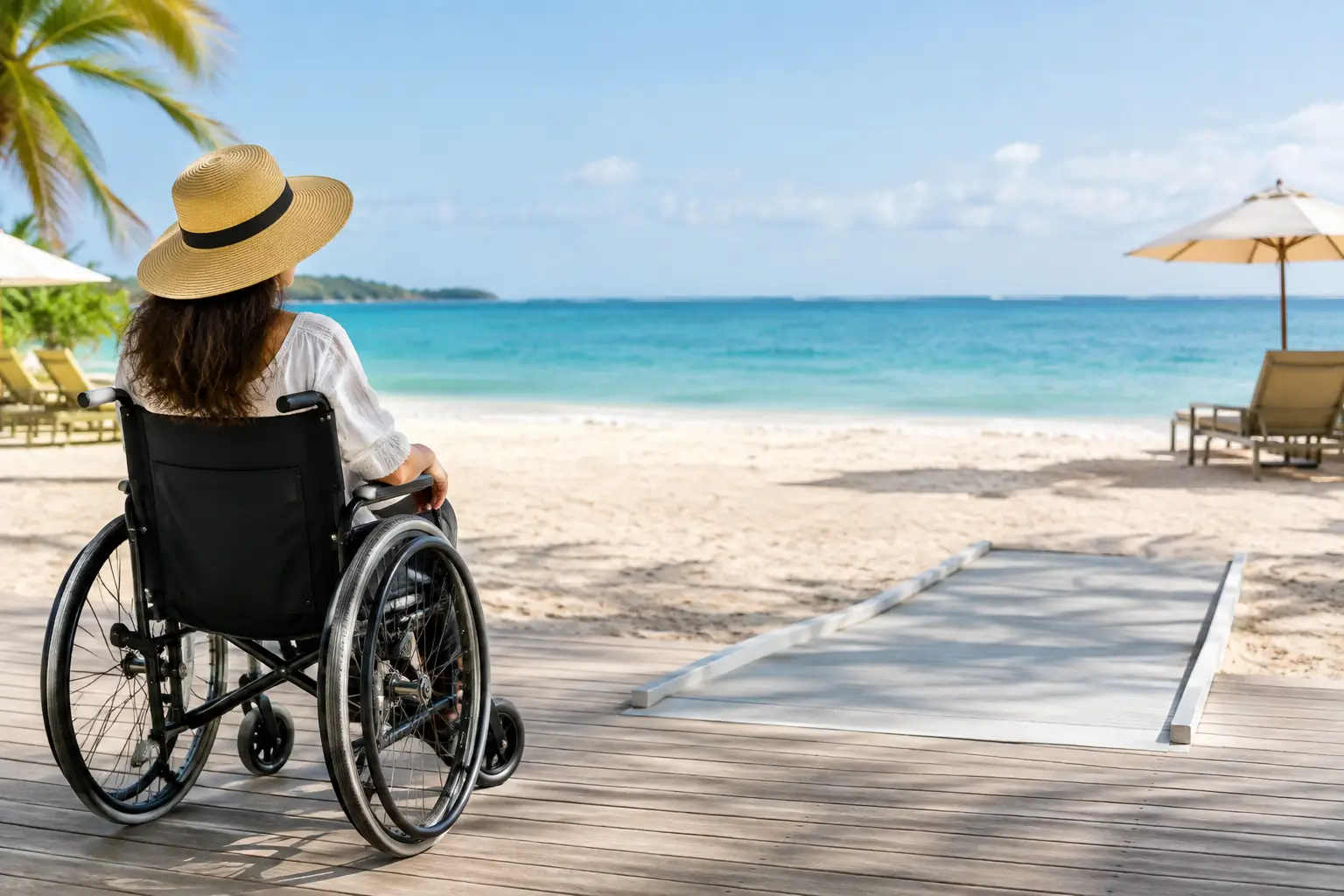
A glossy photo of a flat, golden beach tells you very little when you use a wheelchair or mobility scooter. Are beach resorts wheelchair accessible? Some are, genuinely. Others have one ramp to reception, a so-called adapted room, and a beach that can only be reached down steep sand or a flight of steps.
The difference matters because a beach holiday is not just about getting into the hotel. You need to move around the resort, reach the pool, get to the promenade, use the toilet, board transport and, ideally, get close enough to the sea to enjoy it. Accessibility has to work as a whole route, not as a tick-box feature in a booking description.
Are beach resorts wheelchair accessible in practice?
They can be, but it depends heavily on the property, the destination and your own equipment. Purpose-built newer resorts often have level public areas, wide doors, lifts and roll-in showers. A resort may also have paved grounds and a beach promenade that is easy to use independently.
That still does not guarantee beach access. Sand is the biggest obstacle. Even a powerful mobility scooter can quickly sink, while manual wheelchair users may need assistance unless the resort provides a proper access mat, boardwalk or beach wheelchair. A hotel can be excellent for an accessible city break and still be frustrating for a beach-focused holiday.
Treat any claim of “wheelchair friendly” as the beginning of your research, not the answer. Ask for details that relate to your day, from leaving your room in the morning to returning after dinner.
Why the word “accessible” can be misleading
Hotels use accessibility in different ways. One may mean a ramp at the entrance. Another may have accessible bedrooms but no pool hoist. A third may be fully step-free inside, yet built on a hill with a beach reached by dozens of steps.
There are also differences between a wheelchair user who can transfer independently, someone travelling with a carer, and a mobility scooter user with a larger turning circle and charging needs. An adapted bathroom with grab rails may be perfectly usable for one person and impossible for another if the toilet is too close to the wall or the shower has a raised lip.
Beach resorts bring extra variables: hot surfaces, sea air, uneven paving, windy promenades and distances that look modest on a site map but feel very different in 30-degree heat. If the restaurant, room, pool and beach are spread across a large complex, a scooter may make the holiday far more manageable - but only if it can be safely stored and charged.
What to check before booking a wheelchair-accessible beach resort
Do not rely on a single accessibility symbol beside the room type. Contact the resort directly, preferably in writing, and ask for current photographs or a short video. A recent video of the exact room and route to the beach is worth far more than polished promotional images.
The room and bathroom
Ask whether the room is on the ground floor or served by a lift, and whether there are any steps from reception, the lift or the nearest drop-off point. Confirm the clear width of the bedroom and bathroom doors, particularly if you use a larger powered chair or scooter.
For the bathroom, ask whether the shower is level-entry, whether there is a fixed or portable shower seat, and where the grab rails are positioned. Check the under-sink clearance, bed height and space beside the bed for transfers. If you need a hoist, do not assume one will be available simply because the room is labelled accessible.
Routes around the resort
A resort map can hide a lot. Find out whether paths are smooth and level, or made from loose gravel, cobbles or steep ramps. Ask about gradients between the room, restaurants, pool, reception and beach exit. Also ask whether there are steps at any of the bars, terraces or evening entertainment areas.
If you use a mobility scooter, confirm where it can be parked overnight and charged. Some hotels will not allow scooters in bedrooms or corridors due to fire rules, and a vague promise that staff will “find somewhere” is not enough. You need a secure, accessible charging arrangement before you travel.
Getting onto the beach
This is the question that changes everything: can you reach the sand, and can you travel across it? A firm promenade beside the beach is useful, but it is not the same as access to the shoreline.
Ask whether there is a permanent boardwalk or seasonal access mat, how wide it is, and how close it gets to the water. Wooden paths can be excellent when maintained, but gaps, raised edges and sand build-up can make them difficult. Check whether beach wheelchairs are available, whether they must be booked, and whether staff assist with transfers.
A beach wheelchair is often designed for soft sand and shallow water, but it may not be self-propelled. If independent access is essential, establish exactly how it works before committing. The same applies to beach buggy services, which can be brilliant but may only operate at set times.
Pools, toilets and food areas
A pool with steps is not an accessible pool. Ask whether there is a pool hoist, a sloped entry or both, and whether staff are trained to operate the equipment. It is sensible to ask for a photograph too, as a hoist may be present but stored away, poorly positioned or unsuitable for your transfer needs.
Check that there is an accessible toilet near the pool and beach, not just in the hotel lobby. Restaurants should have step-free access, usable table spacing and at least one accessible route to the buffet or bar. Small details such as a high buffet counter or heavy self-closing doors can chip away at independence.
Questions worth sending in one message
Keep your enquiry clear and specific. Give the resort the dimensions of your chair or scooter and explain whether you transfer independently. Ask them to answer these points rather than simply confirming that the hotel is accessible:
- Are there any steps or steep slopes between the accessible room, reception, restaurant, pool and beach?
- Is the shower completely level-entry, and is a shower chair supplied?
- Can my wheelchair or mobility scooter be securely charged overnight?
- Is there a boardwalk, access mat or beach wheelchair, and is it available throughout my stay?
- Does the pool have a working hoist, and can guests use it without lengthy notice?
- Can an accessible taxi or transfer vehicle drop me at the correct entrance?
The quality of the reply is useful evidence. A resort that answers each point clearly, sends photos and acknowledges limitations is usually more reliable than one offering a cheerful but vague “no problem”.
Think beyond the resort gates
A resort can meet your needs while the surrounding area does not. If you want to go out for meals, visit a harbour or use the local beach promenade, check the pavements, kerbs, public toilets and accessible taxi availability. In some destinations, a hotel shuttle has steps, and the only accessible transfer needs booking well in advance.
Season also matters. Temporary beach mats, beach wheelchairs and accessible toilets may operate only during the main season. Strong winds can cover boardwalks with sand, while storms can damage ramps and paths. If beach access is the main reason for the trip, ask what is available during your exact travel dates, not just in summer generally.
Do not forget the journey from airport to hotel. An accessible room loses much of its value if you arrive to find a standard minibus with no lift and no space for your chair. Confirm whether your wheelchair travels with you, how it will be secured, and whether a scooter can be accommodated without being dismantled.
When a resort is not the right fit
Sometimes the honest answer is that a beautiful beachfront property will create too much work. There is no failure in choosing a resort a little farther back from the sea if it has level grounds, reliable accessible transport and a proper beach access point nearby.
A self-catering flat near an accessible promenade can also be a better option than a huge all-inclusive hotel with long, uneven routes. What matters is the freedom to do the things you came for, without having to plan every movement around a set of avoidable barriers.
If you are travelling with family or friends, be realistic about how much help you are happy to need. Assistance can make a difficult route possible, but it should be a choice, not the only way you can leave your room or reach the sea.
The right beach resort is the one that gives you more than an adapted bathroom. It gives you a workable route to the moments that make a holiday feel like a holiday: the sea air, a drink by the water, an evening along the promenade, and the freedom to decide where to go next.
0 Comments
Leave a Comment