
Airport Assistance for Scooter Users
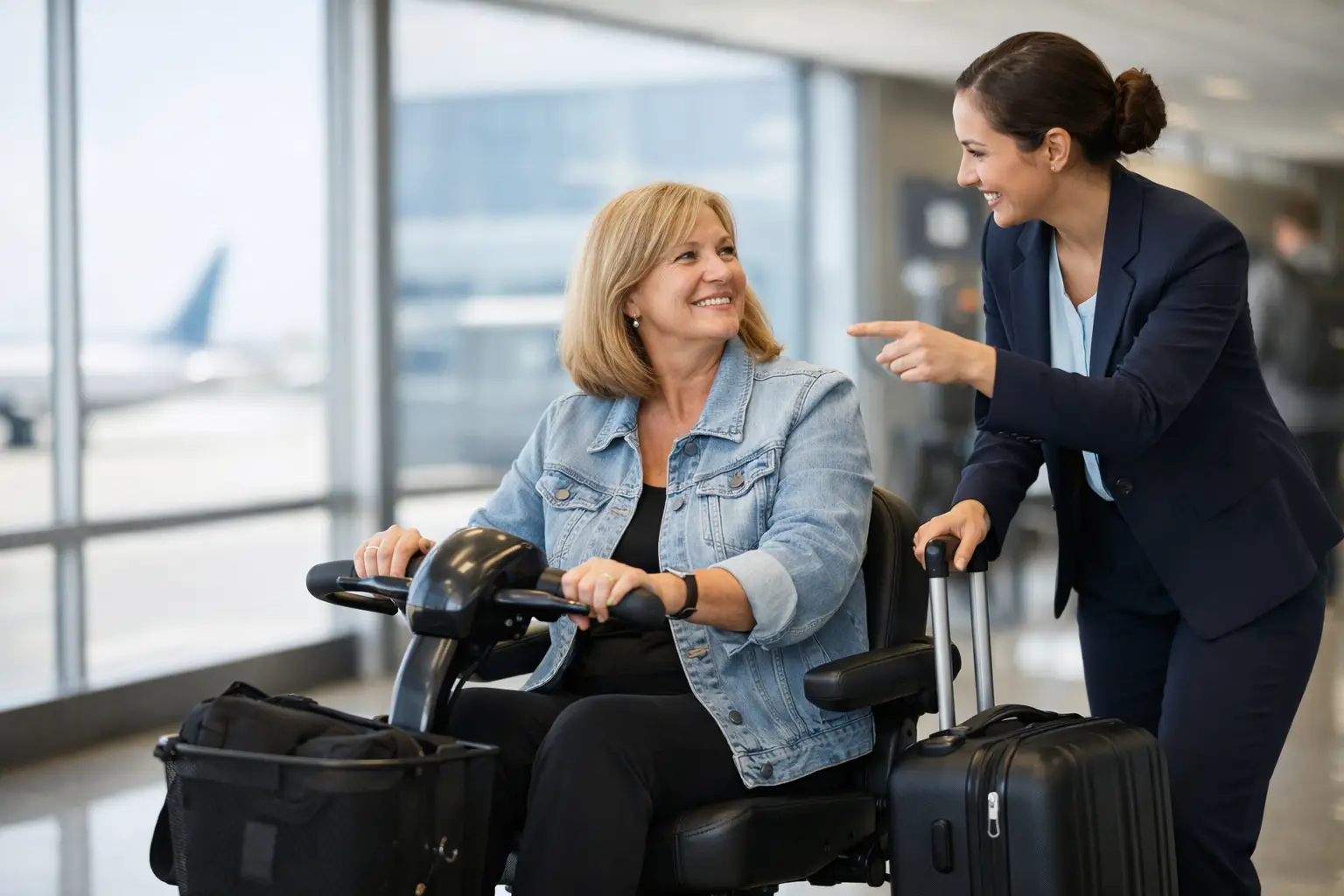
Turning up at the airport with a mobility scooter and hoping the process sorts itself out is a good way to start your trip under pressure. Airport assistance for scooter users can work very well, but only when the airline, the airport and you are all working from the same information.
That is the bit too many generic travel pages miss. They tell you assistance exists, but not where things usually go wrong. If you use a scooter, the details matter - battery type, scooter weight, whether it folds, how far you can walk if asked to transfer, and what happens if staff try to separate you from your scooter too early. Getting those points right can make the difference between a smooth departure and a stressful argument at check-in.
What airport assistance for scooter users actually covers
Airport assistance is not one single service. It is a chain of handovers. Depending on the airport and airline, that may include help from the terminal entrance, support at check-in, assistance through security, help to the gate, boarding support, and assistance again on arrival.
For scooter users, the gap between what is promised and what is delivered often comes down to how your scooter is classified and how confident staff are with mobility equipment. Some teams are excellent. Others understand wheelchairs better than scooters and may make assumptions that do not fit your situation.
In practice, you should expect assistance staff to help you get from one stage to the next once you have checked in and identified yourself. What you should not assume is that every member of staff will know your scooter's battery rules, dismantling method, or whether you can remain in it until the aircraft door. Those are points you often need to repeat calmly and clearly.
Book assistance early and be precise
The biggest mistake is asking for "special assistance" and leaving it at that. That is too vague. When you book, give proper detail about your mobility needs and your scooter.
Tell the airline whether you travel in a mobility scooter, whether it is manual folding or powered, and whether you can walk short distances or not at all. Give the make and model if possible, plus the dimensions and weight. Also state the battery type - usually sealed lead acid, gel or lithium - because battery approval is often the issue that slows things down.
If your scooter folds or comes apart, say so, but do not let that turn into permission for staff to handle it without guidance. If there is a specific way to switch it to freewheel, remove the battery, secure the tiller or protect fragile parts, write it down and carry that information with you.
It is also worth checking whether your airport wants assistance booked through the airline, directly with the airport, or both. In theory the systems should talk to each other. In real life, confirmation can be patchy. I would always recheck a few days before flying.
Know the battery rules before the airport does
This is where scooter travel lives or dies. Airlines are cautious about batteries, and if your battery information is unclear, the default response may be delay or refusal.
Sealed batteries are usually more straightforward than lithium, but you still need the exact specification. If you use lithium batteries, the watt-hour rating matters. Do not guess. Check the label, the manual, or the manufacturer paperwork and keep a photo on your mobile phone. Some airlines will want advance approval, and some will have a limit on the size or number of batteries they accept.
It is also sensible to carry simple written instructions explaining how to isolate the battery if required. Staff may not know your scooter, and that uncertainty can lead to rough handling or unnecessary dismantling. The more clearly you can explain what needs doing, the better.
Arrive earlier than you think you need to
If you are using airport assistance for scooter users, extra time is not optional. Even when everything is booked correctly, there can be queues for assistance teams, confusion over documentation, or delays getting an aisle chair or lift vehicle.
I would rather spend extra time airside than start the day chasing missing assistance. Aim to arrive with enough margin for check-in problems, battery discussions and the possibility that you need to explain your scooter more than once.
That early arrival also gives you a better chance of keeping your scooter with you for as long as possible. Once the airport gets busy, staff are more likely to want to move equipment quickly rather than carefully.
Check-in is where you set the tone
At check-in, be clear, polite and direct. Confirm that assistance has been booked, confirm that your scooter is tagged correctly, and ask when you will need to transfer out of it.
This last point matters. Many scooter users can stay in their own device until the gate or even the aircraft door, depending on airport procedure. Others are asked to transfer earlier into an airport wheelchair. If you can safely stay in your scooter longer, say so. Your own scooter is usually the most supportive and least tiring option.
This is also the time to hand over any instructions for dismantling or securing the scooter. If your tiller folds, if the key needs removing, or if freewheel mode must not be engaged on a slope, make that plain. Never assume baggage staff will work it out.
Security can be awkward, but it is manageable
Security is one of the least comfortable parts of the airport for many disabled travellers because procedures are not always explained well. If you cannot stand unaided, cannot walk through the scanner, or need a private search, say so early rather than waiting to be told what to do.
For scooter users, staff may swab the scooter, inspect cushions or bags attached to it, and ask questions about removable parts. None of that is unusual. What matters is whether they communicate properly and give you time.
If you are travelling with medication, tools for dismantling your scooter, or spare battery-related items approved by the airline, keep them organised and easy to show. A rushed bag search is harder when everything is buried under travel essentials.
Boarding is usually the most tiring stage
Even good airports can struggle here. You may be taken to the gate early and then left waiting, or boarded last when everyone else is already seated. Sometimes you will use an airbridge, sometimes a high loader vehicle, and sometimes an aisle chair for the final transfer.
There is no single perfect method because aircraft type and airport layout make a difference. What matters is reducing unnecessary transfers. Every extra move increases fatigue, discomfort and the chance of something being handled badly.
If your scooter is being taken for loading, remove anything detachable that could get lost or damaged. That may include the key, basket, cushion, charger, control panel cover or armrests if they come away easily. Take photos of the scooter from several angles before handing it over. It is a simple step, but very useful if anything comes back bent, scratched or missing.
Arrival support is just as important as departure
A lot of travellers focus on getting onto the aircraft and forget the other end. Yet arrival can be where patience really gets tested.
In the best-case scenario, your scooter is returned at the aircraft door or very close to it, and assistance staff help you through passport control and baggage reclaim. In less ideal situations, you may be left waiting onboard while equipment is located, or transferred into an airport chair while your scooter comes separately.
That is why you should ask before departure how the scooter will be returned on arrival. If the answer is vague, ask again at the gate. It is easier to push for clarity before take-off than after landing when everyone is trying to clear the aircraft.
Where things commonly go wrong
The most common problem is poor communication between airline and airport teams. The second is incomplete information about the scooter. The third is staff assuming all mobility equipment works the same way.
Sometimes the issue is not refusal but overhelp. Well-meaning staff may try to fold, lift or push parts that should not be forced. If that starts happening, step in immediately and explain. Being assertive is not being difficult. It is protecting the equipment you rely on.
There is also a trade-off between independence and process. Some travellers prefer to keep full control until the last possible moment. Others would rather transfer earlier and avoid last-minute pressure. Neither is wrong. The right approach depends on your stamina, pain levels, confidence with transfers and how reliable the airport has been in the past.
A practical mindset helps more than perfect paperwork
Good preparation matters, but flexibility matters too. Even when you have done everything right, airport assistance can still be inconsistent. The aim is not to expect perfection. It is to remove as many avoidable problems as possible.
Carry your scooter specifications, battery details and handling instructions in print and on your mobile phone. Keep essential items in your hand luggage, not in the scooter basket. Build in time, ask direct questions, and do not be afraid to repeat yourself. That is not fussing. That is sensible travel planning.
For many disabled travellers, flying with a scooter feels daunting the first few times because so much depends on other people. But airport assistance should support your independence, not shrink it. The more clearly you know your own equipment and the process around it, the easier it becomes to hold people to the standard you need - and keep your trip focused on the destination, not the drama at departures.
0 Comments
Leave a Comment