
Accessible Train Travel in Britain
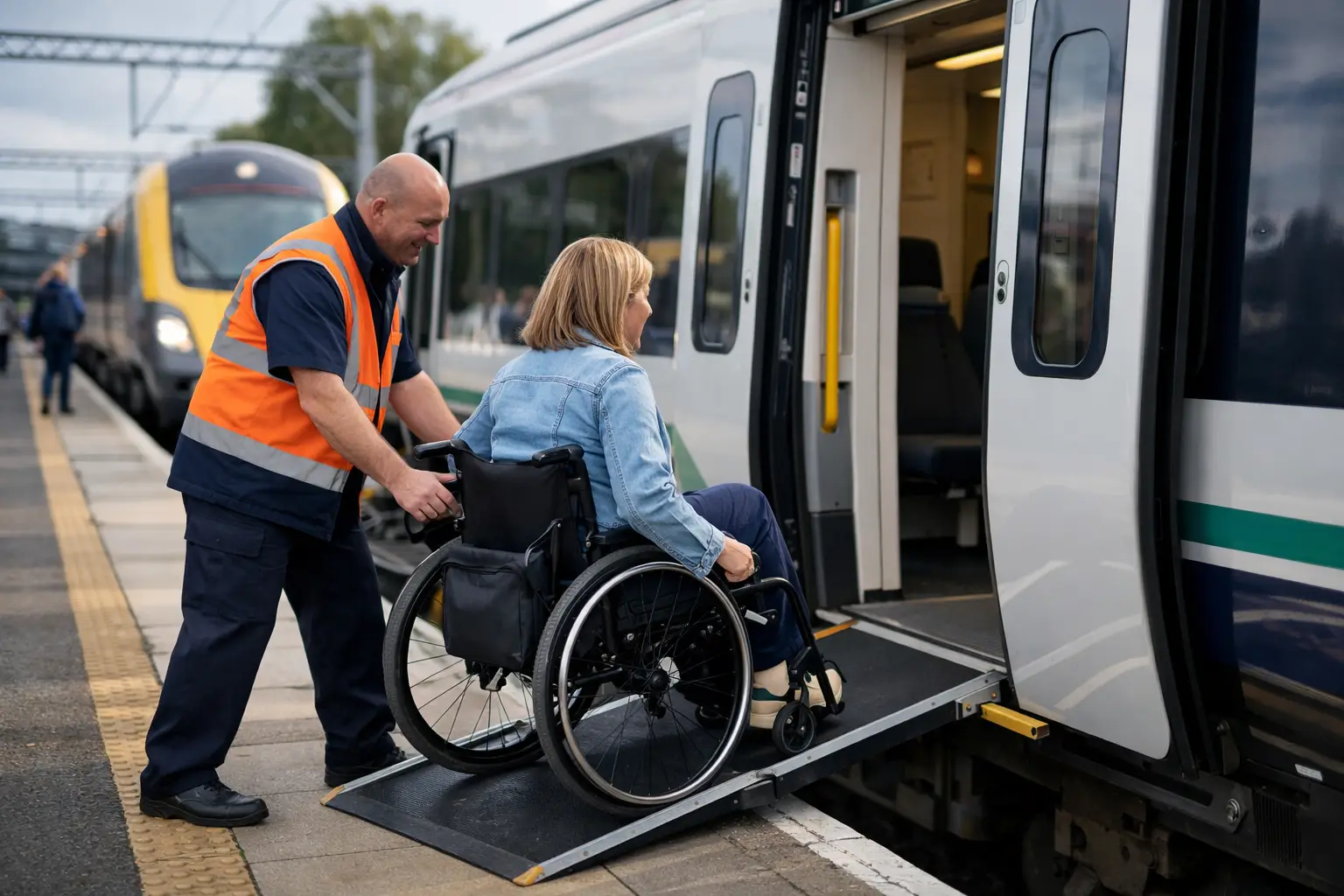
If you use a wheelchair or mobility scooter, train travel can give you a level of freedom that driving, parking and airport queues often do not. But accessible train travel in Britain still depends heavily on planning, station layout and whether staff do what they are supposed to do on the day. That is the honest version, and it is the version that helps people travel with confidence.
Britain’s rail network can absolutely open up city breaks, day trips and longer journeys. I have found trains can be one of the most practical ways to travel if the route, station access and boarding arrangements all line up properly. The problem is that rail accessibility is rarely as simple as a tick-box on a booking page. A station may be called accessible, but that can mean anything from step-free from street to platform to a long diversion involving ramps, staff assistance and one working lift.
What accessible train travel in Britain really looks like
The biggest mistake people make is assuming accessibility is standard across the network. It is not. Some stations are straightforward, modern and well organised. Others are technically manageable but only if everything works perfectly. That means the lift needs to be operational, staff need to be available, and the platform-train gap needs to be handled properly.
For wheelchair users, the key issues are usually boarding ramps, accessible spaces on board, station lifts and accessible toilets. For mobility scooter users, there is an extra layer. Not every train company accepts every scooter, and size and turning radius can matter. A journey that works for a manual wheelchair user may not work for a larger Class 3 scooter.
That does not mean trains are off the table. It means you need proper information before you commit your time and money.
Start with the train company, not just the ticket price
When people book rail travel, it is tempting to go straight for the cheapest fare and sort accessibility later. In practice, that is often backwards. First find out which operator runs your route and what their mobility policy says. Then check whether your wheelchair or scooter fits their rules for boarding and onboard spaces.
Some operators are clearer than others. A few explain dimensions well and provide sensible guidance. Others are vague, which is frustrating when you need certainty. If you use a mobility scooter, pay attention to whether they require it to be folded, whether they insist on transfer to a seat, or whether they allow travel while seated on the scooter. These differences matter a lot.
It is also worth checking whether your route includes changes. A direct train is usually the safer option if you have limited mobility, because every change adds another chance for things to go wrong. One late train or one missing member of staff can turn a manageable journey into a stressful one very quickly.
Book assistance, even if you usually travel independently
There is no loss of independence in booking help when the system is built around staff-operated ramps and controlled boarding. Passenger assistance exists for a reason, and for many journeys it is the difference between a smooth trip and a needless battle on the platform.
You can often book assistance in advance for boarding, alighting and help between platforms. If you are changing trains, make sure every leg of the journey is covered. Be specific about what you need. Saying you are a wheelchair user is useful, but telling them you need a ramp, lift access and support at an interchange is better.
That said, assistance is not foolproof. Most disabled travellers know this already. Sometimes staff are excellent and everything runs exactly as planned. Sometimes nobody appears and you have to start advocating for yourself. This is why I always recommend arriving with enough time to speak to staff before the train comes in, even if assistance has been booked.
Check stations properly, not casually
A station being marked step-free does not always tell the full story. You need to know whether step-free access exists for the specific platform you need, and whether it depends on a lift, a long bridge, or a side entrance that is easy to miss.
For accessible train travel in Britain, station research is often the part that saves the journey. Look at station access notes, platform information and whether there is staff coverage throughout the day. If a station is unstaffed for part of your trip, that changes the risk. If the station depends on lifts and one is out of order, you may not be able to travel at all.
This matters even more at older stations, where heritage layouts and modern accessibility do not always sit comfortably together. A beautiful station can still be awkward if the route to the platform is steep, narrow or split across multiple lift sections.
Onboard access varies more than it should
Modern trains are generally better, but not all rolling stock is equal. Some accessible spaces are well designed, with decent turning room and clear priority areas. Others feel like accessibility was added reluctantly and squeezed into whatever space was left.
Accessible toilets are another mixed picture. When they are available and working, they make a huge difference on longer journeys. When they are locked, out of order or blocked by luggage, the experience changes fast. If you are planning a long route, especially with a change involved, it is sensible to think about toilet access at stations as well as onboard.
The gap between the train and platform is another practical point. At some stations the ramp process is quick and routine. At others, there is a noticeable height difference or a larger gap, which makes staff support essential. That is not necessarily a reason not to travel, but it is a reason to avoid assuming every station will work in the same way.
Mobility scooter users need to ask different questions
Wheelchair access information and scooter access information often get lumped together, but they are not identical. A scooter user should check dimensions, weight limits, whether there is a permit scheme, and whether the operator allows travel on that specific type of scooter.
This is where generic accessibility claims become especially unhelpful. You need operational detail. Can the scooter turn into the designated space? Is there enough room near the doorway? Are staff familiar with boarding scooter users or are you likely to spend ten awkward minutes explaining your equipment on the platform?
That level of detail is exactly why lived experience matters. It is also why brands like Andy Wright Travel have value for disabled travellers - not because accessibility sounds good in theory, but because practical detail decides whether a trip is realistic.
Build in backup plans
This is the part many mainstream travel articles skip, but disabled travellers know better. You should always think about what happens if the lift is broken, the assistance does not show, or the train is cancelled and the replacement transport is not accessible.
A backup plan might mean choosing a route with fewer changes, travelling earlier in the day when staffing is stronger, or identifying a nearby accessible station if your first option fails. It could also mean carrying the train company’s assistance contact details and allowing extra time so you are not trying to solve a problem under pressure.
None of this is about lowering expectations. It is about travelling on your own terms and not being caught out by a system that can still be inconsistent.
When trains are the right choice
Despite the caveats, trains can still be one of the best options for disabled travel in Britain. City centre arrivals are a major advantage. You avoid car parks, long transfers and the nonsense that often comes with trying to get dropped off close to a venue. For many routes, especially between major cities, rail is faster, less tiring and more practical than driving.
The network also becomes easier to use once you know how particular operators and stations behave. Confidence often grows route by route. A journey that feels daunting the first time can become fairly routine when you know where the lift is, which carriage to aim for and how responsive the staff usually are.
That is the real heart of accessible rail travel. Not perfection, because Britain is not there yet. It is about knowing enough to reduce the uncertainty.
The honest way to travel better by rail
Accessible train travel in Britain is possible, and for many people it is worth pushing through the extra planning because the payoff is genuine independence. But good journeys rarely happen by accident. They happen because you checked the station, questioned vague accessibility claims, booked assistance where needed and gave yourself room to adapt if something changes.
You should not have to do that much homework just to catch a train. For now, though, that is the reality. The upside is that once you start learning which routes and operators work for you, the map gets bigger, the options improve and travel starts to feel like yours again.
0 Comments
Leave a Comment