
Accessible Thailand Island Guide for Wheelchairs
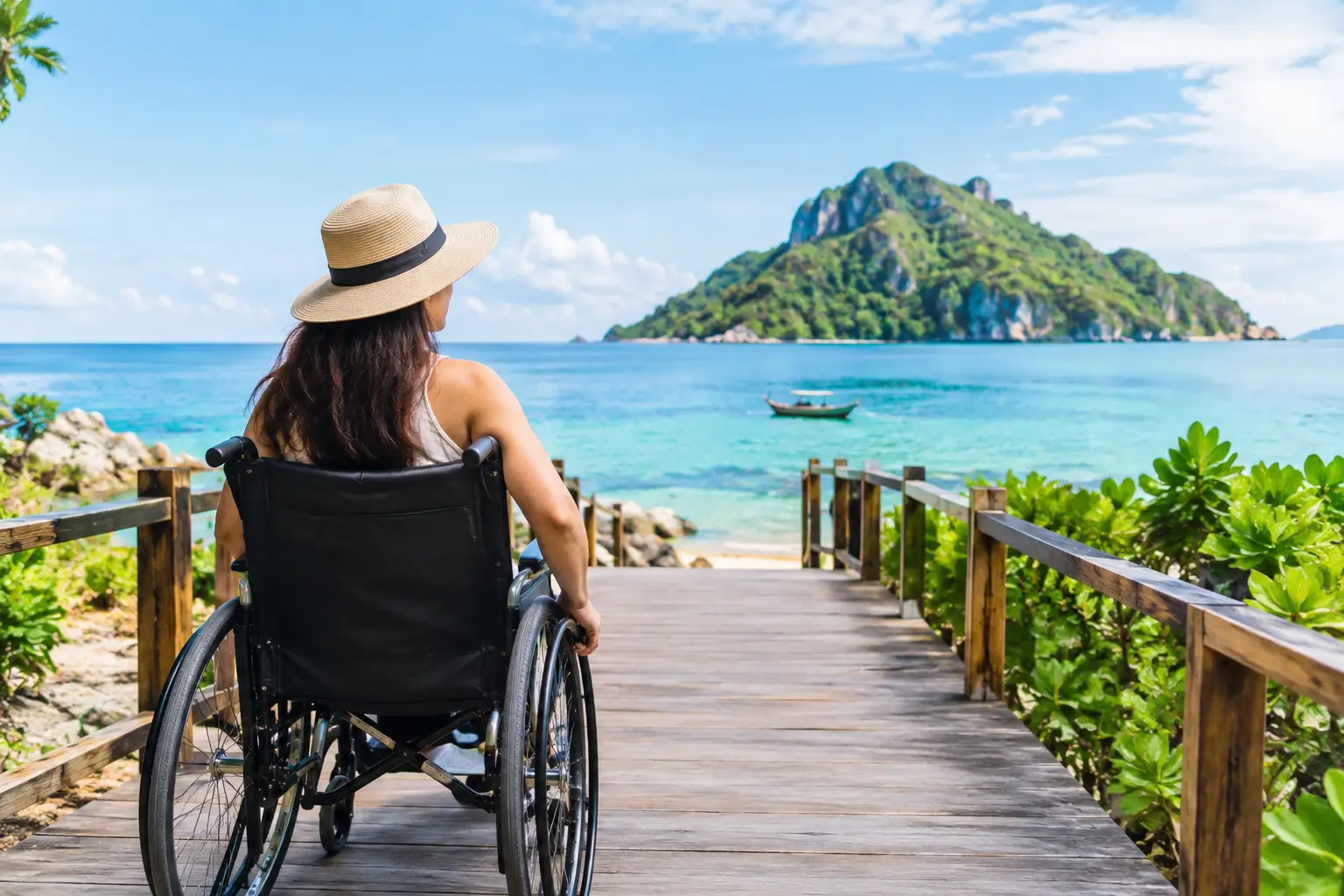
Thailand’s islands can be a brilliant holiday choice, but they are not interchangeable when you use a wheelchair or mobility scooter. This accessible Thailand island guide starts with the decision that makes the biggest difference: choosing an island where you can actually get from the airport or ferry to your hotel, then out to eat, shop and see the sea without turning every journey into a problem-solving exercise.
The glossy photos rarely show the broken pavements, steep hotel driveways, sand paths or high kerbs. None of those automatically rules Thailand out. They do mean that a good trip depends on planning the practical bits before you pay a deposit.
Start with the right island, not the cheapest hotel
For many wheelchair and scooter users, Phuket is the most straightforward island choice. It has an international airport, a large choice of resorts, more accessible-style rooms than smaller islands, private adapted transfers and developed beach areas. Pavements remain inconsistent and the main resort areas can be busy, but it is generally easier to find alternatives when one route or venue does not work.
Patong is lively and convenient for restaurants, shops and nightlife, but it can be noisy, crowded and awkward on a scooter once traffic and parked motorbikes narrow the pavement. Kamala, Kata and Karon can feel more relaxed, although the exact location of the hotel matters more than the resort name. A property set on a hill can make an otherwise accessible room useless without an adapted vehicle.
Koh Samui is a sensible second option, particularly if you want a slower island feel while retaining an airport and established resorts. The island’s ring road is useful for vehicle travel, but walking and rolling independently outside a hotel can be difficult. Pavements often disappear, drainage channels break up routes and beach roads may be steep. Choose a hotel with restaurants and facilities on site, or budget for a driver rather than expecting to roll along the road each evening.
Koh Lanta appeals to travellers wanting quiet beaches, but it is less forgiving for independent mobility. Roads, beach access and transport options are more limited. It can work well with a suitable resort and a pre-arranged accessible vehicle, but it is not the place to arrive hoping to improvise. Smaller islands reached only by speedboat or traditional ferry need even more caution. Boarding may involve uneven pontoons, steps, tides and crew lifting equipment. If you cannot safely transfer, or your scooter cannot be handled without risk, an island ferry can be the point where the plan falls apart.
Getting there: make transfers the first booking
The flight is only one part of the journey. Tell the airline at booking that you are travelling with a wheelchair or mobility scooter and provide the battery type, dimensions and weight. Lithium batteries have specific rules, and airlines can have different limits for detachable batteries. Keep battery information, a photograph of the label and your chair or scooter’s specifications with you.
At the airport, request assistance all the way to the aircraft door. If you cannot walk to your seat, make clear that you need an aisle chair. Do not assume this has been added merely because a wheelchair was selected during booking. For powered equipment, remove loose items such as cushions, baskets, keys and controllers where possible. Label the equipment with your name, phone number and simple handling instructions.
On arrival, the key question is not whether a taxi exists. It is whether a vehicle can take you and your equipment safely. Standard Thai taxis and shared minibuses are rarely suitable for a full-size wheelchair or mobility scooter. A larger van may still have no ramp, no lift and no proper securing points.
Arrange an adapted transfer before travelling, ideally in writing with the equipment measurements included. Ask whether the vehicle has a ramp or lift, whether you remain in your wheelchair during travel, and whether staff can manage the hotel entrance. A driver who says “no problem” without asking a single measurement is not necessarily confirming anything useful. Send photos if needed.
For a multi-island holiday, be equally direct with ferry operators and transfer companies. Ask about boarding from the pier, the number of steps, whether a ramp is available at both ends and what happens at low tide. A service described as wheelchair friendly may simply mean staff will carry a folding chair. That is very different from safely transporting a heavy mobility scooter.
Choose accommodation by the route, not the room label
An “accessible room” in Thailand can mean anything from a ground-floor room with a wider bathroom door to a genuinely well-designed space. Request photographs and measurements before booking. This is not being difficult. It is how you avoid paying for a room that you cannot use properly.
Check the width of the entrance and bathroom doors, the height of the bed, the shower threshold, the location of grab rails and the space beside the toilet. A roll-in shower is helpful only if there is enough turning space and the floor does not send water across the whole bathroom. Ask whether there is a fixed shower seat or whether one can be supplied.
Then check the wider property. Is there a step from the drive to reception? Are there ramps between the room, breakfast area, pool and beach? Is the route level or sharply sloped? Are lifts available in every building, and will your scooter fit? Resorts are often spread over large grounds, so a room near reception can be a better choice than a supposedly upgraded room at the far end of a steep path.
A beach-front hotel does not guarantee beach access. It may mean a beautiful view over steps, rocks or deep sand. If putting your wheels on the beach is important, ask specifically whether there is a mat, boardwalk, beach wheelchair or firm path. Ask where it starts and ends. Some hotels can provide assistance, but that is not the same as independent access.
Moving around once you are there
Thailand is easiest when you plan for a mix of independence and support. Within a well-chosen resort, you may be able to get about comfortably. Outside it, uneven paving, open drains, dropped kerbs that are too steep and motorbikes parked across footways can quickly change the picture.
A mobility scooter is useful on smooth hotel grounds and promenades, but it is vulnerable to heavy rain, standing water and rough surfaces. Keep charging arrangements simple. Confirm the local voltage is suitable for your charger, take the correct plug adaptor and avoid relying on a single extension lead. If your accommodation has frequent power cuts, ask whether there is a generator.
For day trips, a private vehicle and driver is usually more realistic than group excursions. Group tours often involve minibuses, piers, high-sided boats, beach landings and rushed timings. A private itinerary lets you stop when you need a toilet, avoid a venue with steps and choose attractions with flatter access. It costs more, but it can turn a frustrating day into one that is actually enjoyable.
Temples, viewpoints and markets vary hugely. A ground-level temple courtyard may be manageable, while the famous viewpoint nearby is reached by steep steps. Night markets are often good for food and atmosphere, but go early before crowds build and leave room to turn. Carry small cash for accessible taxis, snacks and toilets, and keep a waterproof cover handy during the wet season.
Manage the heat, rain and beach reality
Heat affects batteries, tyres, medication and energy levels. Plan outside activities for morning or late afternoon, drink regularly and do not be pressured into a full-day tour simply because it is on the itinerary. In hotter months, an air-conditioned vehicle between stops is more than a luxury.
Rain brings another set of challenges. Sudden downpours can flood low pavements and make tiled entrances slippery. Keep a lightweight poncho that covers your controls, a dry bag for medication and documents, and a towel for wet seats or footplates. If you use a powered chair or scooter, check the manufacturer’s guidance on rain exposure rather than assuming it is waterproof.
Beach holidays also need an honest expectation. Firm sand near the waterline may be accessible at one tide and impossible at another. Beach wheelchairs are useful where available, but they generally need someone to push them. A pool with level access may give you more reliable swimming than the sea, particularly if you are travelling independently.
The questions worth asking before you book
Send the same clear questions to the hotel and transfer company, rather than relying on a booking site filter. Ask whether you can stay in your own wheelchair in the transfer vehicle, whether the accessible room has a step-free shower, and whether the route from your room to breakfast and the pool is step-free.
Also ask for current photographs. Properties change, ramps are sometimes blocked, and older pictures can hide a lot. If the reply is vague, keep looking. A clear answer from a modest hotel is more valuable than a five-star promise that nobody can explain.
Thailand rewards preparation, not blind optimism. Pick an island with usable transport, give your hotel the details of your equipment, and leave breathing space in the itinerary. Once those foundations are in place, the warm evenings, excellent food and island views are there to enjoy on your own terms.
0 Comments
Leave a Comment