
Accessible Hotel Room Checklist
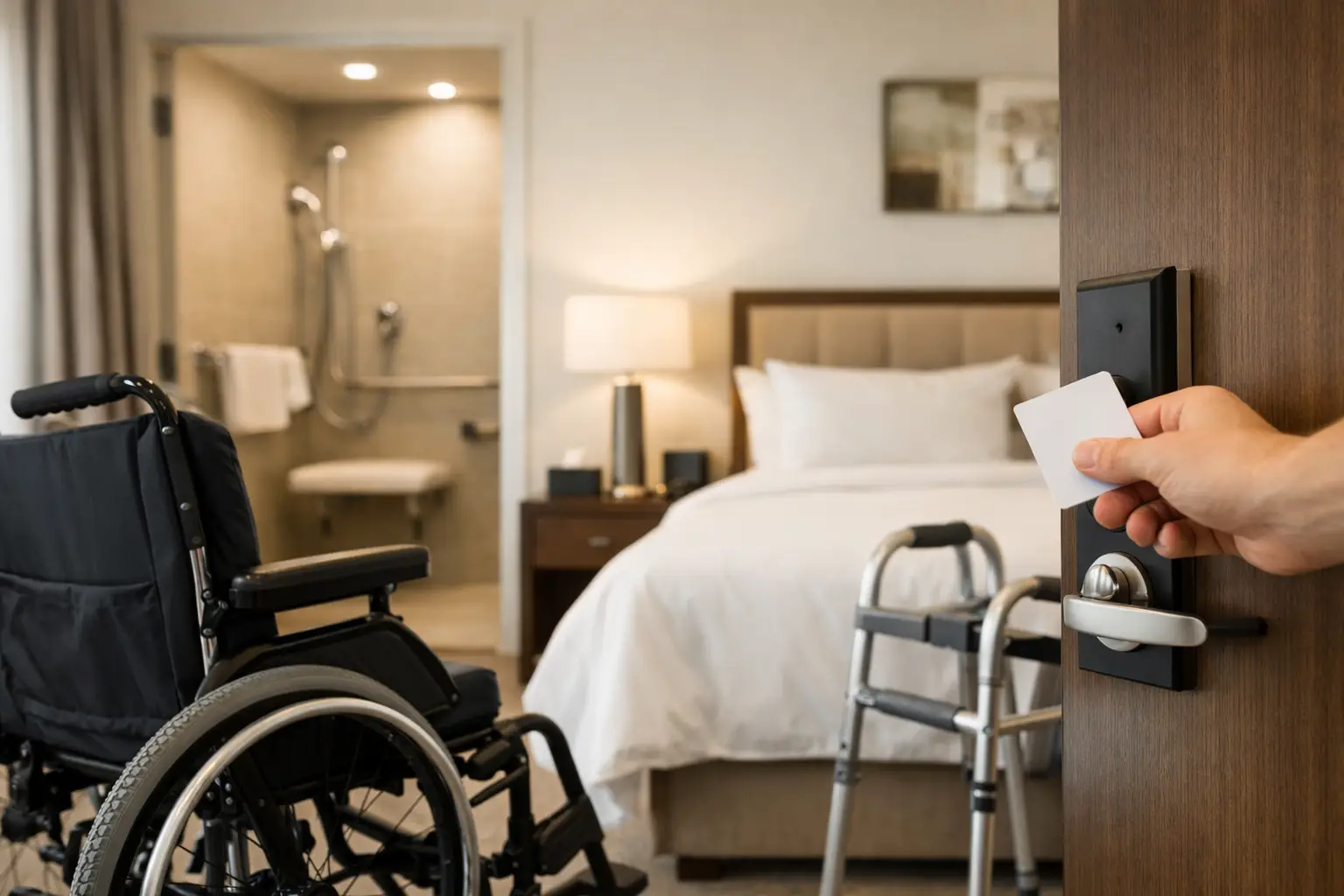
A hotel can look perfect online and still be completely wrong the moment you arrive. One so-called accessible room might have a step into the bathroom, a bed too high to transfer onto, or a charging point hidden behind heavy furniture. That is why an accessible hotel room checklist matters. It helps you move past vague promises and focus on the details that actually decide whether a stay works.
If you use a wheelchair, mobility scooter or walking aid, the room is only part of the story, but it is the part that can ruin a trip fastest if it is wrong. A decent location and a friendly receptionist do not make up for a bathroom you cannot use independently. The aim is not to be fussy. It is to avoid being stuck, unsafe or forced to rely on help you did not plan to need.
For video reviews, please watch the Hotel, Motel and Holiday Inn playlist on the YouTube channel.
What an accessible hotel room checklist should cover
A good checklist is not just a list of features copied from a booking site. It should help you test whether the room works for your body, your equipment and the way you travel. Accessibility is rarely one-size-fits-all. A powerchair user may care most about turning space and charging. Someone who can walk short distances might be more focused on grab rails, bed height and whether the shower has a proper seat.
That is why the best approach is to treat accessibility in layers. First, can you get into the room and move around it? Second, can you use the bathroom safely? Third, can you manage everyday practical things like charging devices, storing equipment and reaching controls? If one of those layers fails, the room may not be suitable no matter what the hotel calls it.
Before the room itself, check the route to it
Hotels often talk about the accessible bedroom and skip the route from the car park or entrance. That is a mistake. A fully adapted room is not much use if there are heavy doors, a steep ramp or a lift too small for your scooter.
Ask whether there is step-free access from arrival to reception, and from reception to the room. Do not assume that because a hotel has a lift, it will fit every chair or scooter. Check the lift door width and internal depth if your equipment is on the larger side. If the room is on the ground floor, ask whether there are any thresholds or changes in level along the corridor.
It is also worth asking how far the room is from the lift or main facilities. Distance may not matter to some travellers, but if walking is painful or you conserve energy carefully, a long corridor can turn a manageable stay into hard work.
Door widths, turning space and furniture layout
This is where many accessible rooms fall apart. Hotels may technically provide a wider door, then fill the room with bulky chairs, fixed desks and decorative furniture that blocks movement.
Check the clear width of the main room door and bathroom door. Ask for actual measurements, not descriptions like roomy or wheelchair-friendly. You also need to know whether there is enough turning space beside the bed, near the entrance and inside the bathroom. A room can be large on paper but unusable if the layout is awkward.
Furniture matters more than hotels realise. Ask whether chairs, tables or luggage stands can be removed if needed. If you travel with a hoist, transfer board or medical equipment, a cluttered room can become a real problem. This is one area where photos help, but only if they show the whole room rather than a carefully cropped angle.
The bed is not a small detail
For many disabled travellers, bed height decides whether a hotel is workable at all. If the bed is too high or too low, transfers become difficult, unsafe or impossible. Yet this detail is often missing from listings.
Ask for the height from the floor to the top of the mattress, and whether the bed has clearance underneath for a mobile hoist if you use one. Also check whether both sides of the bed are accessible. Some rooms only leave transfer space on one side, which may be fine for one guest and completely wrong for another.
Do not forget mattress firmness and bed stability. A soft mattress or a bed that shifts during transfer can be a problem. Hotels may not always understand why you are asking, but it is far better to ask than to arrive and find the setup does not work for you.
Bathroom checks that actually matter
An accessible bathroom is often the biggest make-or-break feature, and also the one most likely to be described badly. Wet room, roll-in shower and adapted bathroom are terms used loosely. You need specifics.
Start with the shower. Is it genuinely level access, or is there a lip that will stop a wheelchair or shower chair? Is there a fixed seat, a fold-down seat, or no seat at all? If there is a seat, ask for its height, width and weight limit if relevant. Also ask where the grab rails are placed. A shower seat without a rail in the right position may not be usable.
The toilet setup matters just as much. Check the toilet height and whether there are grab rails on one or both sides. Some travellers need space for a lateral transfer from the left, others from the right, so the transfer side is not a minor detail. Ask whether there is clear wheelchair space beside the toilet, not just in front of it.
The sink should also be checked properly. Is there knee clearance underneath? Can you reach the tap, mirror and toiletries shelf from a seated position? Hotels often fit accessible bathrooms with stylish sinks that look good and work badly.
Power points, charging and equipment storage
If you use a powerchair, scooter, medical device or simply travel with several chargers, plug socket access matters. Yet it is often overlooked until bedtime, when you discover the only usable socket is behind the bed.
Ask where the sockets are and whether there is one close to where your scooter or chair will be parked overnight. If your battery charger gets warm, you may also need a sensible space with ventilation rather than a cramped corner. For some travellers, the room must be large enough to store both mobility equipment and luggage without blocking the route to the bathroom.
This is also where honesty matters. If the hotel says there is enough room to store a scooter, ask what size they mean. A compact travel scooter is one thing. A larger mobility scooter is another entirely.
Controls, handles and the little things that stop independence
The details that seem small to non-disabled travellers can have the biggest impact on independence. Can you reach the light switches from bed? Are the curtains heavy? Is the door handle easy to use if you have limited grip? Can you adjust the air conditioning or heating without standing up or stretching awkwardly?
Tea and coffee facilities are another common issue. If the kettle, cups and supplies are placed high up, they may as well not be there. The same goes for safes, wardrobes and hairdryers. None of this sounds dramatic, but when several things are out of reach, you end up relying on other people for basic tasks.
Do not rely on the word accessible
One of the hardest lessons in disabled travel is that accessible means different things to different hotels. Sometimes it means there is a grab rail. Sometimes it means the room is near the lift. Sometimes it genuinely means the room has been designed with wheelchair users in mind. You cannot tell from the label alone.
That is why it helps to ask direct questions in plain language. Do not ask, is the room accessible? Ask, can a wheelchair user get beside the bed? Is the shower step-free? What is the toilet height? Can furniture be moved? Specific questions get specific answers, and vague questions usually get vague reassurance.
If staff are hesitant, unsure or keep repeating marketing phrases, treat that as useful information. It does not always mean the hotel is unsuitable, but it does mean you should be careful. Confidence in the answer matters almost as much as the answer itself.
Build your own accessible hotel room checklist
The most useful accessible hotel room checklist is the one shaped around your own needs. Start with your non-negotiables. That might be a level-access shower, a bed within a certain height range, enough turning space for a powerchair, or step-free access all the way from the entrance. Then add your strong preferences, such as a room near the lift, a lowered peephole, or sockets by the bed.
Keep the checklist simple enough that you will actually use it when calling or emailing hotels. Over time, you will notice patterns in what catches you out. For some people, that is bathroom layout. For others, it is beds, slopes, lifts or room clutter. Real travel experience sharpens the questions.
At Andy Wright Travel, that practical side of accessibility is what matters most, because disabled travellers do not need glossy promises. We need facts we can use before booking.
A hotel room does not need to be perfect to be workable, but it does need to be honest. The more clearly you check what is there before you travel, the more likely you are to arrive ready to enjoy the trip rather than spending the first hour rearranging furniture, questioning the bathroom and wondering how you are meant to charge your scooter overnight.
0 Comments
Leave a Comment