
Accessible Holidays That Work in Real Life
A hotel can call itself accessible, tick a box on a booking site, and still leave you stuck at the front door with a step, a narrow lift or a bathroom you cannot use properly. That is why accessible holidays are never just about picking a destination. They are about checking the details that make the difference between a good trip and a stressful one.
If you use a wheelchair or mobility scooter, or you are planning for someone who does, you already know the biggest problem is often bad information. Not a lack of information - bad information. "Step-free" might mean one entrance, but not the restaurant. "Accessible room" might mean grab rails, but no turning space. A resort might look perfect online, then have steep pavements, cobbles or beach access that stops at the promenade.
The good news is that accessible travel is absolutely possible, including ambitious trips. The trick is to plan around the journey as a whole, not just the place you sleep.
What makes accessible holidays actually accessible?
A genuinely accessible holiday works at every stage. You need to be able to get there, get in, move around, use the bathroom, eat without hassle and enjoy the destination without feeling like every outing is a military operation.
That sounds obvious, but plenty of travel companies still treat accessibility as a room category rather than a full travel experience. For wheelchair and scooter users, that approach falls apart quickly. A brilliant room is no use if the transfer vehicle cannot take your equipment. A flat seafront is no use if your hotel entrance has two steps and no ramp. Good access is joined-up access.
In practice, that means looking at five areas before you book: transport, accommodation, local terrain, attractions and backup options if something goes wrong. If one of those is weak, the whole trip becomes harder.
Start with transport, not the brochure
A lot of people begin with the destination. In reality, the first question should be simpler: can you get there without unnecessary hassle?
If you are flying, ask how your wheelchair or scooter will be handled, what the battery rules are, whether assistance is available from check-in to boarding, and what happens at the destination airport. Not all airports are equal. Some are well organised and quick. Others involve long waits, poor communication and equipment handling that feels far too casual.
If you are travelling by train, check step-free access at both ends, not just the main station listing. One broken lift can change the whole day. For cruises, ferries and coaches, the same rule applies - ask specific questions, and do not settle for vague reassurance.
It is also worth thinking about what happens after arrival. Airport transfers are often where accessible holidays start to wobble. A hotel may be suitable, but the shuttle is not. A taxi firm may say yes to wheelchairs, but mean a manual chair that folds, not a mobility scooter. The more precise you are with dimensions, weight and whether you remain seated in your chair, the fewer nasty surprises you get.
Accessible holidays and the hotel trap
Accommodation is where the marketing often gets ahead of reality. Photos rarely show doorway widths, shower lips or the amount of room beside the bed. You need to ask.
An accessible room should be judged on function, not labels. Can you enter independently? Is the bathroom genuinely useable? Is there enough space to turn? Can you reach storage, sockets and switches? Is the bed height manageable for transfers? If there is a roll-in shower, is it truly level, or does it have a raised edge that makes it awkward or unsafe?
This is also where it helps to think about your own needs rather than a generic accessibility checklist. Some travellers need a wet room and hoist space. Others can manage with grab rails but need a reliable lift and no steps around the property. Someone using a compact powerchair may cope in places that would be frustrating for a larger scooter. Accessible holidays are personal. What works well for one disabled traveller may be a poor fit for another.
When possible, request recent photos or a floor plan. If the staff answer clearly and know the room, that is a good sign. If every question gets passed around and nobody seems sure, take that as useful information too.
The bit most people forget: the ground outside
You do not spend your whole holiday in the room, so the local area matters just as much as the hotel. This is where first-hand knowledge becomes far more useful than glossy destination copy.
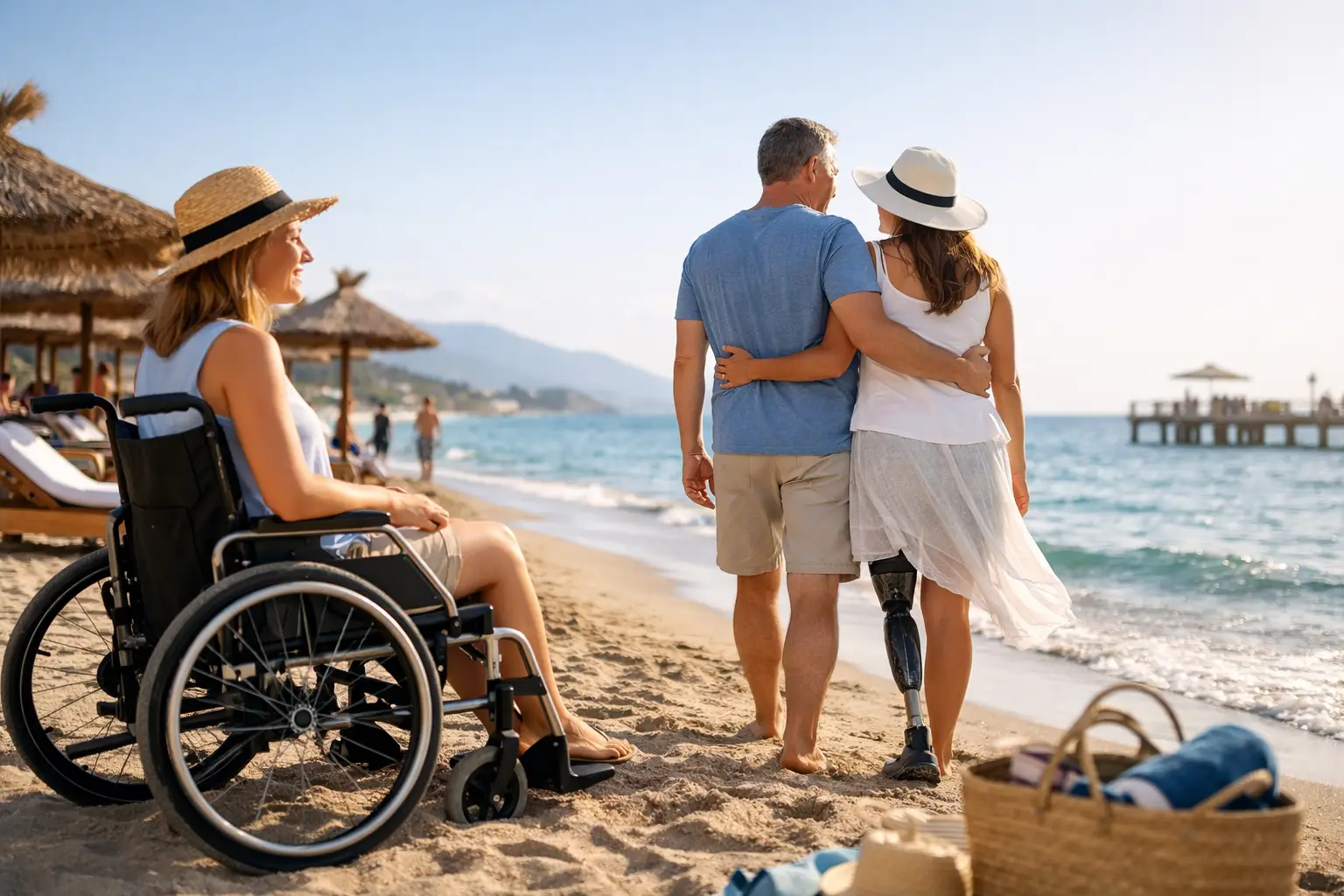
A place can have adapted hotels and still be difficult once you leave reception. Steep hills, uneven paving, cobbles, poor dropped kerbs and narrow streets all affect how independent you can be. Beach resorts are a classic example. Some are excellent along the promenade but become awkward the minute you try to reach the sand, shops or public loos.
Town and city breaks need the same scrutiny. Ask yourself how far you are likely to travel each day, whether pavements are smooth enough for a scooter, and whether key attractions are close together or spread out. A destination that looks manageable on a map may involve gradients or surfaces that wear you out quickly.
Weather plays a part as well. Heat can drain batteries faster and make long outdoor routes harder. Heavy rain can turn dropped kerbs, ramps and old paving into a nuisance. None of that means do not go. It means plan realistically.
Attractions, restaurants and everyday access
One accessible museum does not make an accessible destination. You need enough practical options around it. Can you find accessible toilets without a long detour? Are restaurants easy to enter? Are there enough places where you can sit comfortably without feeling like an afterthought?
This matters more than many tourism boards seem to realise. A holiday is built from ordinary moments - getting coffee, using the loo, stopping for lunch, entering a shop, crossing a road safely. If those things are awkward all day, the destination stops feeling relaxing.
The best way to judge this is to look for detail, not promises. Words like "welcoming" and "inclusive" tell you very little. Measurements, photos, route descriptions and clear notes about lifts, ramps, toilets and surfaces are far more valuable. That is one reason brands such as Andy Wright Travel matter to this audience. Lived experience spots the practical issues that standard travel copy misses.
Why overplanning can be a good thing
For disabled travellers, overplanning is often just sensible planning by another name. It is not about removing spontaneity. It is about protecting your independence.
A little extra preparation can save a lot of stress. Confirm assistance in writing where possible. Keep your equipment measurements handy. Check charging arrangements for scooters and powerchairs. If you rely on medication or specialist items, pack with delays in mind rather than hoping everything goes to plan. If you are hiring equipment at the destination, confirm exactly what model is available and whether it suits your needs.
It is also smart to build in some slack. Do not cram every day. Leave room for delays, tiredness or a route that takes longer than expected. Accessible holidays are usually better when the pace is realistic. More is not always more.
Confidence matters, but honesty matters more
There is a lot of cheerful messaging around disabled travel now, and some of it is genuinely helpful. But confidence without honesty is useless. Not every destination is equally easy. Not every hotel deserves the accessible label. Not every traveller wants the same kind of trip.
That is fine. The goal is not to prove anything by forcing a bad fit. The goal is to travel well, with dignity and as much independence as possible.
Sometimes that means choosing the easier route because it gives you a better holiday. Sometimes it means going long-haul because you have done the research and know it will work. Sometimes it means rejecting places that look great on Instagram but are a pain in real life. There is no prize for struggling through poor access.
How to choose better accessible holidays
The strongest approach is to judge each trip on evidence. Look beyond the headline claims. Ask awkward questions. Compare answers. Check how the whole journey fits together, from your front door to the hotel bathroom to the route to dinner.
If a destination gives you confidence because the details line up, that is usually a good sign. If you find yourself filling in too many gaps with hope, keep looking.
Accessible holidays do exist, and good ones can be brilliant. Not because barriers magically disappear, but because the right preparation gives you control back. And once you have that, the world opens up in a much more practical way.
0 Comments
Leave a Comment