
Accessible Cruise Excursions That Work
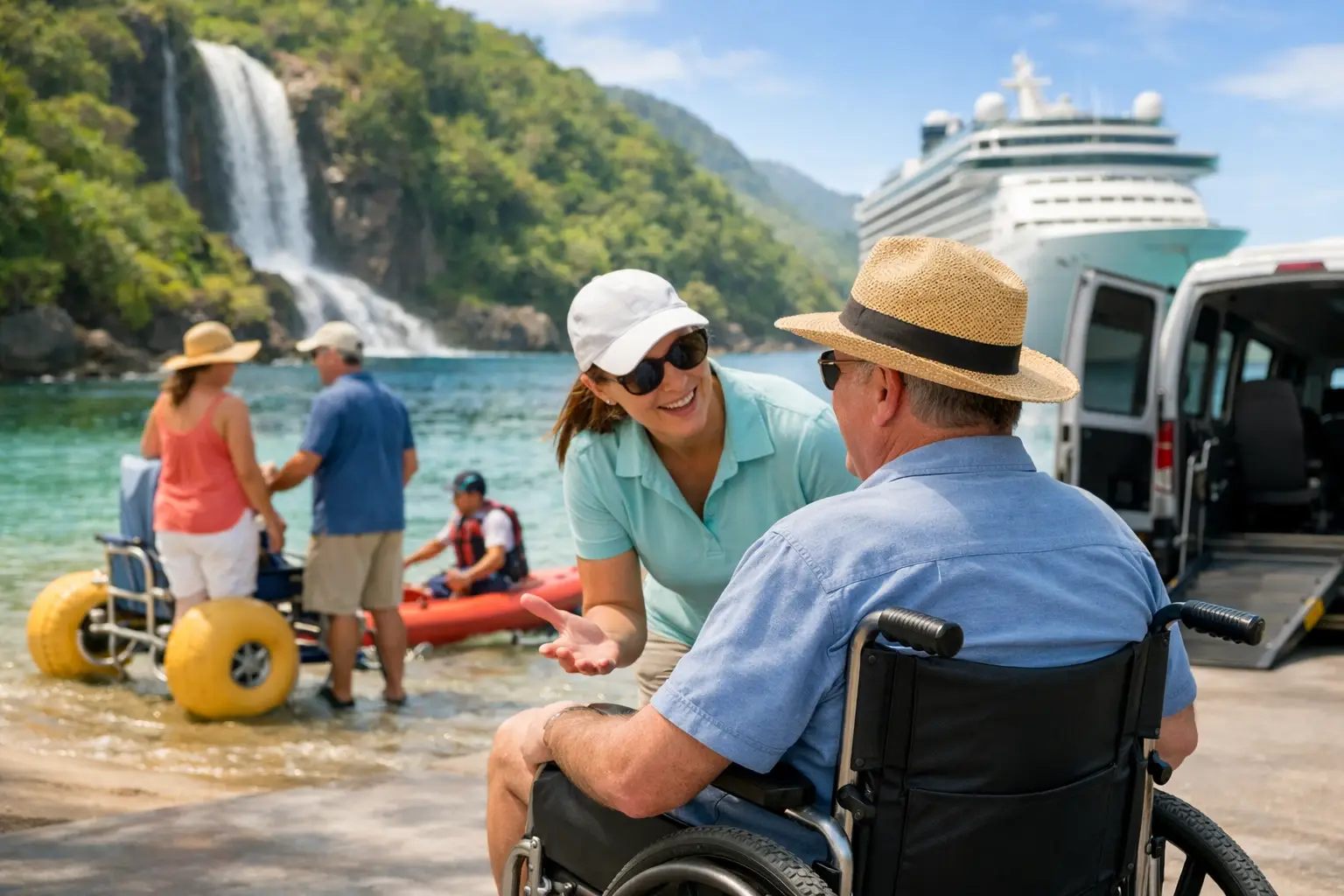
If you have ever rolled off a ship expecting an easy day ashore and found a steep coach step, cobbles, or a so-called accessible route that clearly was not, you will know the problem with accessible cruise excursions. The brochure might say one thing. The reality on the ground can be very different. That gap matters even more when you use a wheelchair or mobility scooter, because a poor excursion is not just disappointing - it can leave you stranded, rushed, or forced to sit out a day you paid for.
Cruise lines love to sell shore trips as simple add-ons. For disabled travellers, they are nothing of the sort. The right excursion can make a cruise feel freeing. The wrong one can make you feel like you are asking for too much, when really you are just asking for usable information and basic planning.
What makes accessible cruise excursions genuinely accessible?
This is where the marketing often falls apart. A cruise line may label an excursion accessible because there is minimal walking, but that tells you very little if you use a wheelchair or scooter. You need to know whether you can get off the ship independently, whether the transfer vehicle has a lift or ramp, whether the route has steep gradients, and whether there are accessible toilets during the trip.
A genuinely accessible excursion is built around the full journey, not just the attraction at the end. There is no point offering an accessible museum if the coach has steps and no storage for a folded wheelchair. Equally, a flat promenade stop is not much use if the tender port means you cannot even get ashore safely.
The details that matter are usually the unglamorous ones. Kerb drops. Surface quality. Distance from coach park to entrance. Whether a manual wheelchair user will need assistance on a slope. Whether a mobility scooter can be accommodated at all, rather than tolerated if there is space.
Start with the port, not the excursion
Before you even compare tours, look at how the ship docks. This is one of the biggest factors in whether accessible cruise excursions will work for you. If the port uses tenders, access becomes far less predictable. Some cruise lines can assist some wheelchair users in calm conditions, but mobility scooters are often a different matter. Even if they allow you to board a tender one day, weather and sea conditions can change that decision very quickly.
If the ship is docked alongside and you can use a gangway, the next question is the gradient. A long, steep gangway can be manageable for some powered chairs and scooters, but very difficult for manual wheelchair users or anyone with limited upper body strength. It is worth asking the cruise line how they assess gangway conditions and whether assistance is available, rather than assuming it will be fine.
Port terminals also vary wildly. Some are smooth and modern. Others involve uneven paving, shuttle buses, and a fair bit of distance before you even reach your excursion meeting point. That is not a minor detail when energy management is part of your travel planning.
The questions worth asking before you book
Most cruise excursion pages are too vague. If you rely on proper access, vague is not good enough. You need specifics, and ideally in writing.
Ask what vehicle is used and whether it has a lift or ramp. Ask whether you can remain in your wheelchair during transport or whether you must transfer to a fixed seat. Ask whether mobility scooters are accepted, and if so, what size and weight limit applies. Many operators say they allow scooters, then mean only small boot scooters that can be dismantled.
You also need to ask about the route itself. Is it all step-free? Are there cobbles, gravel paths, or steep inclines? How long is the distance from drop-off to the main site? Is there seating if walking is limited but not impossible? Are there accessible toilets, and are they reliable or merely listed on a map somewhere?
If you are travelling with a companion who helps you, ask whether they can stay with you throughout boarding and disembarkation. If you need equipment such as oxygen, a hoist sling, or medical supplies close at hand, check whether the operator can accommodate that without fuss.
Why cruise line descriptions often are not enough
Cruise lines tend to write for the broadest audience possible. That means you get phrases like moderate activity, uneven terrain, or limited walking. Those phrases are not useless, but they are nowhere near detailed enough for disabled travellers making a real decision.
Moderate activity for one person could mean strolling round a square. For another, it could mean climbing onto a coach and walking 400 metres over rough paving. Limited walking sounds promising until you discover the accessible toilet is up a slope and across a car park.
This is where lived experience matters. The disabled travel community has learned, often the hard way, that accessibility claims need translating into practical reality. A no-nonsense approach is far better than glossy reassurance. If a trip is only suitable for manual wheelchair users who can transfer with help, say that. If scooters are not practical because of vehicle storage, say that too. Honest information saves ruined days.
Independent tours can be better - but not always
There is a common view that private or independent tours are always better for accessibility. Sometimes they are. A good local operator can offer adapted transport, flexible timing, and a route built around your needs rather than a coach full of mixed passengers. That can be a far better experience than being squeezed into a standard excursion that only half works.
But it depends. Booking outside the cruise line means taking on more responsibility yourself. You need to be confident about timings, cancellation terms, and how easily the operator can respond if the ship docks late or changes port. In some destinations, accessible vehicles are limited and need booking well in advance. In others, the term accessible may simply mean easier than average, not truly wheelchair or scooter friendly.
There is also the question of support if things go wrong. Cruise line excursions have the obvious advantage that the ship knows where you are, and there is usually a clearer process if delays happen. That reassurance can be worth paying for, especially on ports with tight turnaround times.
Choosing excursions that match your energy, not just your access needs
An excursion can be technically accessible and still be a poor fit. This is one of the most overlooked parts of cruise planning. If you have already dealt with travel to the port, embarkation, and a couple of busy sea days, your energy levels may not be the same as they were when you booked the trip months earlier.
A four-hour accessible city tour with two photo stops and one accessible toilet may sound manageable. On the day, it could still feel relentless if there is heat, queues, or pressure to keep moving with the group. Some of the best cruise days are the simplest ones - a flat waterfront, an accessible taxi, one good lunch stop, and enough time to look around without being herded.
There is no prize for choosing the busiest option. Independence often comes from pacing, not from trying to squeeze every landmark into one day.
Common problem areas nobody mentions enough
The biggest issue is transport. Lift-equipped vehicles are not available everywhere, and when they are, they may need pre-booking through a separate team rather than the standard excursions desk. Storage for scooters is another repeated problem. Some operators are happy with a folding wheelchair but cannot manage a heavier mobility aid.
Historic ports can also be awkward even when attractions themselves are accessible. Old towns often mean stone surfaces, narrow pavements and sudden gradients. You may be able to reach the centre but find the final stretch frustrating or unsafe. Beach stops are another classic example. A destination may advertise beach access, but that can still mean a boardwalk that ends long before the shoreline, with no beach wheelchair and no accessible loo nearby.
Then there is timing. Group excursions do not always leave enough margin for slower boarding, toilet breaks, or equipment checks. If a tour feels tightly scheduled on paper, it will probably feel tighter in real life.
How to give yourself the best chance of a good day ashore
The strongest approach is to treat cruise excursions as part of your wider accessibility planning, not as a last-minute extra. Research the port, ask direct questions, and be realistic about what your equipment can handle. If you use a mobility scooter, check battery range and whether there is enough time to recharge back on board before the next stop. If you use a wheelchair, think about surfaces and how much pushing will be involved, not just distance.
Take screenshots or print written confirmations about access arrangements. If a vehicle lift, wheelchair space, or scooter acceptance has been agreed, it helps to have that to hand. Allow extra time to get to meeting points, and if something feels wrong on the day, say so early. It is much easier to sort a problem before a coach leaves than once everyone is seated and impatient.
This is exactly why practical disabled travel content matters. Brands like Andy Wright Travel have built trust by talking about what actually happens, not what should happen in theory.
Cruising can still open up brilliant places with less packing, less hotel hopping, and the chance to see several destinations in one trip. But the best days ashore rarely happen by luck. They happen when the access details are clear, the expectations are realistic, and you choose the excursion that works for you rather than the one with the prettiest sales pitch.
0 Comments
Leave a Comment