
Accessible Coach Versus Rail Travel Compared
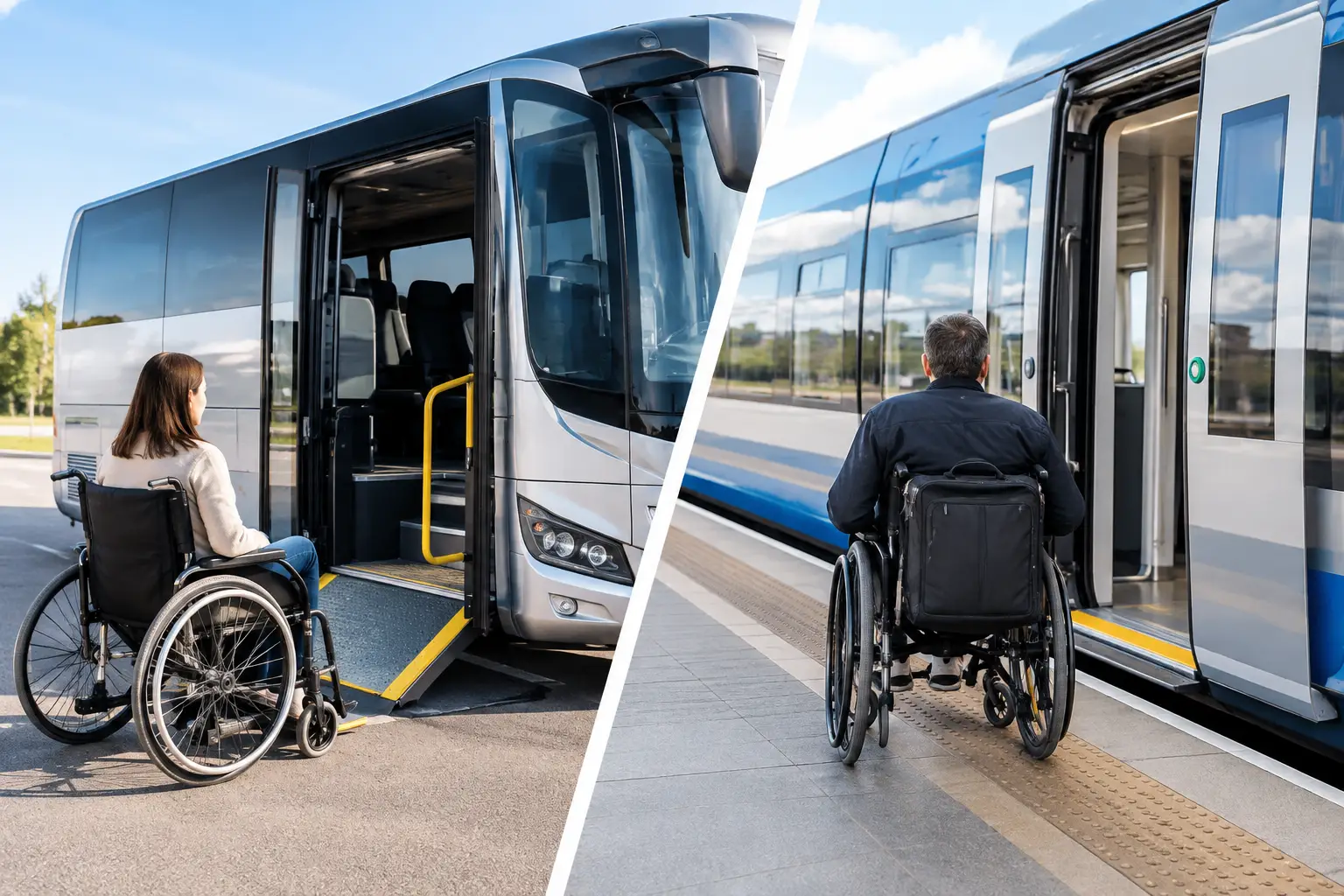
A cheap coach fare can look like the obvious choice until you discover your mobility scooter is not permitted in the luggage hold. Equally, a train journey that looks straightforward can involve a booked wheelchair space, a ramp, two changes and a platform alteration. Accessible coach versus rail travel is not simply a question of price or speed. For wheelchair and scooter users, it is about whether you can board safely, stay comfortable and still be in control when plans change.
Accessible coach versus rail travel: the real differences
Rail usually offers more independence once you are on board. Most mainline trains have designated wheelchair spaces, accessible toilets and staff assistance that can be booked in advance. You remain in your own wheelchair or approved mobility scooter, rather than being transferred into a vehicle seat. That matters if you cannot transfer safely, need postural support, or simply do not want to hand over control of your mobility aid.
Coach travel can be a very useful option, particularly on direct routes between towns that are poorly connected by rail. It can also be significantly cheaper. But accessibility varies much more sharply between operators, individual vehicles and routes. A coach advertised as accessible may have a lift and one wheelchair position, yet still be unsuitable for a larger powered chair or scooter. Some services accept manual wheelchairs only. Others require mobility scooters to be folded, dismantled or placed in the hold, which is not realistic for many users.
The practical difference is this: trains are generally designed to carry mobility equipment in the passenger area; coaches often have limited space and stricter conditions. Never assume a low-floor local bus-style vehicle and a long-distance coach will work in the same way.
When rail is the stronger option
For many disabled travellers, rail is the safer bet for longer journeys, especially when travelling independently. The ability to book Passenger Assist means the operator knows you are coming and can arrange a ramp at both ends of the journey. On a good day, it removes a great deal of uncertainty.
Rail also tends to work better when your wheelchair or scooter is central to your independence. You can usually stay seated in it throughout the trip, keep essential items close by and use the accessible toilet if the train provides one. That is a major advantage over a coach journey where the accessible space may be unavailable, the toilet may be too small to use, or you may have to transfer to a fixed seat.
That said, booking assistance is not a magic guarantee. Stations can have broken lifts, short-notice platform changes and staff shortages. If your route has changes, check every station rather than just the departure and arrival points. A station may be labelled step-free while only offering step-free access to some platforms, or only via a long route outside the station.
Train design matters too. Older rolling stock can have narrow doorways, steep ramps, awkward toilet layouts and wheelchair spaces beside a busy doorway. Newer trains are often better, but not automatically perfect. If you use a mobility scooter, confirm that it meets the relevant operator's size and turning requirements and ask whether a permit is needed. These rules are not identical across the network.
Rail is less attractive when the journey involves several tight connections. A direct two-hour coach trip may be less tiring than a train journey with three changes, particularly if you are travelling with a carer, luggage or medical equipment. It depends on how much energy you have to spare, not just the timetable.
Rail booking: what to check before committing
Book assistance as soon as you have chosen your train, but also check the actual service rather than relying solely on a journey planner. Confirm the number of wheelchair spaces, whether your chair will fit, where the accessible toilet is and whether the train has any planned replacement bus section.
If there is a connection, allow more time than the minimum shown online. A connection that works for a passenger walking quickly across a platform may be stressful or impossible if you need a ramp, a lift and help through a busy station. Keep your booking reference accessible on your phone and carry a written note of key assistance details too, as mobile signal and battery life cannot always be relied upon.
When accessible coach travel makes sense
Coach travel can be excellent when the route is direct and the operator has confirmed in writing that your exact mobility aid is accepted. It is worth considering for airport links, intercity journeys, day trips and routes where the rail alternative is expensive or inconvenient.
A direct coach can remove the platform changes, gaps and station navigation that make some train journeys hard work. You may be dropped closer to your destination than the railway station, which can make a real difference in a town with steep hills or poor pavements. For a manual wheelchair user travelling with someone who can help where appropriate, a modern lift-equipped coach may be perfectly workable.
The limitation is capacity. Many coaches have only one wheelchair position. If it is already booked, there may be no alternative service that day. The space can also be positioned near the front door, which means less privacy and more movement around you. On a busy route, the practical experience may feel quite different from the brochure photographs.
Mobility scooters are the biggest point of caution. Do not book on the assumption that a scooter can travel in the luggage compartment. Batteries, weight, size, damage risk and handling arrangements all affect the answer. A scooter that folds may be accepted as luggage by one operator but refused by another, while a road-legal or larger pavement scooter is often not accepted at all. Ask about your model's dimensions, total weight and battery type, and get a clear answer before paying.
Questions to ask a coach operator
Before booking, establish whether the specific departure uses an accessible coach, whether the lift is available, and whether the wheelchair space is still free. Ask if you must transfer to a coach seat, whether an accessible toilet is fitted and usable during the journey, and how much notice is required.
For scooters and powered wheelchairs, ask whether they are accepted on board, not merely whether the company is "accessible". Confirm maximum dimensions and weight, battery policy, securement method and whether the driver can operate the lift. If the answer is vague, treat that as a warning sign and look for another option.
Cost, comfort and disruption
Coach travel often wins on headline price. Advance rail fares can be excellent, but they disappear quickly and accessible booking can make some people reluctant to commit to a specific service. If you need flexibility because of pain, fatigue or medical appointments, look carefully at the conditions before choosing the cheapest ticket.
Comfort is personal. A train allows you to move a little, position your chair and usually access a larger toilet. A coach may be quieter and more direct, but you could be fixed in one position for several hours. Consider pressure relief, medication timings, food, fluids and toilet access honestly. A journey that is technically possible is not always a journey worth taking.
Disruption is where both options can become difficult. On rail, cancellation can mean replacement transport that cannot carry your wheelchair or scooter. On coach, a vehicle swap or missed connection may leave you waiting for a service with no spare accessible space. Carry charged phone power, essential medication, water and a clear note of your mobility aid details. If you are travelling alone, tell someone your plan and expected arrival time.
Choose the journey that gives you most control
The best choice is rarely the one with the shortest advertised journey time. Choose rail when you need to remain in your chair, want greater on-board facilities and can manage the stations and connections. Choose coach when it is genuinely direct, your equipment has been specifically approved and the lower cost or simpler route outweighs the tighter space.
There is no prize for battling through a journey that leaves you exhausted before your holiday or appointment has even started. Ask the awkward questions, get answers before booking and build in enough time to travel at your own pace. Independence is not about doing it the hardest way. It is about choosing the option that lets you arrive ready to enjoy where you have gone.
0 Comments
Leave a Comment