
Accessible Beaches for Mobility Scooters
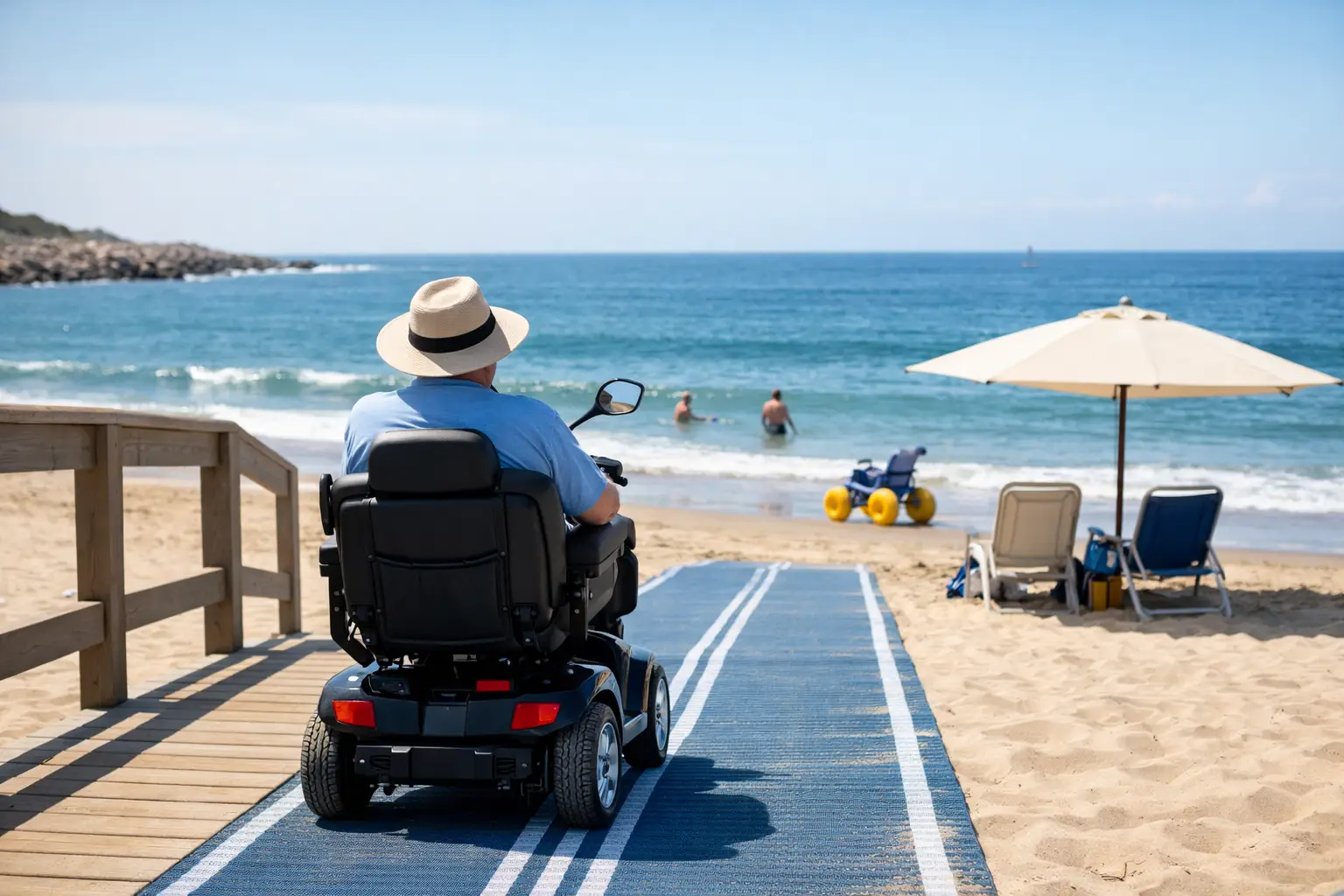
Some beaches look accessible in the brochure, then fall apart the moment your front wheels hit soft sand. A wide promenade is helpful, but it is not the same as proper beach access. If you are searching for accessible beaches for mobility scooters, the real question is not whether a destination says it is inclusive. It is whether you can arrive, park, get to the seafront, find an accessible toilet, move safely and actually enjoy the place without a wrestling match.
That is where a lot of beach advice goes wrong. It is often written by people who mean well but do not travel with a scooter, wheelchair or mobility limitation themselves. For scooter users, beach access is never just about the sand. It is about the full chain from car park to café, from dropped kerb to promenade surface, from toilet access to whether there is anywhere sensible to turn around.
What makes beaches accessible for mobility scooters
A beach does not need to offer direct access onto open sand to be worth visiting. For many people, a good beach day means getting close enough to enjoy the sea air, the view and the atmosphere without being stranded at the first obstacle. In practice, the best accessible beach locations usually combine several features rather than relying on one headline claim.
A reliable accessible car park nearby matters more than many tourist boards admit. If the only parking is a long distance away, uphill or on loose gravel, the day starts badly. The same goes for the route from parking to the seafront. One steep ramp, a rough path or a badly placed step can turn a technically accessible destination into a frustrating one.
Surface type is usually the deciding factor. Mobility scooters cope well with concrete promenades, compact tarmac, firm boardwalks and properly maintained paved routes. They struggle on soft sand, deep shingle, uneven timber and loose stone. Even larger scooters with better ground clearance can get bogged down or lose traction, especially near beach entrances where sand drifts over the path.
Then there are the basics people should not have to fight for - accessible toilets, seating, shelter, step-free cafés and enough width to pass other users without edging into danger. A beach can tick one box and still fail overall. It depends on how all those details work together.
The difference between promenade access and beach access
This is one of the biggest misunderstandings when researching accessible beaches for mobility scooters. Many seaside towns are excellent for promenade access but poor for direct access onto the beach itself. That does not make them useless, but it does mean expectations need to be realistic.
If your priority is a relaxed seafront outing, promenade access may be more than enough. A long level front, accessible toilets, nearby parking and places to stop for food can make for a very good day out. It can also be a better option if you are travelling alone and do not want to risk getting stuck.
If you specifically want to get onto the beach, look for proper boardwalks, beach access matting or designated firm routes. Even then, check how far they actually go. Some matting only covers the first short stretch, which may help manual wheelchair users transferring to a beach chair but still not work for a mobility scooter. Others are seasonal and may not be out when you visit.
The key point is simple. Being near the beach and being on the beach are not the same thing.
What to check before you set off
The safest way to plan is to think operationally, not romantically. Beautiful photos tell you almost nothing about access. What you need is practical detail.
Start with parking. Check whether accessible bays are close to the seafront, whether there is a level route from the car park and whether payment machines are reachable. If you are relying on public transport, look at the distance from the nearest stop and the condition of the route, not just the map.
Next, look at gradients. Seafront towns often have steep approaches even when the promenade itself is flat. Street View can help, but it does not always show kerb cuts, barriers or seasonal clutter. If possible, ring ahead and ask specific questions. Not "Is it accessible?" but "Can a Class 3 mobility scooter get from the accessible car park to the promenade without steps or steep slopes?"
Toilets matter more than destinations like to admit. Check whether there is a Changing Places toilet if you need one, whether standard accessible loos are open year-round and whether radar key access is required. A beach may sound brilliant until you realise the nearest suitable toilet is twenty minutes away.
Finally, think about battery range and weather. Seafronts can involve longer distances than expected, and strong winds can make exposed promenades tiring or uncomfortable. Wet boardwalks and sandy paths can also reduce grip.
Common problems at the coast
Coastal access often fails in predictable ways. The path may be fine until you reach a gate with an awkward turn. The promenade may be smooth until café tables narrow the route. An accessible toilet may exist but be locked, out of order or used for storage. These are not minor details when you are planning a day around mobility needs.
Sand drift is another issue. Even where there is a paved route, sections can become partially covered, especially after bad weather. For scooter users, a thin layer of sand can be manageable, while a deeper patch can stop you dead. Maintenance standards vary a lot between resorts.
Seasonality catches people out as well. Summer often brings better facilities, but also bigger crowds, more temporary obstacles and harder parking. In quieter months, access may be physically easier but toilets, cafés and beach equipment may be shut. There is no perfect season for every traveller. It depends on whether you prioritise services or breathing space.
How to judge if a beach suits your scooter
Not all mobility scooters cope with the same conditions, so general advice has limits. A compact boot scooter that works well in shopping centres may struggle badly at the seaside if surfaces are uneven. A larger road-legal scooter may handle slopes and rougher ground better, but it will still not perform miracles on soft sand.
Think about your turning circle, ground clearance and tyre type. Also be honest about your own comfort level. A route that is technically possible may still feel stressful if it is narrow, crowded or sloped towards the sea wall.
If you travel with a carer or partner, you may be willing to attempt trickier sections knowing someone is there to help. If you are solo, the safer option is often the better one. Independence is not about proving a point. It is about choosing places where you can move confidently and enjoy yourself.
Best signs of genuinely accessible beaches for mobility scooters
The strongest sign is not marketing language. It is detail. When a council, attraction or local venue can clearly explain parking, route surfaces, toilet provision, boardwalk length and any problem spots, that usually tells you they understand disabled visitors in practical terms.
Good destinations also tend to think beyond the shoreline. They offer step-free cafés, sensible dropped kerbs, clear signage and enough bench seating to break up the journey. If the whole seafront works well, the beach visit is more likely to work too.
Another good sign is honesty about limitations. If a place openly says direct sand access is not suitable for scooters but the promenade is fully accessible, that is far more useful than vague claims about being welcoming to all. Straight answers save wasted journeys.
A smarter way to plan a beach day
When I look at coastal access, I am rarely chasing perfection. I am looking for places that remove enough barriers to make the trip enjoyable rather than exhausting. That usually means treating the beach as part of a wider accessible day out. If the seafront, nearby parking, toilets and food options all work well, the trip can still be a success even if the sand itself is off limits.
That mindset helps avoid disappointment. It also opens up more options. Some of the best seaside visits for disabled travellers come from choosing a solid promenade town with dependable facilities rather than gambling on a remote beauty spot with no real infrastructure.
Andy Wright Travel has always been about that kind of realism. Not lowering expectations, but replacing guesswork with information that respects your time, your energy and your independence.
If you are planning a coastal trip, do not settle for the word accessible on its own. Ask what it means on the ground, picture each stage of the journey and give yourself permission to choose the place that works, not just the place with the prettiest photo.
1 Comment
Leave a Comment