
Accessible Beach Holiday Guide That Works
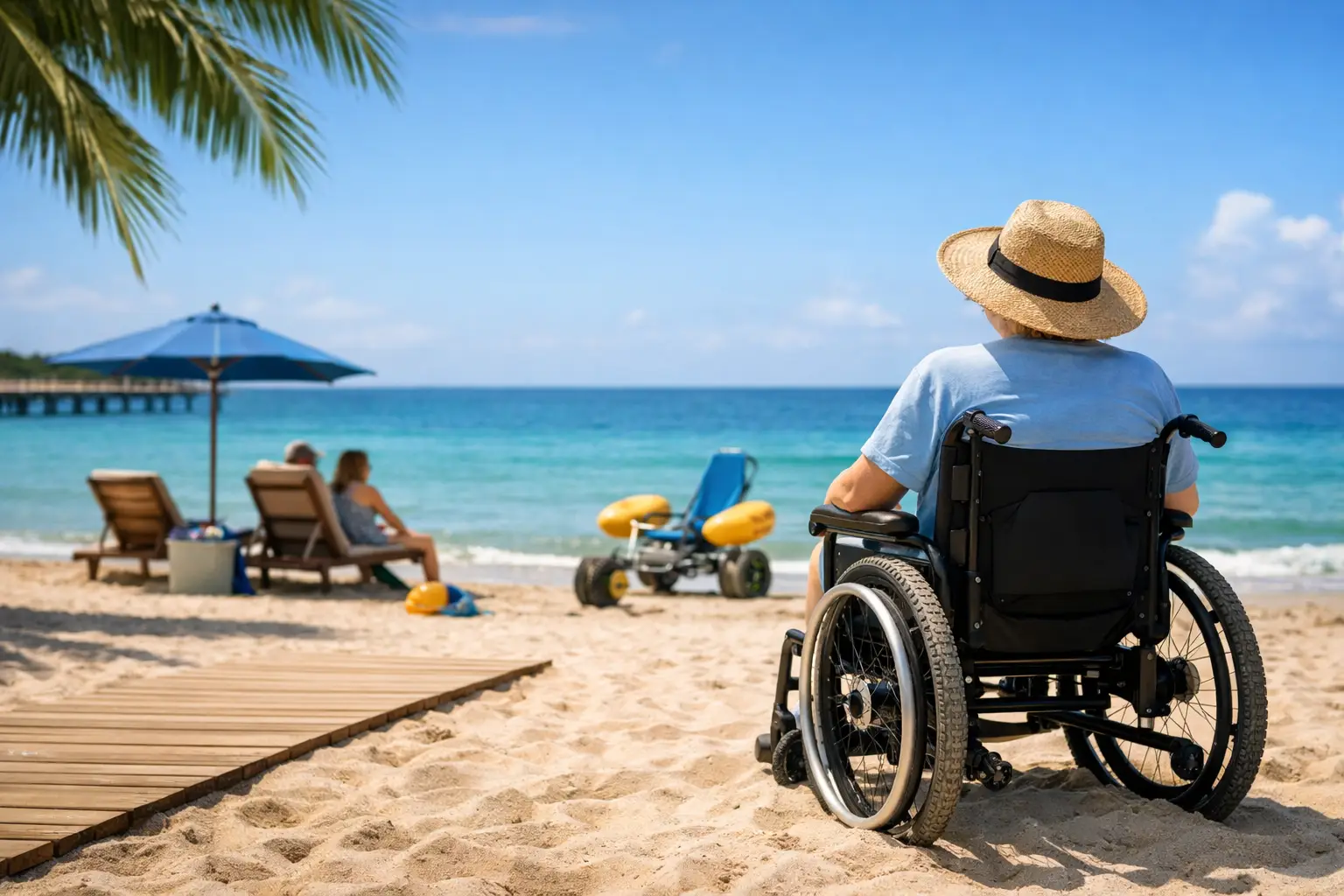
A beach can look perfect on the brochure and still be a nightmare once you arrive. Soft sand, steep ramps, tiny accessible toilets, broken boardwalks and hotels that call themselves step-free when they clearly are not - this is exactly why an accessible beach holiday guide needs to focus on the details that actually affect wheelchair users and mobility scooter users.
The good news is that beach holidays are absolutely possible with the right planning. The bad news is that you usually have to do more checking than non-disabled travellers. That is not fair, but it is the reality. If you approach it properly, you can avoid the worst surprises and give yourself a much better chance of a holiday that feels relaxing rather than like a constant access battle.
What makes an accessible beach holiday
For most people, the word accessible gets thrown around far too loosely. A hotel might have a ramp at reception and still be useless for a proper beach break. A resort might have an accessible room but no realistic way to reach the beach itself. If you use a wheelchair or scooter, access has to work as a chain. If one link fails, the whole trip becomes harder.
A genuinely accessible beach holiday usually depends on five things working together: your journey, your accommodation, the route around the resort, the beach access itself, and what you can actually do when you get there. That last point matters. There is a big difference between seeing the sea from a promenade and being able to spend proper time at the beach with some comfort and dignity.
This is also where honesty matters. Some travellers are happy with a smooth seafront and a good view. Others want beach wheelchairs, accessible changing places and reliable adapted transport. Neither approach is wrong. The right trip depends on your mobility, your equipment and how independent you want to be once you arrive.
Start with the beach, not the destination
A lot of people choose the country first and only then start checking access. In practice, it often works better the other way round. Find beaches or resorts with a proven record of accessibility, then build the rest of the trip around them.
Look for hard pathways or boardwalks that go close to the shoreline. Not all boardwalks are equal. Some are wide and stable enough for scooters, while others are short, uneven or stop well before the sand. Check whether there is beach matting, accessible viewing areas or firm promenade access if getting onto the sand is not realistic.
If swimming or getting closer to the water matters, ask whether beach wheelchairs are available, how they are booked and whether staff actually help with them. A destination may advertise one adapted chair, but if it is damaged, stored away or only available in peak season, that is not much use.
Tide and terrain matter too. A flat, compact beach can be far easier than one with deep loose sand, pebbles or a sharp drop from promenade to beach. Photographs can help, but they do not always show gradients clearly. Street-level video and recent traveller reports are often more useful because they show what moving through the space is really like.
The hotel can make or break the trip
Beach access gets the attention, but the hotel often decides whether the holiday is manageable. An accessible room means very little if the route to the pool, restaurant or beachfront is awkward every single day.
Ask direct questions and keep them specific. Is the accessible room truly step-free from entrance to bed to bathroom? Is the shower roll-in or just labelled accessible because it has a grab rail over a bath? What is the door width? Is there space to turn a scooter? Is there a hoist, and if there is, where exactly is it used?
Also check the outdoor layout. Large resorts can look brilliant online but involve long distances, steep paths and split-level areas. That may be fine for some manual wheelchair users travelling with support, but much less practical for solo travellers or scooter users who need predictable routes and charging access.
If you are travelling abroad, make sure the hotel understands what a mobility scooter is. Too many properties hear wheelchair and assume a standard manual chair. That can lead to poor advice about room size, lift dimensions or charging. It is better to explain your equipment clearly and ask for exact measurements rather than general reassurance.
Transport is where access plans often fall apart
An accessible beach holiday guide is not much use if it ignores the bit between the airport and the resort. Transfers are one of the most common failure points, especially if you use a powered wheelchair or scooter.
Before booking, check how you will get from airport to accommodation and from accommodation to the beach area if it is not directly outside. Do not assume an airport transfer listed as accessible will take a larger powerchair or scooter. You need to know whether it is ramped, whether tie-downs are provided, and whether your equipment can travel upright.
If you are flying, battery rules need checking early, not the night before departure. Different scooter and wheelchair batteries have different handling requirements, and airlines can be inconsistent. Keep your equipment specifications ready and confirm them in writing where possible.
Rail-based beach trips in the UK can be excellent, but station access still varies. Some coastal stations are straightforward, others rely on staff-operated ramps, limited step-free routes or awkward gaps. The journey can still be worth doing, but only if you know what you are dealing with before the day.
An accessible beach holiday guide to the small details
The small details are usually what turn a decent trip into a comfortable one. Toilets are a big example. One accessible loo near the promenade sounds fine until you realise it closes at 5 pm or needs a Radar key you left at the hotel. If you need a Changing Places toilet, check that separately. Standard accessible toilets are not the same thing.
Food and drink matter as well. A beachfront restaurant may be technically accessible but packed so tightly that getting through is a struggle. Outdoor terraces can be easier, but only if the route to them is level and wide enough.
Shade is another issue people often overlook. Sitting out on a beach or seafront is far less enjoyable if accessible seating is stuck in direct sun with no shelter. If heat affects your condition, that becomes more than a comfort issue.
Charging points need thought too. If you use a scooter or powerchair all day along a seafront, battery range matters. A resort with long promenades and scattered facilities can use more power than expected, especially in hot weather or on slopes.
What to pack for a beach trip with mobility equipment
Packing for the coast is partly about convenience and partly about damage control. Sand, salt and heat are not ideal for mobility equipment. You do not need to overdo it, but a few sensible extras can save a lot of hassle.
A small brush or cloth helps keep sand away from controls and footplates. A weather cover is worth having even in warm destinations because sea air, sudden showers and blowing grit can all cause problems. If you have removable cushions or accessories, think about how easily you can move and protect them when you are near the water.
For your own comfort, lightweight layers, good sun protection and a reliable bag attached to your chair or scooter make a real difference. If you use medication or anything heat-sensitive, plan for that properly. Beaches are not the place to discover something has overheated in the sun.
Expect trade-offs and plan around them
Not every accessible beach destination offers the same type of holiday. Some places are strong on hotel access but weaker on beach equipment. Others have excellent promenades and adapted facilities but less reliable transport. It depends what matters most to you.
For some travellers, a lively resort with mostly good access and one or two compromises is still a great break. For others, especially if transfers, hoists or changing facilities are essential, those compromises can make the trip unworkable. There is no prize for forcing a destination to fit if the basics are wrong.
This is where first-hand disabled travel content is so valuable. Generic tourist information tends to tell you that something exists. Real experience tells you whether it is genuinely usable. That difference is exactly why practical reporting from brands like Andy Wright Travel helps cut through the usual vague promises.
How to book with more confidence
When you have narrowed down your options, build your decision around evidence, not hope. Ask hotels for recent photos and measurements. Check whether beach access features are seasonal. Confirm whether promenade works, lift outages or local transport changes are affecting access. If something sounds unclear, keep asking until it is clear.
It also helps to prioritise your non-negotiables. If you need a proper roll-in shower, that goes above sea view. If you need beach wheelchair access, that matters more than a larger pool. The more honest you are about what makes the trip workable, the less likely you are to book something that looks good but fails in practice.
A beach holiday should not feel out of reach because you use a wheelchair or mobility scooter. It just needs to be planned on facts rather than wishful thinking - and when you get that right, the sea is still yours to enjoy.
0 Comments
Leave a Comment