
A Practical 5-Day Accessible Bangkok Itinerary
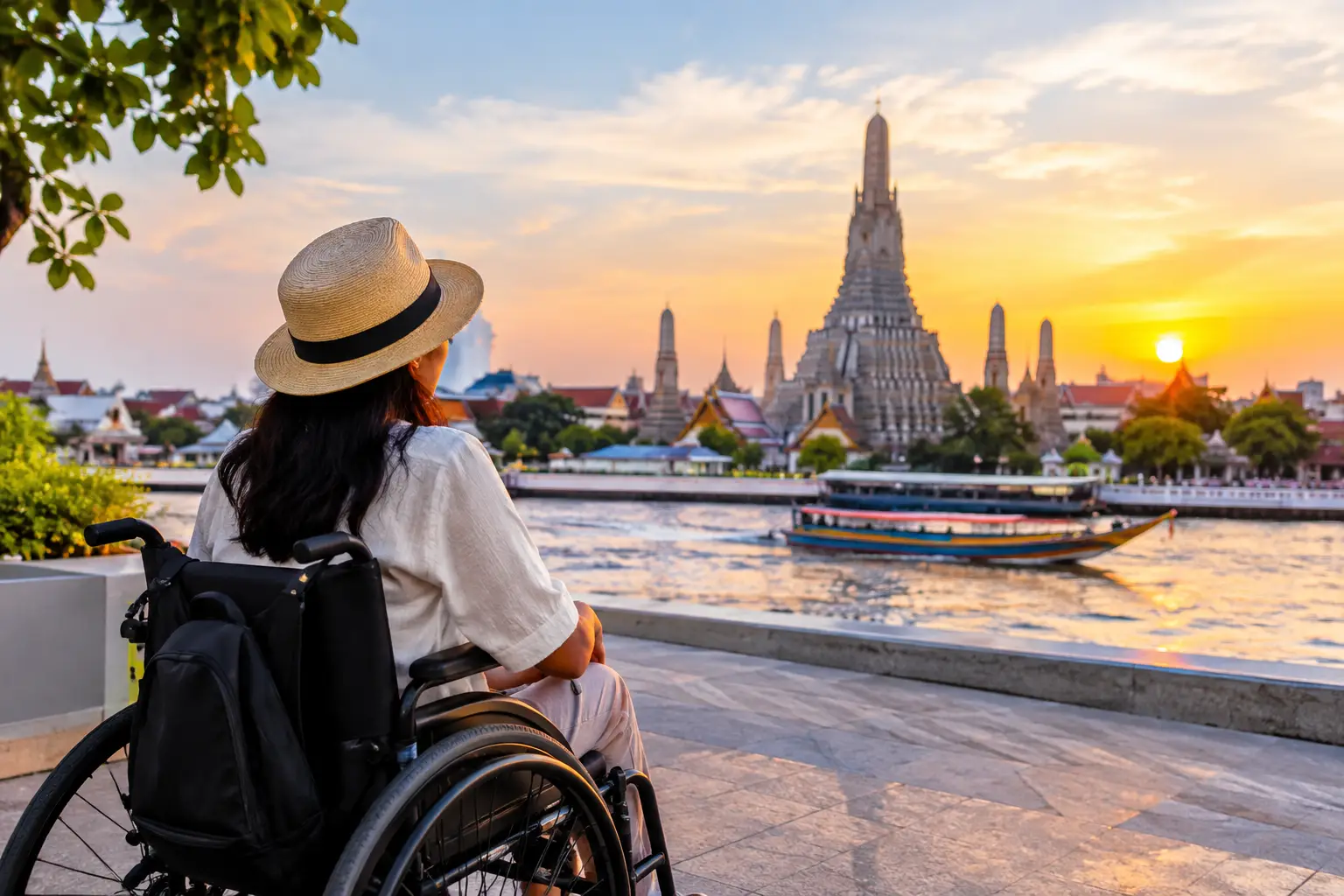
Bangkok can be brilliant for wheelchair and mobility scooter users, but it rewards planning more than optimism. An accessible Bangkok itinerary needs to account for intense heat, uneven pavements, railway stations with variable lift access and taxi drivers whose idea of a suitable vehicle may not match yours. Get the basics right, though, and this is a city of grand temples, excellent food, river views and warm, helpful people.
The key is not trying to see every famous sight in one rush. Build in air-conditioned breaks, use the river where it makes sense, and choose a hotel close to transport and shopping rather than one that simply calls itself “accessible”.
Before you build your accessible Bangkok itinerary
For most UK travellers, flying into Suvarnabhumi Airport is the simplest option. It is a large, modern airport with step-free routes, accessible toilets and staff assistance, but allow extra time for immigration, baggage and finding your pre-booked transfer. Do not assume an ordinary saloon taxi can take a wheelchair or dismantled scooter. Arrange a vehicle with the space you genuinely need, and confirm the size and weight of your equipment before travelling.
A central hotel around Sukhumvit, Asok, Phrom Phong or the riverside can work well, but each has trade-offs. Sukhumvit puts you near malls, restaurants and the BTS Skytrain, although the pavements can be narrow, broken or blocked by street furniture. Riverside hotels offer a calmer base and attractive views, but you may rely more heavily on accessible taxis. A room may be marketed as accessible while still having a tight bathroom turning circle or a shower lip, so ask for measurements and current photographs before booking.
Bangkok’s BTS and MRT networks can be useful, particularly when traffic is heavy. However, lift availability and the route from lift to platform should be checked station by station. Some stations involve a long outdoor approach, and not every exit puts you on the side of the road you need. The MRT is often the easier option for a wheelchair user because stations tend to have more consistent lift provision, but it depends entirely on your daily route.
Day 1: Settle in and use the malls as your bearings
Keep your first day deliberately light. After a long-haul flight, Bangkok’s heat and humidity can drain your battery and your energy much faster than expected. Check your chair or scooter has charged safely, buy drinking water, get a local SIM or eSIM sorted, and learn the practical route from your hotel to the nearest station, shopping centre and accessible toilet.
For a gentle first outing, head to one of the major shopping centres around Siam, Chidlom or Phrom Phong. Centres such as ICONSIAM, Siam Paragon, Emporium and Terminal 21 are generally far easier to navigate than street-level Bangkok: wide aisles, lifts, cooling and plenty of food choices. They are not the reason to travel to Thailand, but they are excellent confidence-builders on day one.
Use this time to test local transport. If you plan to use taxis or ride-hailing services, take a short journey first rather than discovering the limitations when you are tired and far from your hotel. Foldable wheelchairs are much easier than mobility scooters in standard cars. If your scooter cannot be lifted safely, budget for a larger booked vehicle instead of hoping for the best.
Day 2: Temples, old Bangkok and realistic expectations
The Grand Palace and Wat Pho are obvious choices, and they can be managed by many wheelchair users, but this is not a smooth, fully step-free heritage experience. Expect crowds, uneven surfaces, occasional thresholds and areas where you may need to take a different route or accept that a particular building is not practical. Go early, ideally close to opening, before the temperature and coach groups build.
Wat Pho is particularly worth considering for the Reclining Buddha and its atmospheric grounds. Keep your pace slow and carry water. Dress requirements apply at major temples, so cover shoulders and knees. A light overshirt and loose trousers are more practical than finding yourself turned away or overheating in heavy clothing.
Rather than forcing a long pavement journey between sights, use a pre-arranged accessible vehicle for this part of the city. The old town is rewarding but not mobility-friendly in the way a modern shopping district is. This is a good example of where an accessible Bangkok itinerary should be honest: you can experience the highlights, but you may not be able to enter every shrine, gallery or raised platform.
Day 3: Use the river, but check the boarding point
The Chao Phraya River offers a welcome change from road traffic. Riverside promenades, hotel piers and modern developments can be pleasant for a wheelchair or scooter, especially around ICONSIAM and some of the larger hotels. River travel is also a useful way to see Bangkok without spending an hour in a taxi.
Do not treat every public boat as automatically accessible. Piers can have slopes, gaps, floating pontoons and steps that change with water levels. Boat crews may be willing to help, but willingness is not the same as a safe boarding setup for a heavy powered chair. Check the specific pier on the day, and have a road-based alternative ready.
A straightforward plan is to spend the morning at ICONSIAM, take in the river views and food options, then return to your hotel for a rest before an evening meal nearby. The shopping centre is large, so it is easy to cover too much ground without realising it. Keep your charger with you if your scooter’s range is reduced by heat or air-conditioning use.
Day 4: Choose one major experience, not three
For day four, pick the part of Bangkok that matches your interests. If you enjoy history and museums, the Jim Thompson House is worth researching in advance, but traditional buildings and steps mean it may not suit every wheelchair user. If you want a more dependable day, visit Bangkok Art and Culture Centre, a large shopping district or a modern museum with confirmed lift access.
Food is often one of Bangkok’s greatest pleasures, but street-food areas can be difficult at peak time. Tight seating, kerbs, motorbikes and crowds make a relaxed meal harder for a wheelchair user or anyone travelling with a carer. Go earlier than the busiest period, choose a restaurant with indoor seating, or eat in a food hall when you need certainty around space and toilets.
This is also the day to book a massage, rooftop drink or hotel afternoon tea if that appeals. Not every venue will have a level entrance or accessible loo, so ask directly. A vague answer such as “no problem” is not enough. Ask whether there are steps at the entrance, whether there is a lift, and whether a wheelchair can enter the toilet.
Day 5: A flexible finish and departure preparation
Keep your final day close to your hotel. Bangkok traffic can be unpredictable, and the last thing you need is a stressful cross-city dash after a holiday. Revisit a favourite mall, enjoy a riverside lunch, or simply use the hotel pool area if it is genuinely accessible.
Before departure, confirm your airport transfer, flight assistance and the handling instructions for your wheelchair or scooter. Take photographs of your equipment, including controls, battery connection points and any detachable parts. Carry a short written note explaining how it should be lifted, secured and switched off. For powered equipment, airline battery rules vary, so never rely on information from a previous trip.
Small details that make Bangkok easier
A few practical habits make a real difference in this city:
- Start outdoor sightseeing early, then plan an indoor or hotel break during the fiercest heat.
- Carry more water than you think you need, plus a rain cover or poncho during the wetter months.
- Keep hotel cards and your destination written in Thai as well as English, especially for taxi journeys.
- Use kerb ramps with care. Some are steep, poorly maintained or end abruptly in traffic.
- Leave extra battery range for detours, because a blocked pavement can turn a short route into a long one.
Bangkok is not barrier-free, and pretending otherwise helps nobody. Pavements can be frustrating, accessible vehicles require effort to arrange, and heritage attractions come with limits. But the city also has modern spaces, excellent hospitality and enough practical options to make an ambitious trip possible. Travel at your own pace, question vague accessibility claims, and give yourself permission to change the plan when the pavement, weather or crowds say it is time to.
0 Comments
Leave a Comment