
Accessible Accommodation: What to Check First
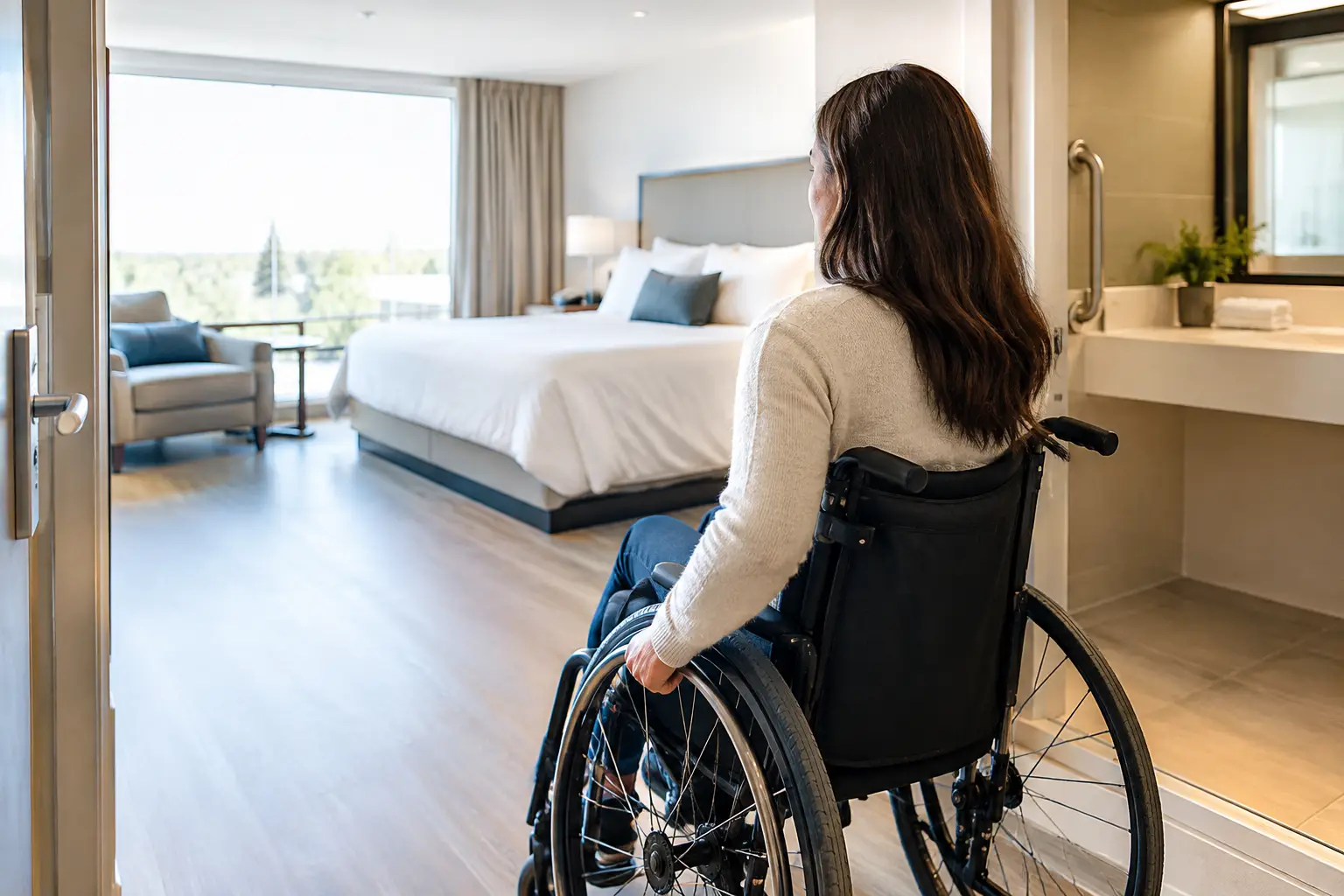
A hotel can call itself accessible and still leave you stranded at the front step, unable to get a scooter into the lift or facing a bathroom you cannot safely use. That is why accessible accommodation needs more than a wheelchair symbol beside a room type. It needs checking properly, before you hand over your money.
For wheelchair and mobility scooter users, the right room is not a luxury upgrade. It is the difference between having a proper holiday and spending it managing avoidable problems. Photos, measurements and a few direct questions will tell you far more than a vague line saying a property is suitable for guests with reduced mobility.
Start with your own non-negotiables
There is no single accessible room that works for everyone. A guest using a compact manual wheelchair may manage perfectly in a hotel that is impossible for someone with a larger powered chair or mobility scooter. Equally, a roll-in shower is of little help if the bed is too high to transfer to, or the route from reception includes a steep ramp.
Before searching, write down what has to work for you. Think about the full day, not just sleeping. Can you transfer independently? Do you need a level-access shower, a shower chair, grab rails or a bath hoist? Is an accessible parking bay essential? Will you be charging a scooter overnight, and can it be brought safely into the room or a secure storage area?
Be specific about width, turning space and weight where it matters. If your wheelchair is 70cm wide, a claimed 75cm doorway does not leave much room for fingers, wheel rims or a slightly awkward approach angle. If you travel with a scooter, ask whether it is permitted inside the building rather than assuming it is. Fire rules, lift size and insurance policies vary widely.
Accessible accommodation starts at the kerb
The bedroom is only one part of the stay. A genuinely usable property begins where you arrive: the car park, drop-off point, station taxi rank or pavement outside.
Ask whether there is step-free access from the accessible parking bay to reception, and whether the route is level, surfaced and lit. A property may have a ramp, but that does not automatically make it suitable. A long, steep ramp with no handrails can be difficult in rain, and loose gravel is a problem for many chairs and scooters.
If you are not driving, check the practical route from public transport. A hotel might be technically accessible but sit at the top of a sharp hill or behind a cobbled street that makes independent travel exhausting. This matters particularly in historic towns, coastal resorts and city centres where the building itself may be adapted but the surrounding streets have not changed.
Once inside, look beyond reception. Is there a lift to every floor you need? What are its internal dimensions, not merely its door width? Is the restaurant step-free, including the route to the breakfast area and accessible toilet? If you will be using a bar, pool, garden or terrace, ask about those areas too. You should not have to stay in your room because the rest of the hotel has been treated as an afterthought.
Get the bathroom details in writing
Bathrooms are where broad accessibility claims most often fall apart. A room described as having a wet room may have a small lip at the entrance, poor drainage, a fixed glass screen that blocks transfers, or a toilet positioned too close to a wall.
Ask for recent photographs of the actual bathroom in the room you are being offered. Not a stock image from another property, and not a picture taken so tightly that it hides the space around the toilet. You need to see the shower entrance, controls, seat, rails, sink clearance and turning area.
Useful questions include whether the shower is level access, whether a fixed or portable shower seat is provided, and which side the grab rails are on. The side matters if you transfer from one particular side of your chair. Ask for the toilet seat height and clear space beside it if that affects your transfer. It may feel fussy to ask, but it is far easier than discovering the answer after a long journey.
Also check the small details. Are toiletries mounted where you can reach them? Is the mirror usable from a seated position? Does the bathroom door open outwards, or could it block the space if assistance is needed? These are not minor points when you are trying to stay safely and independently.
Do not assume an adapted bath will work
Some hotels describe a bathroom as accessible because it has grab rails around a bath. That may suit a guest who can step in with support, but it is not the same as a roll-in shower. If a bath is your only option, ask whether a bath board, bath lift or hoist is available and whether staff are trained to set it up. Never rely on equipment being available unless it has been confirmed for your dates.
Check the room, not just the bathroom
An accessible bedroom should give you space to live, not just squeeze through the door. Look for a clear route around the bed, room for a wheelchair to turn, sockets that can be reached for charging, and controls for curtains, heating and lights that are not positioned at standing height.
Bed height is often overlooked. A bed that is too low or too high can make transfers unsafe and can ruin an otherwise good room. Ask the hotel to measure from the floor to the top of the mattress, including any topper. If you need a profiling bed, bed rails or space for a carer to sleep, raise this before booking rather than hoping a standard accessible room can be altered on arrival.
For scooter users, charging needs proper thought. Charging in a corridor or blocking a fire exit is unlikely to be allowed. Find out where the scooter can be stored, whether there is a power socket nearby, if the area is secure and whether you can access it early in the morning or late at night. A hotel that accepts scooters but expects you to leave yours outdoors is not necessarily meeting your needs.
Call the property and ask for the right person
Online booking filters are useful for narrowing down options, but they are not proof. A quick call can expose gaps in the information and, just as importantly, show how the property responds to disabled guests.
Ask to speak with someone who knows the rooms - often the duty manager, reservations manager or housekeeping supervisor. Explain the equipment you use and the features you need. Then ask them to physically check details if they are unsure. A confident but vague answer such as “you should be fine” is not a confirmation.
Follow up by email with the agreed details and ask for your accessible room and any equipment to be noted clearly on the booking. This creates a record and reduces the risk of arriving to find that the room has been reassigned. It does not guarantee everything will be perfect, but it gives the team a better chance to prepare properly.
A helpful response is a good sign, but do not confuse friendliness with knowledge. Some of the best staff will admit they need to check. That honesty is far more useful than a rushed promise made by someone who has never seen the accessible rooms.
Watch for common booking traps
“Accessible” can mean different things across hotels, holiday cottages, cruise cabins and flat-style stays. Older buildings may offer a ground-floor room but still have steps at the entrance. A cottage may have wide doors but a gravel drive, narrow bathroom or raised threshold to the patio. A serviced flat may be step-free inside but have a heavy communal entrance door and no lift if the building’s main one is out of order.
Be particularly careful with phrases such as “suitable for less mobile guests”, “disabled-friendly” and “easy access”. They are not measurements. They can describe anything from a handrail on a staircase to a properly adapted room.
Reviews can help, especially when written by another wheelchair or scooter user, but check when they were posted. Hotels refurbish rooms, change equipment and sometimes remove features during renovations. Recent photographs from guests are useful, yet they should support direct confirmation, not replace it.
If you are travelling with family or a carer, check whether adjoining rooms are genuinely adjacent and whether both rooms can be reached without steps. Some properties can provide a companion room nearby, but availability may be limited. It is worth booking early when you need a particular room layout rather than simply an accessible category.
Make a realistic decision, not a perfect one
Very few places will tick every box. The goal is to know the compromises before you travel and decide whether they are manageable for you. A brilliant location near accessible transport may be worth a slightly smaller room. A beautiful country hotel may not be the right choice if you need independent access to shops, restaurants and taxis.
If a property cannot answer basic questions, treat that as useful information. You are not being difficult by asking how you will enter, wash, sleep and charge your equipment. You are planning a trip with the same right to comfort, safety and freedom as any other guest.
The best accessible accommodation is the place that lets you get on with the reason you travelled: seeing somewhere new, spending time with people you care about and enjoying the day without every doorway becoming a negotiation.
0 Comments
Leave a Comment