
How Accessible Is Public Transport in Bangkok?
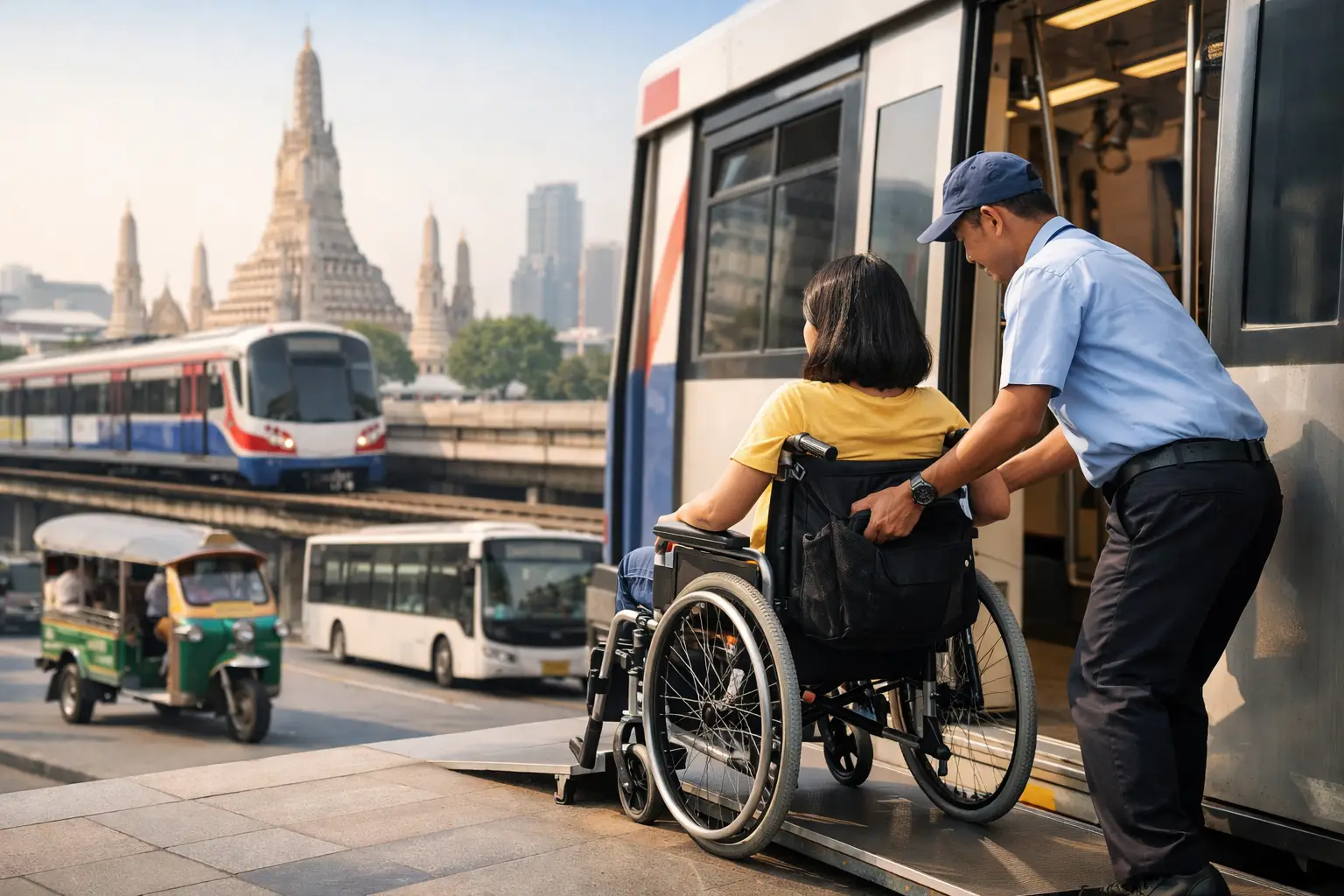
Bangkok can feel like two different cities at once. Up on the modern rail lines, getting around can be surprisingly manageable for wheelchair users and many mobility scooter users. Down at street level, broken pavements, steep kerbs and missing dropped crossings can turn a short journey into hard work. So if you are asking how accessible is public transport in Bangkok, the honest answer is that some parts work well, some really do not, and planning matters.
That probably will not surprise anyone who has travelled with mobility needs before. Bangkok is not a place where you can assume every station, pavement and vehicle will line up neatly. But it is also not a city you need to write off. If you know which systems are worth relying on and where the weak points are, you can move around with far more confidence.
How accessible is public transport in Bangkok really?
The best accessible transport options in Bangkok are the rail systems, particularly the BTS Skytrain and the MRT. They are not perfect, but they are generally the most dependable for step-free travel compared with buses, older boats and random street-level routes. Taxis can also fill the gaps, although wheelchair-accessible taxis are not common in the way they are in some UK cities.
The biggest issue is not always the train or station itself. It is often getting from your hotel to the station entrance safely and without exhausting yourself. You might find a lift at the station, only to discover the pavement outside is uneven, blocked by poles or simply too narrow for comfortable wheelchair access. That is the real Bangkok transport picture - the accessible bits exist, but they do not always connect cleanly.
BTS Skytrain accessibility
For many disabled travellers, the BTS will be the backbone of getting around Bangkok. Stations are elevated, trains are modern, and many stations have lifts and staff who are used to assisting passengers with reduced mobility. Boarding is usually much easier than on buses or boats, and once you are on the network, travel can be straightforward.
There are still checks worth making. Not every station is equally easy, and lift provision can vary by entrance. In some cases, there is a lift, but not on the side of the road you first reach, which means you may need to cross a difficult junction or circle around to another entrance. That can be frustrating in the heat, and more so if you are using a larger mobility scooter.
Platform access is usually the strong point. Trains are frequent, stations are staffed, and there is often help available if you need a ramp or a little extra boarding time. Gap and height differences can vary, so this is one of those situations where a manual wheelchair user, a powerchair user and a scooter user may all have slightly different experiences.
If your hotel is close to a well-equipped BTS station and the route there is manageable, Bangkok immediately becomes more accessible.
MRT accessibility in Bangkok
The MRT is another solid option and, in some cases, can feel even more practical than the BTS. Stations tend to be newer in feel, lifts are commonly available, and the system can be easier to navigate if you want a calmer station environment. For wheelchair users especially, the MRT is often one of the better public transport experiences in the city.
Again, the caveat is the route to and from the station. A fully accessible station does not help much if the surrounding area is hostile at street level. Bangkok regularly catches people out this way. The transport system itself may look good on paper, but the last 200 metres can be the problem.
It is also sensible to allow extra time. Even where lifts are present, you may need staff direction to find them, or you may end up using a less direct route through the station than ambulant travellers. None of that makes the MRT unusable. It just means you should not plan Bangkok journeys too tightly.
Are Bangkok buses accessible?
This is where things become less encouraging. In practical terms, Bangkok buses are not the first choice for most wheelchair users or mobility scooter users. Even if a bus appears technically possible, the boarding process, bus stop layout and traffic conditions can make it awkward or unrealistic.
Low-floor buses do exist on some routes, but consistency is the problem. You cannot assume the next bus will be accessible, the ramp will be usable, or the driver will have the space and time to deploy it properly in heavy traffic. Bus stops themselves can also be difficult to access because of uneven surfaces or poor pavement approaches.
For travellers who need certainty rather than guesswork, buses are usually the weak link. If you are confident, flexible and travelling with someone who can help, you might try them selectively. If you rely on step-free boarding and want stress kept to a minimum, stick with rail and taxis where possible.
Boats and river transport
Bangkok's river and canal boats can look tempting, especially if you want to avoid road traffic. For many disabled travellers, though, they are one of the least reliable options from an accessibility point of view.
Piers can involve steep ramps, changing water levels, uneven boarding points and quick boarding procedures. That combination is not great if you use a wheelchair, and it can be a complete non-starter for a mobility scooter. Some tourist-focused boat services may be easier than local commuter boats, but this is very much an it-depends situation.
If a river journey is high on your list, it is worth checking the exact pier and operator rather than assuming all boats are the same. A sightseeing cruise may be manageable where a public commuter boat is not. But as everyday accessible transport, boats are not the strongest option in Bangkok.
Taxis and ride-hailing apps
When public transport does not join up properly, taxis often become the fallback. In Bangkok, that can be both useful and frustrating. Ordinary taxis are everywhere, and ride-hailing apps can make booking simpler, but fully wheelchair-accessible vehicles are not standard.
For ambulant disabled travellers or people who can transfer from a folded wheelchair, taxis can work well. For those staying in their wheelchair or travelling with a larger mobility scooter, it is much more hit and miss. Vehicle boot sizes vary, drivers may be reluctant to take larger equipment, and loading can be awkward.
This is where being practical matters more than being idealistic. Sometimes the best approach is to use the BTS or MRT for the main leg of the journey, then take a taxi for the last section rather than battling inaccessible pavements. It costs more, but it can save a huge amount of energy.
What makes Bangkok harder than it first appears?
When people ask how accessible is public transport in Bangkok, they often picture lifts, ramps and train doors. Those things matter, but Bangkok's real challenge is the space between them.
Pavements can be cracked, cluttered or disappear entirely. Kerbs can be high. Parked motorbikes, street stalls and utility poles can force you into the road. Crossing points are not always where you need them, and the heat adds another layer of fatigue if you are pushing a manual chair or spending longer outdoors than planned.
That means your hotel location is part of your transport strategy. Staying near an accessible station is good. Staying near an accessible station with a genuinely usable route to it is much better. This is one of the biggest lessons disabled travellers learn in Bangkok, and it is why first-hand detail matters far more than broad claims about a district being "well connected".
Practical tips for using public transport in Bangkok
The most sensible way to approach Bangkok is to build your days around the rail network and keep backup options in mind. If you can, choose accommodation close to a BTS or MRT station that you have already checked for lift access. A hotel five minutes away on a map may be far less suitable than one ten minutes away on a smoother route.
Travel outside the busiest commuter periods if you want an easier boarding experience. Carry enough battery charge for longer diversions if you use a powerchair or scooter. If you are using a larger scooter, be realistic about turning space in lifts, station gates and taxi boots.
It also helps to keep your day flexible. Bangkok journeys can unravel because of one blocked pavement or one station entrance that is harder than expected. Leaving room to change plans makes the whole city feel more manageable.
For readers of Andy Wright Travel, that is really the key point. Bangkok is not fully accessible in the way many of us would like, but it is often more doable than people fear if you plan with the right level of realism.
So, is Bangkok public transport accessible enough for a trip?
Yes, for many wheelchair users and some mobility scooter users, Bangkok public transport is accessible enough to support a good trip - especially if you rely mainly on the BTS and MRT and do not expect buses and boats to carry the load. No, it is not consistently accessible across every mode, every station approach and every street-level connection.
That may sound like a compromise, because it is. Bangkok rewards preparation, patience and sensible route choices. If you go in expecting a perfectly joined-up accessible network, you will be disappointed. If you go in knowing where the reliable bits are, you can still see a great deal of the city with your independence intact.
The best trips are often built on that kind of honesty. You do not need Bangkok to be perfect to make it work for you.